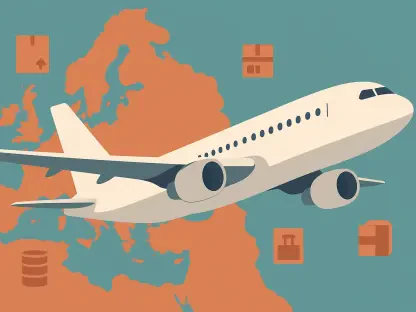

Rohit Laila brings decades of deep-rooted experience in the logistics and supply chain sectors, having witnessed the industry’s evolution from traditional freight to the high-speed demands of modern e-commerce. Today, we explore how new European Union levies on low-value imports are reshaping the air cargo landscape between Asia and Europe. Our discussion covers the immediate 14% drop in freighter capacity, the varying levels of impact across major European hubs like Budapest and Milan, and the strategic options available to airport managers. We also examine whether this downturn is a permanent shift or a temporary market recalibration as the industry searches for a new balance.
How do you interpret the recent 14% drop in freighter capacity from Asia to Europe, and what does this signify for the immediate future of the air cargo industry?
When you see a 14% contraction in freighter capacity, you aren’t just looking at a spreadsheet; you are seeing the equivalent of 18 widebody freighter flights disappearing from the sky every single day. This is a massive shift in the logistics landscape that signals a cooling of the cross-border e-commerce frenzy we have seen recently. In June, we felt the full weight of these new EU fees on low-value imports, and the response from the market was almost instantaneous. It shows just how sensitive e-commerce demand is to even small price hikes, forcing carriers to pull back as the profitability of these routes comes under intense scrutiny.
The data suggests a very uneven impact across European cargo hubs, with some gateways like Budapest seeing a 46% decline while others are less affected. Why is there such a stark difference between these regional entry points?
The map of European cargo is being redrawn by local customs regimes and how quickly specific hubs react to regulatory changes. While Schiphol and Liège saw drops of 12% and 16% respectively, Milan Malpensa’s 24% dip and Budapest’s staggering 46% decline suggest that these hubs were heavily reliant on the specific e-commerce flows now being taxed. There is a palpable sense of anxiety at these airports as they realize their previous growth was tied to a very specific, and now more expensive, trade model. Italy, for example, managed to avoid an even steeper crash because the government chose to delay a €2 levy on items under €150 until October, providing a temporary shield against the broader downturn.
With Milan Bergamo reporting a 40% reduction in e-commerce cargo movements, what can airport managers realistically do to mitigate these losses when they don’t have a direct relationship with the e-commerce platforms?
It is a frustrating position for airport operators because they are essentially one step removed from the source of the problem, which is the consumer’s wallet. When a commercial aviation manager sees a 40% drop, they know they cannot just call up an e-commerce giant and fix the demand; their primary contract is with the airline. The strategy now has to be one of intense collaboration and operational flexibility to keep those airline partners from moving their aircraft to more lucrative regions. We are seeing a move toward finding solutions that improve load factors and consolidate shipments more efficiently to offset the higher costs.
What is your forecast for the Asia-Europe e-commerce trade lane?
I believe the current shock is a necessary but painful adjustment period that will eventually give way to a more stable cargo environment. Once the “sticker shock” of the new fees wears off, market participants will likely innovate their way out of the slump by consolidating smaller shipments to minimize the per-item impact and restore cargo volumes. E-commerce is too integral to modern life to disappear, so I expect volumes to gradually recover as carriers and shippers find the right balance between cost and delivery speed. We are entering a phase of “quality over quantity,” where the efficiency of every cubic meter of space will matter more than ever before.