
The rapid evolution of high-performance vision systems has fundamentally transformed how logistics managers perceive the physical security and operational efficiency of their warehouse environments. For many years, telematics provided clear visibility into the journey of a truck between terminals, yet the site itself remained a chaotic black box of unindexed video footage. While traditional cameras were merely passive observers, the current generation of artificial intelligence surveillance acts as an active participant in the facility, capable of interpreting complex human behaviors and vehicle patterns. This review examines how these systems have moved from recording history to managing the present moment in the high-stakes world of global supply chains.
Evolution of Intelligent Site Monitoring
The technology governing site monitoring has transitioned from centralized analog recording to decentralized intelligent observation. In the previous decade, surveillance was a reactive tool used primarily for forensic investigation after a theft or injury had already occurred. The emergence of high-resolution digital imaging was a step forward, but the sheer volume of data produced by 4K cameras quickly overwhelmed human operators and local network bandwidth. The core principles of modern intelligent monitoring now focus on “exception-based” reporting, where the system only alerts human staff when a pre-defined rule is violated, such as an unauthorized person entering a restricted loading zone.
This evolution is highly relevant in the broader technological landscape because it mirrors the general industry shift toward automation and data-driven decision-making. As logistics facilities become larger and more complex, the cost of manual oversight has become prohibitive. Intelligent site monitoring provides a scalable solution that integrates security with operational throughput. By treating a camera as a sensor rather than just a lens, companies are now able to harvest valuable business intelligence from their existing safety infrastructure, effectively turning a sunken cost into a source of competitive advantage.
Core Architectural and Functional Components
Edge Processing and On-Device Analytics
The most significant architectural shift in recent years is the move toward edge processing, where the actual “thinking” occurs on the camera rather than a central server. This decentralization is the economic engine of the entire category. When a camera processes video locally, it analyzes every frame for specific metadata—identifying a forklift or a safety vest—without needing to stream raw video to a data center. Consequently, this reduces the strain on the corporate network and allows for immediate response times. The performance gain is substantial because latency is virtually eliminated, which is critical when an alert for a potential forklift collision must reach a worker in milliseconds.
Beyond speed, edge processing addresses the massive storage challenges inherent in modern logistics. Instead of archiving weeks of empty warehouse floors, these systems use intelligent filtering to store only the moments where activity is detected. This significance cannot be overstated for multi-site operations where managing bandwidth costs across dozens of terminals was once a primary barrier to adoption. By shifting the heavy computational lifting to the device itself, logistics providers can maintain high-fidelity surveillance across every square foot of a facility without the traditional infrastructure overhead.
Advanced Vehicle and Barcode Recognition
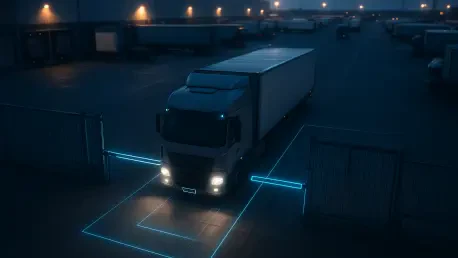
Another key technical pillar involves the integration of convolutional neural networks for highly granular object recognition. Traditional plate capture often failed due to poor lighting or angled views, but modern systems like those utilized by Hanwha Vision now classify vehicles by make, model, color, and type. This level of technical sophistication allows a yard management system to distinguish between a third-party delivery truck and a local contractor vehicle automatically. Such performance characteristics transform a standard gate camera into an automated digital logbook that remains accurate even if a license plate is obscured by mud or missing entirely.
In the warehouse interior, the technology extends to high-speed barcode recognition paired directly with video capture. On a fast-moving conveyor system, these cameras identify parcel labels and link that data to a specific video segment. This creates an undeniable visual audit trail for every package, making it possible to resolve damage claims in seconds by retrieving the exact clip of the item being handled. This real-world usage bridges the gap between digital scan logs and physical reality, providing a level of accountability that manual scanning or traditional video surveillance could never match independently.
Current Trends in Logistics Surveillance
A major shift in the current landscape is the rise of “trainable” AI, which allows facility managers to customize detection protocols for their specific environment. Rather than relying solely on generic pre-set categories like “person” or “car,” users can now train their cameras to recognize unique objects such as specific dangerous goods containers or proprietary packaging types. This trend reflects an industry-wide move toward flexibility, as logistics hubs often handle specialized cargo that standard security software is not designed to recognize. This customization ensures that the surveillance system is directly aligned with the specific operational risks of a particular site.
Moreover, the integration of AI governance and international standards has become a defining trend for 2026. Buyers are no longer satisfied with simple image quality; they now demand audited frameworks for how AI models are managed and updated. The move toward ISO/IEC 42001 certification signals a more mature market where transparency and ethical AI deployment are prioritized. This trend is influencing the trajectory of the technology toward more secure, auditable, and non-biased systems that can withstand the scrutiny of both internal audits and external regulatory bodies.
Real-World Applications and Industrial Use Cases
The implementation of these technologies is particularly evident in high-volume environments like the Gonjiam Mega Hub, where hundreds of 4K AI cameras monitor everything from gate entry to conveyor belt flow. In such sites, the application of slip-and-fall detection provides an immediate safety benefit. When an employee falls in a remote aisle, the system triggers an alert to the medical team, ensuring that response times are not dependent on a passerby discovering the incident. This is a critical use case in manufacturing and logistics centers where the health and safety of personnel are directly tied to liability outcomes.
Furthermore, dock analytics have expanded to include the monitoring of forklift proximity and the identification of blocked emergency exits. By identifying an obstruction in a fire lane or a forklift exceeding the speed limit, the system provides documented evidence for OSHA compliance. This turns the surveillance network into a continuous safety audit tool. In sectors like port operations or heavy manufacturing, these applications prevent accidents before they occur by identifying risky behaviors, such as workers entering a hazardous zone without proper high-visibility attire or safety gear.
Adoption Obstacles and Regulatory Challenges
Despite the technical benefits, several significant hurdles remain, particularly regarding regulatory compliance and international manufacturing standards. For instance, the National Defense Authorization Act (NDAA) and the Trade Agreements Act (TAA) restrict which brands can be used in government-affiliated or sensitive infrastructure projects. Navigating these requirements is a major obstacle for many firms, as it limits their choice of suppliers to those manufactured in approved regions like South Korea or Vietnam. This regulatory environment forces procurement teams to prioritize origin and certification over raw performance or price.
Technical hurdles also persist, specifically when layering advanced AI over legacy network architectures. Many older warehouses were not designed with the cabling or power infrastructure required to support a dense network of intelligent sensors. Ongoing development efforts are focused on making AI more efficient, allowing it to run on lower-power devices or via wireless protocols, but the transition period remains difficult. Additionally, the challenge of “false positive” alarms can plague poorly tuned systems, leading to “alert fatigue” where staff begin to ignore notifications because too many were triggered by shadows or non-critical movements.
The Future of AI-Driven Logistics Operations
The trajectory of this technology points toward a more predictive and interconnected future. Within the period from 2026 to 2029, we anticipate that site surveillance will integrate directly with autonomous mobile robots (AMRs) to coordinate traffic flow on the warehouse floor. Instead of robots relying solely on their onboard sensors, the overhead AI cameras will act as a “global eye,” providing the robots with a wider perspective of approaching hazards or changing floor conditions. This synergy will likely lead to a significant increase in the speed and safety of automated material handling.
Furthermore, predictive analytics will become the standard for yard management. By analyzing patterns of truck arrivals and departures, the system will eventually predict potential bottlenecks at the gate or dock before they happen, suggesting re-routing or rescheduling in real-time. The long-term impact on society will be a more resilient and invisible supply chain, where the friction of manual data entry and human error is largely eliminated. As these systems become more intuitive, they will move from simple detection to complex reasoning, ultimately serving as the central nervous system for the fully autonomous logistics facility.
Conclusion and Strategic Summary
The assessment of AI logistics surveillance revealed that the transition from passive monitoring to edge-based intelligence was the defining characteristic of this technology. It was determined that the integration of high-level recognition algorithms and automated compliance tools provided a clear pathway for logistics firms to reduce operational risks and inventory loss. The evaluation also highlighted that while technical and regulatory challenges remained prevalent, the shift toward auditable AI governance and specialized industrial use cases made these systems indispensable for modern facility management.
Strategic implementation of these systems required a shift in perspective, moving away from purely security-focused goals toward an integrated operational model. Successful deployments were characterized by a focus on high-traffic areas such as loading docks and gates, where the return on investment was most immediate through faster claim resolution and improved worker safety. As the technology matured, it became evident that the most effective solutions were those that could be seamlessly integrated into existing management software. Ultimately, the adoption of intelligent surveillance was recognized as a fundamental requirement for any organization seeking to maintain speed and transparency in an increasingly automated global market.