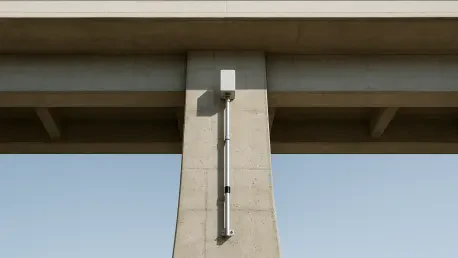

The integrity of our global infrastructure—from the towering chimneys of industrial plants to the sprawling highway bridges that connect our cities—is the invisible backbone of modern logistics and commerce. Rohit Laila stands at the intersection of this physical world and the digital frontier, bringing decades of experience in supply chain management and a deep-seated passion for the technological innovations that keep these structures standing. As an expert in logistics and structural health, he has witnessed how the failure of a single functional object can ripple through a production line or halt a city’s pulse. In this conversation, we explore the shift toward automated, wireless monitoring systems and the critical role of data in extending the lifespan of our most vital engineering assets.
The discussion delves into the transition from manual, line-of-sight geodetic observations to the deployment of autonomous wireless condition monitoring (WCM) systems. We cover the technical intricacies of miniaturized MEMS sensors, the logistics of high-frequency data transmission in demanding industrial environments like steel works, and the vital importance of distinguishing between environmental factors—such as sun-induced thermal expansion—and genuine structural deformation. By examining specific case studies involving massive lime kilns and aging highway bridges, the conversation highlights how sub-millimeter data accuracy and remote configuration are revolutionizing the way asset owners manage risk and maintain operational continuity without disrupting the flow of traffic or goods.
When we look at massive, functional structures like the 48.5-meter lime kiln at the Südzucker site, what are the primary challenges in monitoring their health while they remain fully operational?
Operating a structure of that scale, which is nearly 50 meters high with a diameter of only 2.66 meters, presents a unique set of logistical and physical hurdles. You aren’t just dealing with a static object; you are dealing with a “living” industrial component that undergoes intense firing and loading phases while being blasted by the elements. The primary challenge is that traditional manual monitoring is often impossible or dangerous during full operation, and these structures are extremely sensitive to diurnal cycles. For example, during our observations in September, we saw temperatures at the sensor nodes swing from 15°C at night to over 40°C under direct sunlight. This temperature fluctuation can actually mimic structural movement, as the sensors might show a correlation of roughly 0.03mm/m per degree Kelvin. To truly understand the kiln’s behavior, we had to install tilt sensors in all four cardinal directions near the top and validate them against a base sensor that showed virtually no movement. This configuration allowed us to see the “sun-induced dance” of the tower, proving the upper section was deforming with height rather than tilting as a rigid body, a distinction that is vital for ensuring the structure doesn’t reach a point of catastrophic fatigue.
Many asset owners are hesitant to move away from traditional geodetic methods, so why is the shift toward wireless condition monitoring becoming so essential for modern infrastructure?
The shift is driven by the sheer impracticality of keeping humans or wired systems on-site for long-term, high-frequency observations. Traditional geodetic methods, like using a Total Station, require a clear line-of-sight and frequent manual intervention, which is a nightmare in restricted areas like active rail zones or high-traffic highway abutments. Wireless Condition Monitoring, or WCM, bridges this gap by using maintenance-free hardware that can last over 10 years on a single battery, even when sampling data every thirty minutes. These compact nodes use Micro-Electro-Mechanical Sensors (MEMS) that are roughly the size of a chip, allowing us to detect rotations with a resolution of 0.0001°—that is less than 0.002 mm/m. By removing the need for cables, we eliminate the primary failure point in harsh environments, allowing us to place sensors in locations that were previously inaccessible. The automation allows for a proactive approach where alerts are sent to the cloud the moment a threshold is crossed, rather than discovering a crack during a biennial manual inspection.
In the case of the Thyssen Krupp crane track in Duisburg, you dealt with incredibly high data rates and a very dynamic environment; how does the technology handle that volume of information without losing its wireless efficiency?
That project was a masterclass in pushing the limits of wireless mesh networks within a heavy industrial setting. We were monitoring crane track girders that had shown mysterious wear, and because crane movements are so fast and dynamic, we had to sample data every 2 seconds. When you are collecting that much data across multiple tilt and crack sensors, you end up generating about 400 MB of CSV data every single day. To manage this, we placed gateways directly on the mobile crane bridges to maintain a stable but flexible wireless mesh. Using the 2.4 GHz Wi-Fi frequency provided the high bandwidth necessary for these short sampling intervals, which would have been impossible with the more limited LoRa 868 MHz bands. This setup allowed us to synchronize the sensor readings with the exact timestamp of the crane’s position, giving us a clear picture of how heavy steel slabs induce short-term deformations. It’s a massive amount of data to digest, but it provides the “smoking gun” for wear and tear that occurs in the blink of an eye.
When you are dealing with aging highway bridges, such as the one in Bochum where there was a fear of a “drop” in the bridge deck, how do you balance the need for high-tech data with the requirement for simple, indicative safety solutions?
In situations like the BAB43 bridge in Bochum, the question isn’t always about complex modeling; sometimes the requirement is essentially binary—has the bridge deck dropped or hasn’t it? The asset owner was worried that the cylindrical roller bearing was at its margin and that the abutment tilt might lead to a dangerous vertical displacement of more than 10mm. To address this, we used a very clever, low-cost indicative solution involving a spring-loaded telescopic crack sensor. This device was specifically designed to tolerate the normal diurnal and seasonal horizontal movements of the deck without triggering false alarms, but it was set to flag any vertical sag immediately. It worked alongside the more sophisticated tilt sensors on the abutment to provide a multi-layered safety net. It’s about choosing the right tool for the risk profile: you use the precision tilt sensors to watch the slow-motion movement of the foundation, while the telescopic sensor acts as a literal “tripwire” for sudden, structural failure.
The load test on the Wittekindstraße bridge in Dortmund involved a 48-ton crane and high-precision laser scanning. How did the wireless sensors hold up when compared to these traditional high-accuracy geodetic measurements?
The Dortmund bridge test was a defining moment for validating WCM as a peer to traditional geodesy. We were dealing with a slab structure from 1957, and the civil engineering experts predicted a deformation of about 2 to 4 mm under the weight of that 48-ton fire department crane. We switched the wireless nodes into a “live mode” with 30-second intervals to watch the deformation happen in real-time on our cloud portal. When we compared the tilt sensor data—which we used to calculate a deformation profile via differential equations—to the results of a Zoller & Fröhlich phase scanner, the results were staggering. The two methods coincided almost perfectly, with a difference of only approximately 0.2mm in the final calculation. This proved that even though the laser scanner provides millions of sample points, the strategically placed wireless nodes were able to capture the representative “trough” of the deformation with sub-millimeter accuracy. It gives asset owners immense confidence that they can rely on these automated systems for continuous 24/7 monitoring, only calling in the expensive laser scanning crews when the wireless sensors detect an anomaly.
Interpreting tilt data isn’t as straightforward as reading a ruler. What should engineers keep in mind when trying to convert these angular measurements into something meaningful for structural health?
This is where the “art” of structural monitoring meets the science. You have to remember that a tilt sensor doesn’t give you a 3D coordinate like a Total Station does; it gives you an angle. To turn that into a metric value like millimeters of displacement, you have to make assumptions about the structural stiffness and the length of the “beam” you are measuring. For the lime kiln, we had to validate if the tower was tilting as a rigid body or bending like a reed in the wind. If you assume a structure is rigid and it actually has a deformation curve, your horizontal displacement calculations at the top will be completely wrong. We use built-in mechanical and statistical filters to eliminate outliers and noise, but the human element is still required to build a model that reflects reality. You have to consider the “chainage” and use the tilt values as tangents to solve a system of differential equations to get a true deformation profile. It’s not just about the hardware; it’s about understanding the “personality” of the building.
What is your forecast for the future of structural health monitoring over the next few years?
I expect we will see a total integration of structural health data into the broader logistics and “Digital Twin” ecosystems of our cities. Right now, we are proving that these sensors can survive 10 years on a battery and provide sub-millimeter accuracy, but the next step is using this data to bypass traditional, scheduled maintenance cycles entirely. We are moving toward a world where the bridge itself tells the city’s maintenance department when it needs a repair, based on real-time stress data from 50-ton loads rather than an arbitrary calendar date. This will significantly extend the lifespan of our 1950s-era infrastructure, allowing us to keep these structures safe and operational well into the 2030s and beyond without the massive capital expenditure of a total rebuild. By 2027 and 2028, I anticipate that autonomous monitoring will be a standard requirement for any major engineering asset, serving as a vital insurance policy against the disruption of our increasingly interconnected global supply chains.