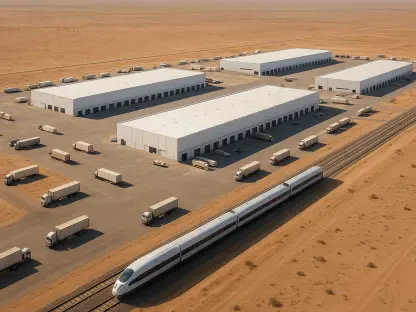

The new facility is projected to eventually scale up to 750,000 TEUs, providing a significant boost to the $8.1 billion in Canadian exports already flowing through the port annually. This massive $750 million investment, known as CANXPORT, represents a watershed moment for North American trade logistics, fundamentally altering how bulk goods transition from the interior to global markets. Situated at the Port of Prince Rupert, the hub serves as a critical junction where the expansive rail networks of Western Canada meet the Pacific’s most direct shipping routes to Asia. This project is the result of a coordinated effort between Ray-Mont Logistics, Canadian National Railway, and the Prince Rupert Port Authority, aimed at streamlining the export process for vital commodities. By providing a seamless transloading interface, the facility ensures that Canadian agricultural, mineral, and forestry products reach their international destinations with unprecedented efficiency. This inauguration signifies more than just new construction; it is a strategic reinforcement of the nation’s supply chain resilience.
Financial Foundations: A Multi-Tiered Investment Strategy
The financial architecture of CANXPORT was built on a sophisticated model that leveraged both private sector ingenuity and substantial public investment to ensure long-term stability. The Canada Infrastructure Bank played a defining role by providing a landmark $150 million loan, which notably represented its inaugural foray into the maritime and port sector. This funding was augmented by nearly $50 million from Transport Canada through the National Trade Corridors Fund, a program designed to enhance the flow of goods across the country’s borders. Furthermore, the Province of British Columbia committed $25 million as part of its broader strategy to diversify regional trade and stimulate the provincial economy. Such a heavy concentration of capital underscores the national importance of the Prince Rupert gateway. These diverse funding streams allowed the project to proceed with the necessary scale to meet the projected demands of international markets from 2026 through the end of the decade.
Beyond the immediate construction costs, these financial commitments served to de-risk the project for private partners like Ray-Mont Logistics, encouraging further innovation in transloading technology. This collaborative approach ensured that the facility could be equipped with the most advanced container-handling systems available today, maximizing throughput while minimizing operational delays. The inclusion of public funds also mandated a focus on sustainable development and public interest, ensuring that the infrastructure serves a wide range of Canadian industries. This blend of public oversight and private operational excellence has created a logistics environment that is both commercially viable and strategically aligned with national economic goals. By securing this funding, the partners have established a blueprint for future infrastructure developments that require high-intensity capital and specialized technical expertise. The success of this fiscal model provides a clear pathway for upcoming port expansions that aim to integrate similar multi-stakeholder participation strategies.
Infrastructure Synergy: Expanding the Gateway Capacity
The effectiveness of the CANXPORT facility is inextricably linked to the broader transportation network that feeds into the Port of Prince Rupert, necessitating significant upgrades to existing rail infrastructure. Canadian National Railway undertook a pivotal role in this endeavor by spearheading the expansion of the Zanardi Rapids Bridge and increasing the overall capacity of the rail corridor leading into the port. These improvements were essential to prevent bottlenecks that could arise from the increased volume of cargo moving through the gateway. By doubling down on the physical connectivity between the prairies and the coast, the rail network now offers a highly efficient conduit for bulk commodities. This integrated ecosystem allows for the rapid movement of goods, ensuring that the transloading facility can operate at its peak design capacity without being hindered by external logistics delays. The synergy between the rail operators and the port facility creates a reliable and predictable schedule for exporters, which is a critical factor in maintaining international trade relationships.
Innovative transloading capabilities are at the heart of the CANXPORT operations, enabling the efficient conversion of bulk rail cargo into shipping containers for overseas transit. This capability allows exporters of agricultural products, forestry materials, and specialty minerals to bypass traditional bulk terminals, which often require much larger shipment volumes to be economically feasible. By utilizing containers, Canadian producers can target smaller, high-value markets in Asia and beyond, providing them with greater flexibility and market responsiveness. This shift toward containerization also enhances the protection of goods during transit, reducing the risk of contamination or damage that can occur in bulk handling. Furthermore, the facility’s proximity to Asian markets—being the closest West Coast port in North America—offers a distinct geographical advantage that significantly reduces ocean transit times. This combination of rail-to-container efficiency and shortened shipping routes positions the region as a dominant player in the global supply chain, offering a competitive edge for years.
Indigenous Partnership: Equity and Economic Inclusion
A foundational element of the CANXPORT development is the profound integration of Indigenous Nations into the project’s structure, moving beyond simple consultation toward active partnership. The contract for the primary site development was awarded to a joint venture comprising the Metlakatla First Nation, the Lax Kw’alaams Band, and the Gitxaala Nation. This arrangement ensured that the foundational work of the hub was performed by the communities with ancestral ties to the lands surrounding the port. By involving these Nations in the earliest stages of construction, the project established a standard for economic inclusion and Indigenous reconciliation in large-scale industrial projects. The collaboration provided high-quality employment opportunities and technical training for local community members, fostering a skilled workforce within the Nations themselves. This approach reflects a shift in how major infrastructure projects are executed, recognizing that local Indigenous participation is essential for the long-term social and economic success of any significant commercial development.
The involvement of Indigenous partners extends into the daily operations of the logistics hub, ensuring a continuous stream of economic benefits for the participating Nations. For instance, the Metlakatla and Lax Kw’alaams Nations hold a majority ownership stake in Gat Leedm Logistics, which operates as the primary provider for truck drayage services at the facility. This operational role provides a sustainable business model that generates revenue and supports long-term community development initiatives. Leaders from the involved Nations have highlighted this partnership as a successful example of how industrial expansion can be leveraged to achieve economic self-determination. By participating as owners and service providers, these Nations are not just observers of the port’s growth but are central figures in the global trade narrative. This model of shared prosperity ensures that the wealth generated by international commerce directly supports the well-being of the local people. It serves as a powerful reminder that inclusive growth is the most resilient form of economic development in the current era.
Strategic Evolution: Future-Proofing the Logistics Ecosystem
The Port of Prince Rupert has already demonstrated remarkable economic performance, and the launch of the CANXPORT hub is expected to accelerate this upward trajectory significantly. Data from the previous year indicated that the port handled over 26 million tonnes of cargo, marking a 14% increase in activity and supporting approximately 8,000 full-time jobs across British Columbia. These positions contribute hundreds of millions of dollars in annual wages and add an estimated $1.5 billion to the national GDP, illustrating the port’s role as a primary engine of regional prosperity. With the new logistics hub now fully operational, the capacity to process diverse export commodities has expanded, allowing the gateway to handle billions of dollars in trade value. The facility’s ability to process up to 400,000 TEUs of transloaded cargo annually provides a robust foundation for meeting the growing global demand for Canadian resources. As the port continues to set new records for throughput, the strategic importance of this logistics hub becomes even more apparent in a globalized economy.
The successful opening of the CANXPORT facility established a new benchmark for North American logistics, but the true value of the hub will be realized through ongoing technological integration. To maintain this momentum, stakeholders must now focus on the implementation of digital supply chain solutions, such as real-time cargo tracking and automated sorting systems, to further enhance operational speed. The project acted as the initial phase of a more comprehensive $3 billion expansion strategy intended to modernize the entire Prince Rupert Gateway through 2028. Future investments should prioritize the development of green hydrogen fueling stations and electrified container handling equipment to align with global sustainability standards. By adopting these advanced technologies, the port can ensure it remains the preferred choice for eco-conscious international shipping lines. The collaborative efforts seen during the construction phase proved that large-scale infrastructure could be delivered with both social responsibility and commercial efficiency. These lessons will guide the next decade of development at the port.