


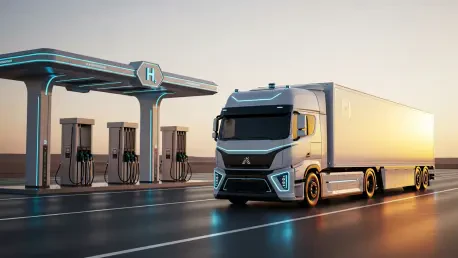

The quiet rumble of heavy-duty engines is currently undergoing a radical acoustic and chemical transformation, but the most significant echoes are not being heard on the highways of the American Midwest or the logistics hubs of Western Europe. Instead, the vast corridors of the Arabian Peninsula have become the primary proving ground for a new era of logistics where hydrogen fuel cells and high-level autonomy are no longer experimental novelties but foundational elements of a commercial supply chain. While the United States remains entangled in the complexities of aging infrastructure and shifting political priorities, Saudi Arabia has leapfrogged traditional development cycles by launching an operational, commercial-grade autonomous hydrogen trucking project in Riyadh. This initiative, spearheaded by the global giant Procter & Gamble, serves as a marker in the race for zero-emission freight supremacy, proving that when institutional will aligns with corporate agility, the transition to green energy can bypass the pilot-stage stagnation that currently plagues many Western markets.
Institutional Barriers and Market Volatility in North America
Institutional Setbacks: The Decline of Pioneering Hydrogen Startups
American hydrogen trucking, once vibrant with the promises of industry disruptors like Nikola and Hyzon, has faced a sobering reality check that analysts are labeling a period of prolonged stagnation. Many of the startups that initially captured the imagination of investors and policymakers have been forced into defensive postures, grappling with the fallout of missed production targets and severe financial instability. Instead of leading a nationwide transition toward long-haul fuel-cell vehicles, these entities are often retreating into specialized niches or undergoing painful restructuring processes to avoid complete dissolution. This contraction has left a palpable void in the Class 8 trucking sector, where the expectation of a hydrogen-fueled revolution has been replaced by a cautious skepticism among fleet managers who cannot afford to gamble on financially precarious technology providers. Consequently, the momentum required to displace diesel power has dissipated, leaving the market in a state of suspended animation.
Established manufacturers in the United States have adopted a wait-and-see approach, prioritizing battery-electric solutions for short-range deliveries while pushing hydrogen timelines further into the future. This strategic delay is justified by the lack of a coherent federal framework that can guarantee the long-term viability of hydrogen as a primary fuel source for heavy trucking. Without a dense and reliable network of refueling stations, the operational risk of adopting fuel-cell vehicles remains prohibitively high for private companies operating on thin margins. The retreat of major players from aggressive rollout schedules indicates a broader failure to synchronize vehicle manufacturing with the necessary fueling infrastructure. This disconnect has hampered the ability of the American logistics sector to compete with regions that have integrated their energy and transportation policies more effectively, resulting in a domestic market that is currently struggling to regain its footing in the global race for clean logistics.
Infrastructure Bottlenecks: Refueling and Funding Misalignment
A primary catalyst for the current impasse in the United States is the persistent “chicken-and-egg” dilemma regarding refueling stations, which continues to stifle the adoption of fuel-cell electric vehicles. While federal initiatives once aimed to establish regional clean-hydrogen hubs across key corridors, the execution of these plans has been marred by bureaucratic hurdles and the reallocation of critical funding. In recent cycles, the Department of Energy has had to reclaim resources originally earmarked for ambitious projects in California and the Pacific Northwest, leading to a loss of confidence among private investors. This unpredictability prevents the construction of the large-scale hydrogen fueling corridors that long-haul trucking requires to be viable. Without a guaranteed network of stations where drivers can refuel with the same speed as diesel, fleet operators are hesitant to invest in hardware that might become stranded assets if the fuel supply remains localized and expensive.
The situation is exacerbated by the high cost of green hydrogen production within the domestic market, which currently lacks the scale needed to achieve price parity with traditional fossil fuels or even electricity for battery charging. Efforts to subsidize production through tax credits have provided some relief, but they have not yet translated into the widespread availability of clean fuel at the pump for commercial carriers. This economic barrier reinforces the cycle of underinvestment, as energy companies are reluctant to build stations without a steady volume of customers, and trucking companies refuse to buy vehicles without a pervasive station network. While the potential for hydrogen to provide superior range and faster refueling times compared to batteries remains theoretically attractive, the practical reality in North America is one of fragmented pilots and localized tests that fail to reach critical mass. This lack of coordination ensures that the transition remains localized rather than systemic across the entire continent.
Middle Eastern Leadership in Freight Innovation
Operational Milestones: Commercial Reality in Riyadh
In stark contrast to the challenges observed in Western markets, Saudi Arabia has successfully moved beyond theoretical frameworks to achieve tangible operational milestones in zero-emission logistics. The Transport General Authority in Riyadh has facilitated the deployment of heavy-duty hydrogen trucks that are integrated directly into the daily supply chain operations of multinational corporations. This is not a government-funded research experiment but a commercial reality involving high-volume freight movements for entities like Procter & Gamble and the regional distributor Ismail Abudawood. By focusing on immediate commercial application rather than long-term research cycles, the Kingdom has demonstrated that the technology is ready for large-scale adoption today. These trucks are currently navigating the demanding logistics corridors of the region, proving that hydrogen-powered fleets can meet the rigorous demands of modern commerce while significantly reducing the carbon footprint of the transport sector.
The deployment of these vehicles is particularly notable for its integration of Level 3 autonomous driving technology, provided by the international specialist Hyperview. This combination of advanced propulsion and self-driving capabilities addresses two of the most significant challenges in the logistics industry: the need for environmental sustainability and the ongoing global shortage of qualified long-haul drivers. By utilizing sensors and sophisticated software, these trucks can operate with minimal human intervention on highways, optimizing fuel consumption and enhancing safety across vast distances. This technological synergy allows the Saudi logistics sector to operate with a level of efficiency that traditional diesel fleets cannot match. The success of this implementation serves as a blueprint for how emerging economies can skip traditional stages of industrial development by adopting cutting-edge technologies that are simultaneously sustainable and economically advantageous, placing them at the forefront of automated transportation systems.
Strategic Integration: Technical Superiority and Global Export Potential
The success of the Riyadh project was rooted in an extraordinary operational range that established a new benchmark for the entire industry. These heavy-duty trucks traveled up to 1,500 kilometers on a single tank of hydrogen, effectively doubling the range provided by fuel-cell prototypes previously tested in North America. This capability was crucial for the Kingdom’s geography, defined by long distances between industrial cities. By moving hydrogen trucks into the true long-haul category, the project eliminated the frequent refueling stops that hampered the efficiency of battery-electric trucks. The hardware utilized was specifically engineered to withstand extreme heat and dust, proving that hydrogen technology was a versatile tool capable of operating in the world’s most demanding environments. This resilience demonstrated that the vehicles were ready for global deployment, validating the durability of green transportation for an international audience and proving that the hardware could maintain performance regardless of climate.
Looking back, the Saudi model of integrating autonomous driving with hydrogen propulsion became the global standard for logistics efficiency. The strategic decision to prioritize hydrogen for heavy long-haul routes, while using battery-electric vehicles for shorter deliveries, maximized the strengths of each technology. This approach provided the industry with a clear path forward, emphasizing that the weight-to-range advantages of fuel cells were the most viable solution for demanding shipping corridors. By taking decisive action when other markets remained stalled by infrastructure delays, the Saudi initiative demonstrated that the transition to a zero-emission future was commercially inevitable. This shift eventually reshaped the landscape of international commerce, as the Kingdom transformed into a leading manufacturer of high-tech hardware through the King Salman Automotive Complex. The complex manufactured 1,000 trucks annually, ensuring that the next generation of global freight was defined by the strategic foresight and technological synergy first proven in the Gulf.


