
The rapid acceleration of global commerce has finally pushed traditional logistics infrastructures to a breaking point where static machinery and manual labor can no longer bridge the gap between consumer expectation and operational reality. At the MODEX 2026 trade show, a landmark partnership between Dematic and GreyOrange signaled a fundamental shift: the transition from static systems to fluid, AI-driven orchestration. This evolution is not merely about adding more robots to a warehouse floor; it is about creating a central nervous system that synchronizes human intuition with robotic precision.
As distribution centers grapple with unprecedented SKU proliferation and shrinking delivery windows, the old model of isolated automation is failing. The modern facility must function as a living organism, capable of reconfiguring itself in real time to meet the ebb and flow of market demand. This transformation moves beyond simple mechanical speed, focusing instead on the intelligent layer that governs how every asset moves in concert.
The End of the Rigid Warehouse
The traditional warehouse is hitting a wall where fixed automation and manual labor can no longer keep pace with the volatile demands of modern commerce. When systems are hard-wired for specific volumes, they become liabilities during seasonal peaks or unexpected supply chain disruptions. The integration of GreyOrange’s GreyMatter platform into Dematic’s ecosystem represents a departure from these inflexible structures, favoring a software-driven approach that prioritizes adaptability over sheer physical scale.
By shifting the focus to orchestration, companies can finally move away from the “set it and forget it” mentality that has plagued logistics for decades. This new framework allows for a dynamic interplay where human pickers and automated systems work within the same digital logic. This ensures that the warehouse is never locked into a single configuration, providing the elasticity required to survive in a high-velocity retail environment.
Why Hardware-Agnostic Integration Is No Longer Optional
Supply chain leaders have long struggled with “automation silos,” where different technologies operate in isolation, leading to data fragmentation and operational bottlenecks. When a sorter from one vendor cannot communicate with an autonomous mobile robot (AMR) from another, the resulting friction kills efficiency. As distribution centers become more complex, the ability to harmonize diverse robotic fleets with existing fixed infrastructure is becoming a competitive necessity rather than a luxury.
This movement toward hardware-agnostic software allows businesses to protect their previous capital investments while gaining the agility to scale. Instead of ripping and replacing expensive machinery, operators can overlay a unified intelligence layer that speaks to every component. This interoperability ensures that the best-of-breed technology can be adopted without the fear of creating new, disconnected islands of automation.
The Core Pillars of Execution-Aware Orchestration
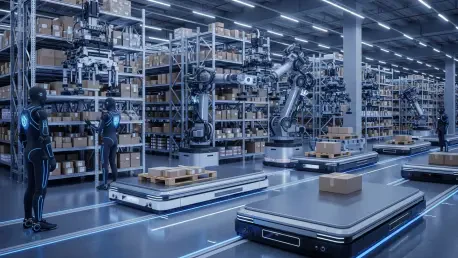
Harmonizing multi-agent environments involves moving beyond simple task assignment to coordinate AMRs, manual workers, and fixed conveyors within a single, cohesive framework. This level of execution-aware coordination ensures that tasks are not just assigned, but are optimized based on the physical location and current workload of every asset. When the system understands the real-time context of the floor, it eliminates the idle time that typically occurs during hand-offs between different types of automation.
Furthermore, real-time operational visibility and dynamic inventory allocation allow managers to identify and resolve throughput bottlenecks before they disrupt the fulfillment cycle. By shifting from static storage to a network-level strategy, companies can manage order flows across distribution centers and distributed fulfillment nodes like retail stores. Breaking away from proprietary friction ensures that the software layer remains the master conductor, managing varied technologies regardless of the manufacturer.
Expert Perspectives on the Unified Logistics Blueprint
Industry pioneers Mike Larsson of Dematic and Akash Gupta of GreyOrange argue that the future of logistics depends entirely on the removal of operational silos. During their joint presentations, they highlighted how the GreyMatter platform acts as a master conductor, ensuring that every asset—whether a human picker or a high-speed sorter—is utilized at its maximum potential. They suggested that the intelligence layer must be “execution-aware,” meaning it understands the minute-by-minute reality of the warehouse floor.
This blueprint for unified logistics suggests that the software must be as flexible as the robots it controls. Experts in the field believe that by decoupling the control logic from the physical hardware, businesses can achieve a level of operational resilience previously thought impossible. The partnership serves as a case study for how legacy providers and modern AI firms can collaborate to solve the most pressing challenges in the global supply chain.
Strategies for Transitioning to Orchestrated Fulfillment
To begin this transition, organizations should first audit existing automation silos to identify where data gaps exist between different technology stacks and manual processes. Understanding these friction points is essential before layering on an orchestration solution. Once the gaps are identified, the priority must shift to software interoperability, ensuring that any new hardware selections are compatible with a centralized AI orchestration platform to avoid future vendor lock-in.
Adopting a scalable pilot program allows firms to integrate AMRs into specific manual workflows before expanding the AI orchestration layer to the entire facility. This incremental approach mitigates risk while providing immediate proof of concept. Finally, a focus on network-level strategy ensures that fulfillment logic extends beyond the four walls of the warehouse to in-store environments and micro-fulfillment centers, creating a truly seamless omnichannel experience.
The shift toward AI-driven orchestration redefined the benchmarks for operational success in the logistics sector. Companies that moved away from proprietary, rigid systems in favor of hardware-agnostic platforms found themselves better equipped to handle the fluctuations of a globalized economy. By prioritizing the “execution-aware” model, leaders effectively bridged the gap between planning and reality, ensuring that their fulfillment networks remained both resilient and highly efficient in the face of constant change.