


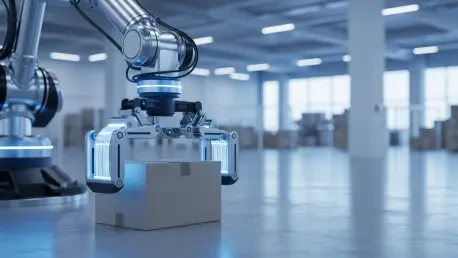

The fundamental shift from pre-programmed robotic arms to machines capable of perceiving and reacting to chaotic environments represents the most significant leap in industrial automation during the current decade. This evolution is driven by Physical AI, a paradigm that merges high-level cognitive processing with the tactile demands of the physical world. While traditional robots excel in repetitive tasks within controlled cells, the modern logistics landscape requires a level of adaptability that only autonomous agents like the Dexterity Mech robot can provide. This machine serves as a prime example of a superhumanoid system designed to navigate the unpredictability of truck loading and palletizing without constant human intervention. However, the success of such advanced artificial intelligence depends entirely on the underlying hardware architecture. Without a system that provides real-time data and precise mechanical control, even the most sophisticated neural networks remain paralyzed by latency and reliability issues found in legacy setups.
Overcoming Fragmentation With Integrated Control Architectures
Industrial facilities have historically struggled with islands of automation, where disparate machines for logic, motion, and safety operated in isolation from one another. This fragmentation created massive hurdles for developers trying to synchronize complex movements, such as a multi-arm system coordinating to lift a heavy, uneven load. By adopting a unified ecosystem, companies are now moving away from these discrete components toward a single, streamlined platform that manages every aspect of robotic behavior. This integration allows for a more cohesive flow of information, ensuring that a robot’s vision system can communicate instantly with its motor controllers. When the software layer can access all hardware parameters through a centralized interface, the complexity of programming decreases while the reliability of the execution increases. This structural shift is essential for Physical AI, as it provides the necessary transparency for the AI to understand the state of the machine at any given millisecond.
The rise of software-defined hardware marks a departure from the era of rigid, single-purpose machines that required extensive manual reconfiguration for every new task. In the current landscape, robots are treated more like high-performance computers that happen to have physical limbs, allowing them to be updated via software to handle dynamic warehouse environments. Utilizing PC-based control systems enables a robot to process high-level AI reasoning—such as identifying a damaged box or calculating an optimal grip—while simultaneously managing low-level machine functions. This dual-capability ensures that the hardware does not become a bottleneck for the intelligence it hosts. As warehouse demands fluctuate, these adaptable systems can be pivoted to new roles without the need for expensive physical overhauls. Consequently, the hardware becomes a flexible vessel for continuous AI improvements, allowing the machine to learn and evolve its physical capabilities over time, much like a human worker would through experience and training.
Maximizing Responsiveness via Deterministic Network Communication
For Physical AI to function effectively in a fast-paced production setting, the communication link between sensors and actuators must be entirely deterministic. This requirement means that data packets must travel with microsecond precision, ensuring that a robot reacts to its environment the moment a change is detected. High-bandwidth networks like EtherCAT serve as the digital nervous system for these modern machines, carrying the massive volumes of sensory data required for real-time perception. Without this level of speed and predictability, a robot might identify a falling object but fail to move its arm quickly enough to catch or avoid it. By providing a stable and fast communication backbone, EtherCAT eliminates the jitter and lag that once plagued industrial networking. This stability is what allows a machine to maintain its superhumanoid performance, processing millions of data points every second while maintaining a physical movement profile that is smooth, predictable, and exceptionally accurate for high-stakes tasks.
Achieving this level of synchronization involves a sophisticated separation of high-level task planning from low-level motion execution within a single network. The AI-driven brain of the robot can focus on the “what” and “why” of a task—such as deciding which pallet to clear first—while the real-time control system handles the “how” of the motor trajectories. This technical hierarchy ensures that even if a high-level AI process experiences a brief delay while crunching complex data, the low-level safety and motion controls remain active and responsive. This division of labor within the synchronized network is crucial for maintaining both efficiency and safety in crowded workspaces. It allows robots to perform high-precision tasks in close proximity to human coworkers without the risks typically associated with delayed responses or unpredictable mechanical jitters. Ultimately, the fusion of high-speed networking and intelligent processing creates a machine that is not only faster but also significantly more aware of its physical context and constraints.
Enhancing Scalability Through Modular Design and Functional Safety
Moving a robotic concept from a laboratory prototype to a production-ready machine requires a fundamental commitment to modular hardware design. By utilizing plug-and-play I/O modules and custom-designed circuit boards, engineers can drastically reduce the physical footprint of the robot while simultaneously increasing its field reliability. This modular strategy simplifies the manufacturing process, allowing companies to assemble and deploy robotic fleets across multiple global locations with much greater speed. If a specific component fails, the modular nature of the system ensures that it can be swapped out quickly without requiring a complete teardown of the machine. Furthermore, this approach allows for easier upgrades, as individual sensors or processing units can be replaced with newer technology as it becomes available. This creates a scalable infrastructure where the physical machines can grow alongside the AI software, ensuring that the initial investment in hardware remains valuable and effective over several years of continuous operation.
Safety has evolved from being an external mechanical barrier to a foundational layer of the automation architecture, integrated directly into the control system. Modern safety protocols now allow protective signals to travel over the same Ethernet cables as the standard control data, which significantly reduces wiring complexity and potential failure points. This integration ensures that the robot can respond to mechanical obstacles or the sudden presence of a human with industrial-grade reliability, even during high-speed operations. By embedding safety into the communication layer, engineers can create sophisticated “virtual cages” that protect workers without the need for physical fencing. This flexibility is vital in the modern warehouse, where floor space is at a premium and human-robot collaboration is increasingly common. When a robot can guarantee a safe stop or a reduced-speed mode within milliseconds of a safety breach, it builds a level of trust that is necessary for the wide-scale adoption of Physical AI in diverse industrial settings.
Strategic Transitions Toward Autonomous Operational Excellence
The transition toward Physical AI necessitated a complete reimagining of how hardware and software interacted within the industrial landscape. Leaders in the field recognized that simply adding a layer of intelligence to old machines was insufficient; instead, they rebuilt the entire foundation to support real-time, deterministic performance across the board. Organizations that successfully navigated this change focused on three primary actions: unifying their control platforms, investing in high-speed communication backbones, and prioritizing modular safety protocols. These steps transformed robots from rigid tools into adaptive partners capable of handling the messy reality of global logistics and complex manufacturing. By maintaining a tight loop between physical feedback and cognitive processing, the industry moved far beyond the limitations of traditional automation. This proactive approach to architectural design ensured that machines were not just smart in theory, but truly capable and safe in the physical world.
Looking back at the implementation phase, the focus for industrial leaders extended toward the integration of edge computing directly into the robotic actuators themselves. This shift successfully reduced the computational load on central processors while enhancing the speed of local decision-making during high-speed contact tasks. Furthermore, the development of standardized data models for robotic perception enabled different brands of Physical AI to collaborate seamlessly on the same warehouse floor. Implementing these next-generation protocols required a workforce that was as skilled in data analysis as it is in mechanical maintenance. As these systems became more self-sufficient, the role of human oversight transitioned from direct control to strategic orchestration of entire autonomous fleets. By embracing these advancements, companies ensured their infrastructure remained resilient against labor shortages and supply chain disruptions, solidifying a competitive advantage in a highly automated global market.


