
The global logistics landscape of 2026 has reached a pivotal juncture where the demand for transporting immense industrial components frequently clashes with the physical limitations of the world’s aging and evolving cargo fleet. While a manufacturer’s maximum payload often captures the spotlight in marketing brochures, experienced logistics managers understand that the actual weight a plane can transport is dictated by a complex interplay of fuel reserves, weather conditions, and structural balance requirements. Shippers are forced to navigate a market where the gap between theoretical specifications and operational reality is wider than ever, making precise planning a survival skill. As the movement of massive equipment becomes more central to global infrastructure projects, the industry must weigh the raw lifting power of established giants against the efficiency of newer designs. This balance determines the fundamental feasibility of international projects that rely on the timely delivery of outsized machinery.
Dominant Players: Defining the Heavy-Lift Hierarchy
The hierarchy of heavy-lift aircraft in 2026 is currently topped by the Antonov An-124 Ruslan, which has solidified its position as the primary choice for specialized charter work. Following the permanent loss of the larger An-225, the An-124 stands alone as the undisputed leader for the heaviest shipments, boasting a structural payload capacity of approximately 150 tonnes. Its ability to swallow locomotives, satellites, and massive industrial turbines makes it an indispensable asset for the aerospace and energy sectors. However, its dominance is not without competition from more common commercial models like the Boeing 747-8F. The 747-8F remains the largest freighter available for standard commercial booking, offering a robust 134-tonne capacity that bridges the gap between traditional air freight and specialized heavy-lift operations. While it cannot match the sheer volume of the An-124, its availability and established maintenance networks through major global carriers provide reliability that specialized aircraft often struggle to maintain.
Beyond the civilian sector, military airlifters such as the Lockheed C-5 Galaxy and the Boeing C-17 Globemaster III continue to showcase impressive payload figures of 122 and 77 tonnes respectively. Despite these capabilities, they remain largely inaccessible to the commercial market, creating a distinct boundary between defense logistics and private sector requirements. This leaves the heavy lifting to a small group of specialized aircraft, including the new Airbus A350F and the industry’s long-haul workhorse, the Boeing 777F. These newer models represent a decisive shift toward efficiency and lower carbon footprints, even if they cannot quite match the raw tonnage of the older titans like the Ruslan. The 777F, while having a lower structural ceiling, offers superior range and lower operational costs per mile, making it the preferred choice for high-priority, dense cargo that fits within standard loading parameters. As we move from 2026 to 2028, the industry will likely see these newer platforms capturing a larger share of the market.
Supply Chain Pressures: Navigating Outsize Logistics Challenges
A major theme in the current market is the growing scarcity of specialized outsize lift capacity, a challenge that has reshaped how industrial planners approach global transport. The loss of the An-225 Mriya several years ago effectively removed the world’s only option for single-lift movements of items exceeding 150 tonnes, forcing a dramatic shift in manufacturing and assembly strategies. What once required a single high-profile flight now often requires multiple rotations on smaller aircraft or a retreat to much slower maritime transport options, which can delay projects by weeks or months. This fragmentation has made global logistics significantly more complex and expensive for heavy industries, as they must now design components to fit within the constraints of smaller cargo holds. The ripple effects are felt throughout the supply chain, as the lack of a “mega-lifter” means that the assembly of large-scale infrastructure often has to happen on-site rather than in a controlled factory environment.
Furthermore, the remaining fleet of An-124 Ruslans is under significant pressure due to the fragility of its specialized support ecosystem. Maintenance and spare parts chains for these unique planes have been severely strained by regional conflicts and trade restrictions, leading to lower overall fleet availability and much higher charter rates for the units that remain operational. Consequently, shippers have moved away from traditional on-demand booking models toward a more rigid “pre-planning” approach to secure the necessary capacity. Securing a heavy-lift aircraft in 2026 now requires a lead time of several months, which has virtually eliminated the possibility of rapid response for emergency industrial transport needs. Companies that once relied on air freight to solve sudden machinery failures are finding that the aircraft they need are already booked through the end of the year. This lack of flexibility is forcing a rethink of emergency inventories and spare part storage for the heaviest components.
Fleet Transitions: The Shift Toward Efficiency
The commercial aviation sector is currently navigating a significant production transition that is fundamentally altering the profile of global cargo fleets. Since the conclusion of the Boeing 747-8F production line, the industry has lost its primary source of new aircraft featuring a nose-loading capability, a feature vital for long and rigid cargo. While the existing fleet of 747 freighters will continue to fly for many years, the market is decisively pivoting toward the fuel efficiency of twin-engine models. The Boeing 777F has emerged as the primary beneficiary of this trend, serving as the backbone of long-haul logistics for many of the world’s largest freight forwarders. However, even this reliable platform is seeing its production timeline draw to a close to make way for the next generation of wide-body freighters. This transition has created a noticeable “capacity squeeze” as operators look for replacements that can balance the high volume of e-commerce with the weight requirements of parts.
This period of transition is exacerbated by delays in the entry-into-service of newer models like the Airbus A350F and the Boeing 777-8F. These delays mean that there are fewer new, high-capacity airframes entering the market just as global trade demand is reaching new heights. For the 2026 calendar year, logistics companies have been forced to utilize their existing airframes more intensively, leading to increased maintenance requirements and potential reliability issues across the global fleet. This gap in the production cycle means that maintaining the operational health of the current aging fleet has become a top priority for global trade participants. Many operators are investing in significant life-extension programs for their older aircraft to bridge the gap until the new generation of fuel-efficient freighters can be delivered in sufficient numbers. The result is a diverse but strained market where older, less efficient planes are still carrying a heavy load while the industry waits for technological breakthroughs.
Structural Limits: Prioritizing Door Geometry and Volume
One of the most important lessons for logistics professionals in 2026 is that weight capacity is often a secondary concern when compared to internal volume and door geometry. A plane might possess the structural integrity to carry a heavy load, yet it remains useless for a specific task if it lacks a door large enough to accommodate the cargo’s dimensions. Many high-value shipments “cube out,” a term used when the cargo fills the entire volume of the hold long before the aircraft reaches its maximum payload weight limit. This physical reality makes the dimensions of the cargo door the primary bottleneck in global shipping, often dictating which aircraft can be used for a specific route. For instance, a relatively light but bulky cooling unit might require a 747-8F not because of its weight, but because it is the only commercial aircraft with a door large enough to accept the unit’s height. This “geometry-first” mindset has changed how logistics contracts are negotiated in the bidding process.
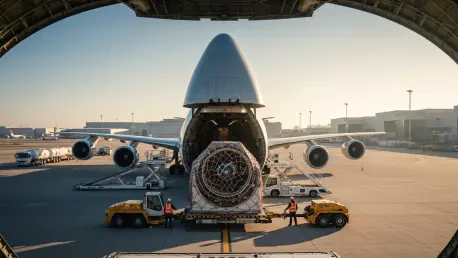
The Boeing 747-8F and the An-124 continue to be uniquely valuable in this environment because of their nose-loading capabilities. This design allows for long, bulky items—such as oil pipes or rotor blades—to be slid directly into the front of the aircraft, bypassing the limitations of side-loading doors. While the newer Airbus A350F features the widest side-loading door in the industry to specifically address these historical limitations, it still cannot fully match the operational ease provided by a nose-loading ramp for certain types of industrial freight. As the market enters this period of tighter capacity and higher costs, the focus has shifted from simple tonnage to the physical accessibility of the aircraft. Shippers are increasingly looking for specialized engineering support to help them package cargo in ways that maximize the available door clearance. This focus on geometry ensures that the physical dimensions of the aircraft remain the ultimate gatekeeper of global trade for years to come.
Strategic Planning: Building Resilience for Global Shipping
Looking back at the shifts that defined the mid-2020s, it became clear that successful logistics managers moved away from reactive booking strategies toward more integrated, long-term partnerships with carrier fleets. The scarcity of specialized aircraft taught the industry that relying on spot-market availability was a high-risk gamble that could derail multi-billion-dollar projects. Companies that thrived were those that integrated transportation requirements into the early design phases of their industrial products, ensuring that equipment was built to fit within the constraints of the available 777F or A350F fleet. They also diversified their transport modes, utilizing sea-air combinations to balance cost and speed while reducing dependence on the shrinking pool of heavy-lift aircraft. This proactive approach turned logistics from a back-end cost center into a strategic advantage, allowing these firms to maintain consistent project timelines despite the volatility of charter rates and fleet maintenance.
Furthermore, the development of regional logistics hubs equipped with specialized loading infrastructure played a vital role in stabilizing the market as it transitioned toward newer aircraft models. Investment in ground handling equipment that could safely manage the transition between different aircraft types allowed for more efficient use of the available fleet. Forward-thinking organizations also began to leverage digital twin technology to simulate the loading of complex cargo before a single piece of equipment left the factory floor, significantly reducing the risk of ground-handling delays or rejected loads. This emphasis on technological integration and infrastructure development provided the necessary buffer as the industry waited for the next generation of freighters to arrive. Ultimately, the lessons learned from the challenges of 2026 paved the way for a more resilient and data-driven global cargo network. These steps ensured that despite the physical limitations of the aircraft, the flow of goods remained steady.