
The once-silent corridors of industrial fulfillment centers have undergone a radical metamorphosis, evolving from static storage repositories into vibrant, sentient ecosystems where silicon and steel orchestrate the relentless flow of global commerce with unprecedented precision. This current era of material handling has successfully transitioned from a period of experimental curiosity into a phase of deep operational maturity, where the adoption of advanced technology is no longer the exclusive domain of global conglomerates with limitless capital. Instead, a democratization of high-tech robotic solutions has allowed mid-sized enterprises to deploy sophisticated automation that was once deemed financially or technically unreachable. In this modern landscape, the question has shifted from whether a facility should automate to how quickly it can integrate these systems to survive the crushing demands of omnichannel retail and the volatile expectations of the global consumer base. Consequently, robotics is now viewed as a ubiquitous necessity, forming the very backbone of any competitive supply chain strategy that aims for high-speed throughput and absolute inventory accuracy.
The Technological Pillars: Foundations of Modern Automation
Advanced Perception: Navigating Complex Environments
The leap in sensory capabilities has transformed warehouse robots from blind, repetitive machines into aware participants capable of navigating the unpredictable nature of a busy distribution center. Modern systems rely on a sophisticated fusion of LiDAR, high-definition stereoscopic cameras, and physical artificial intelligence to build real-time digital maps of their immediate surroundings. Unlike earlier iterations that required fixed magnetic strips or pristine pathways, these contemporary units can detect a stray pallet, a spilled liquid, or a walking technician, recalculating their route in milliseconds without interrupting the broader workflow. This level of environmental perception ensures that automated assets maintain maximum uptime, as they no longer require human intervention every time a minor obstacle appears. By integrating these multimodal sensors, facilities have achieved a level of safety that actually surpasses manual operation, creating a symbiotic environment where humans and machines move in a choreographed dance of efficiency and mutual awareness.
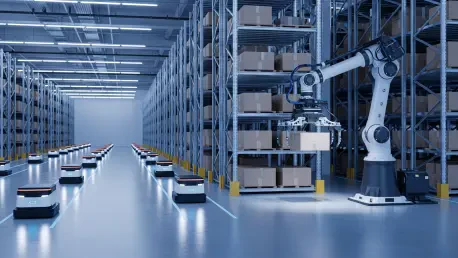
Furthermore, the integration of vision-based software allows these machines to go beyond mere obstacle avoidance and engage in complex object recognition and spatial reasoning. For instance, a robotic arm equipped with advanced perception can now differentiate between a fragile glass jar and a sturdy cardboard box, adjusting its grip and movement speed accordingly to prevent damage. This “physical AI” enables the system to learn from every interaction, continuously refining its understanding of the varied inventory it encounters. As these machines accumulate data across thousands of cycles, they become increasingly adept at handling “live” environments where variability is the only constant. The result is an operational framework that is both resilient and adaptive, providing the reliability required to sustain high-volume output during the most demanding shifts without the need for constant recalibration or specialized facility redesigns.
Mechanical Versatility: Evolution of the End Effector
The mechanical interface between a robot and the physical product has undergone a significant revolution, moving toward flexible, bio-inspired designs that mimic the adaptability of the human hand while maintaining industrial strength. Modern end effectors utilize shape-shifting surfaces and advanced soft robotics to manipulate an incredibly diverse array of stock-keeping units, ranging from small, slippery poly-bags to heavy, oversized industrial components. By employing vacuum-based suction combined with tactile feedback sensors, these robotic grippers can apply exactly the right amount of pressure to secure an item without compromising its structural integrity. This versatility is crucial in an era where product packaging is constantly changing to meet sustainability goals or shipping requirements. A single robotic station can now switch between disparate tasks effortlessly, effectively eliminating the need for specialized machinery for every unique product category within the warehouse inventory.
This mechanical evolution has directly addressed the throughput bottlenecks that previously plagued automated packing and sorting lines. When these advanced grippers are paired with multi-axis robotic arms, they can achieve picking speeds that consistently outperform manual labor while maintaining a near-zero error rate. The ability to handle “ugly” freight—items that are non-conforming in shape or size—has traditionally been the final frontier for warehouse automation, yet modern breakthroughs in material science have largely bridged this gap. High-performing facilities now leverage these versatile mechanical systems to automate the most repetitive and physically taxing aspects of order fulfillment, such as high-velocity bin picking and heavy-duty palletization. This technological shift not only boosts the overall speed of the operation but also provides the flexibility needed to manage the rapid shifts in inventory profile that characterize modern e-commerce trends.
Systemic Specialization: Optimizing for Warehouse Geometry
While the public remains fascinated by humanoid robots, the most impactful gains in modern warehouse efficiency have come from purpose-built systems that are optimized for the specific geometries of industrial spaces. Automated storage and retrieval systems (AS/RS) have reached a peak of performance, utilizing vertical space that was previously wasted and achieving storage densities that are three to four times higher than traditional racking methods. These systems are designed to operate in high-density cubes where human access is unnecessary, allowing for chilled or oxygen-reduced environments that optimize product preservation and fire safety. By focusing on the specific task of rapid retrieval, AS/RS technologies provide the highest possible level of order accuracy, ensuring that the correct item is delivered to the packing station at the precise moment it is needed for shipment.
In parallel with these fixed systems, autonomous mobile robots (AMRs) have matured into specialized tools capable of mastering the most unpredictable areas of the facility, such as the loading and unloading of trailers. The newest generation of AMRs is equipped with telescopic conveyors and heavy-payload bases, allowing them to navigate the narrow confines of a shipping container to palletize or de-palletize goods with minimal supervision. This practical autonomy focuses on solving the most labor-intensive and ergonomically challenging tasks in the warehouse rather than attempting to replicate the human form. By deploying systems that are physically optimized for the specific dimensions of trailers, aisles, and docks, organizations can achieve immediate scalability. These specialized machines represent a pragmatic approach to automation, where the design of the robot is dictated by the requirements of the task and the physics of the environment, resulting in a more robust and cost-effective operational model.
Strategic Deployment: From Installation to Integration
Planning for Success: Identifying Core Operational Constraints
To extract genuine business value from a robotic investment, organizations must resist the urge to automate for the sake of novelty and instead focus on a rigorous, data-driven identification of their primary operational constraints. Implementing a sophisticated robotic arm in a facility where the actual bottleneck is a slow-moving conveyor system or an inefficient software gate will only result in doing the wrong thing faster, rather than improving overall performance. A successful deployment begins with a comprehensive analysis of the existing workflow, identifying the specific points where throughput drops, safety incidents occur, or labor costs become unsustainable. This strategic framework ensures that the technological intervention is surgically applied to the area where it will have the greatest impact on the bottom line. By prioritizing the resolution of these specific bottlenecks, companies can ensure that their automation roadmap is aligned with their broader financial and operational objectives.
Connectivity has become the primary driver of value in the modern distribution center, requiring that every robotic asset be viewed as a single node within a larger, integrated network. This approach necessitates the use of a sophisticated orchestration layer—a software system that sits between the Warehouse Management System and the physical hardware to coordinate the movements of disparate machines. When a facility transitions from standalone machines to an integrated ecosystem, the focus shifts from individual unit productivity to total system flow. For example, the orchestration layer can slow down a picking robot if the downstream packing station is currently backed up, preventing a pile-up of inventory and ensuring a smooth, continuous output. This holistic view of the execution flow allows for a more resilient operation that can dynamically adjust to real-time changes in order volume or equipment availability, ensuring that the facility remains productive even during unexpected disruptions.
Organizational Resilience: The Human-Machine Partnership
High-performing organizations have treated the introduction of robotics as a fundamental shift in their long-term operating model rather than a simple capital expenditure project. This perspective has involved a detailed analysis of how automation can improve organizational resilience, allowing businesses to thrive even in a volatile labor market or during periods of extreme economic uncertainty. Whether modernizing an existing “brownfield” facility or designing a brand-new “greenfield” distribution center, the goal has been to build a scalable foundation that can grow alongside the business. This strategic longevity was achieved by selecting flexible hardware and open-software architectures that can be easily updated as new capabilities emerge. By focusing on the total cost of ownership and the long-term gains in decision-making speed, these companies transformed their logistics operations from a cost center into a significant competitive advantage that supports sustainable growth.
The successful integration of robotics ultimately depended on a renewed focus on augmenting the human workforce and improving facility ergonomics through thoughtful design. By automating the “three Ds”—tasks that are dull, dirty, or dangerous—companies addressed chronic labor shortages while simultaneously improving employee health and job satisfaction. The role of the warehouse associate evolved from a manual mover of boxes into a sophisticated system operator who oversees a fleet of robotic assets, focusing on exception handling and high-value problem solving. To achieve this, leadership teams prioritized comprehensive training programs and transparent communication, ensuring that the workforce viewed automation as a supportive tool rather than a replacement. The result was a more productive and safe environment where the human element remained central to the strategic success of the operation. This transition proved that when technology and talent are aligned, the facility becomes more than the sum of its parts, establishing a new standard for excellence in the global supply chain.