
Rohit Laila has spent decades at the forefront of the logistics and supply chain industry, witnessing firsthand the evolution from manual sorting to the first wave of rigid industrial robotics. His deep expertise in delivery systems and a lifelong passion for technological innovation make him a uniquely qualified voice on the current shift toward physical AI. In this conversation, we explore the breakthrough of Video-Action Models, specifically the FLUX-mimic system, and how it is redefining what is possible on the factory floor. We delve into the transition from static, image-based learning to dynamic video-driven intelligence, the massive efficiency gains in robot training, and the real-world implications of these advancements within Audi’s highly automated production lines.
How does the integration of the FLUX 3 visual architecture enable a robot to understand physical dynamics differently than previous generations of industrial automation?
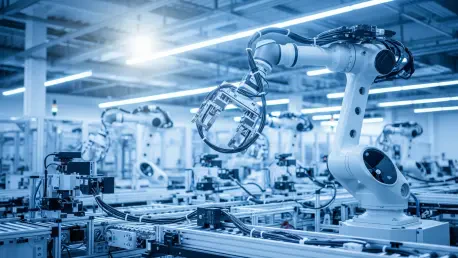
The integration of the FLUX 3 visual architecture allows a robot to move beyond the limitations of static snapshots and actually grasp the flow of the physical world. In the past, most robot learning pipelines relied on Vision-Language-Action models that were pre-trained on simple image-and-text pairs, leaving the robot to guess how objects move or react over time. By using a generative video model as the backbone, the robot observes large-scale video data to learn how materials bend, slide, and fall before it ever touches a tool. This creates a “learned model of the world” where the machine understands the consequences of its movements in a way that feels intuitive rather than purely mathematical. When you see a robot powered by FLUX-mimic handle a complex task, it no longer looks like a programmed machine repeating a loop; it looks like an entity that understands the weight and resistance of the objects in its grip.
Given that traditional robot training often requires dozens of hours of demonstration, what is the practical impact of reducing that requirement to just 30 minutes of data?
Reducing the training requirement from 30 or more hours down to just 30 minutes of robot data is an absolute game-changer for the agility of any production line. In a fast-paced industrial environment, the scent of hydraulic fluid and the constant hum of machinery never stop, and neither can the production schedule. If an engineer has to spend weeks or hundreds of hours programming a single task, the cost of automation often outweighs the benefits, especially when dealing with the high variant diversity found in premium automotive manufacturing. With FLUX-mimic, we are seeing the “engineering overhead” evaporate, allowing robots to be fine-tuned for a specific manipulation task in the time it takes for a worker to have a lunch break. This shift transforms the robot from a specialized, static tool into a flexible partner that can be redeployed across the factory floor to meet changing demands almost instantly.
What specific challenges in automotive production, particularly regarding soft-body manipulation at Audi, does this technology address that conventional robotics could not?
For decades, the automotive industry has been a leader in automation, yet certain tasks like handling flexible parts or soft-body manipulation remained stubbornly manual because they were simply impossible for conventional robotics to solve. Traditional robots excel at rigid movements—picking up a steel bolt and placing it in a hole—but they struggle when a part changes shape, like a wire harness, a piece of fabric, or a rubber seal. Audi has been utilizing this new technology in their Production Lab to solve these exact types of complex, unstructured tasks that require a “finesse” or “feel” that code couldn’t provide. By leveraging frontier Video-Action Models, these robots can now adapt to the unpredictable behavior of soft materials, allowing the plant to automate repetitive and physically demanding tasks that previously required a human’s tactile sensitivity. It is the difference between a machine that just moves to a coordinate and one that truly interacts with the nuanced textures of the assembly line.
How do you envision the relationship between human employees and AI-driven robots evolving as factories transition into the “smart factory” model?
The vision for the smart factory isn’t about replacing the human element, but rather about transforming robots into supportive partners that take over the “dull, dirty, and dangerous” aspects of the job. As we see in the partnership between mimic and Audi, the goal is to provide tailored support for employees, allowing them to focus on higher-level problem solving while the AI handles the grueling repetition of the line. There is a certain dignity in this transition; the worker is no longer a cog in a mechanical process but a supervisor of intelligent systems that can learn and adapt alongside them. We are moving toward an environment where the robot is integrated without months of engineering friction, acting as a flexible tool that responds to the needs of the human team. This collaborative atmosphere creates a much more resilient production network where the intelligence of the software matches the dexterity of the hardware.
What is your forecast for general-purpose industrial automation?
I believe we are entering an era where the “general-purpose” label for robots will finally become a reality rather than just a marketing term. Within the next few years, the reliance on scarce and expensive robot demonstration data will continue to fall as these Video-Action Models become even more adept at learning from the vast amounts of video data already available globally. We will see a shift away from “engineered” cells toward “learned” environments, where a robot can be unboxed and taught a new, complex assembly task in under an hour. This will lead to a massive expansion of automation in sectors that were previously too “unstructured” for robots, such as small-batch manufacturing and complex logistics fulfillment. Ultimately, the barrier between the digital intelligence of AI and the physical reality of the factory floor will disappear, making flexible, intelligent automation the standard for every major industry.