
With decades of experience navigating the complexities of global supply chains, Rohit Laila has witnessed the logistics industry evolve from manual, labor-intensive operations to a high-tech frontier of automation. As an expert who bridges the gap between traditional delivery models and cutting-edge innovation, he offers a unique perspective on how intelligence is being woven into the very fabric of the warehouse. Today, we explore the arrival of a new era in material handling, where vision-based technology allows machines to perceive and react to their surroundings with human-like intuition.
The following discussion delves into the integration of AI-powered navigation within the modern warehouse, examining how a unified ecosystem of autonomous forklifts, tugs, and movers can solve the critical constraints of labor availability and increasing volume demands. We explore the technical leaps in precision and safety that allow heavy machinery to operate at high speeds in dynamic environments, and how intuitive software is drastically reducing the time it takes to bring these systems online.
How does the shift from traditional, infrastructure-dependent navigation to AI-powered Visual SLAM fundamentally change the way facility managers approach warehouse layouts?
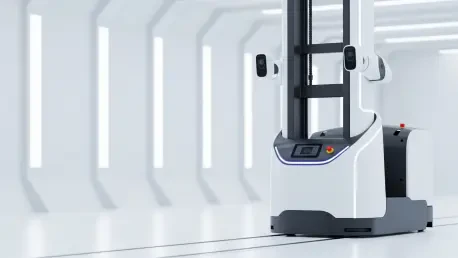
The transition to Visual SLAM is a liberating moment for any facility manager who has ever felt “locked in” by the physical constraints of reflectors, magnetic strips, or floor markers. By using advanced vision and intelligence to map the environment, the Flexley Stack F712 navigates without needing any pre-installed infrastructure, allowing the layout to remain as fluid as the business demands. You can almost feel the collective sigh of relief when a manager realizes they can reconfigure a production floor on a Friday and have the robots adapted by Monday morning. This technology provides a staggering positional accuracy of ±10 mm, ensuring that even in a chaotic, dynamic warehouse, the robot knows exactly where it is down to the smallest fraction of an inch.
In terms of raw operational capacity, what makes the Flexley Stack F712 a standout addition for high-intensity industrial environments like automotive manufacturing?
The sheer muscle and reach of this machine are what truly command attention on the factory floor. We are looking at an autonomous forklift capable of handling loads up to 2,000 kg, which is essential for the heavy components often found in the automotive and industrial sectors. It doesn’t just move weight across the floor; it reaches up to heights of 8.5 meters, maximizing the vertical “air rights” of a warehouse that are so often underutilized. Watching a machine lift two tons of material to the height of a three-story building with total autonomy is a sensory reminder of how far robotics has come. Whether it is handling open pallets, closed containers, or specialized racks, its versatility ensures it can tackle the most demanding end-of-line storage tasks without breaking a sweat.
The concept of a unified ecosystem is gaining traction; how does integrating different types of AMRs under a single software suite impact daily logistics workflows?
Integrating forklifts, tugs, and movers into a single, interoperable ecosystem is the “holy grail” of intralogistics because it eliminates the digital silos that usually plague automation projects. By using a platform like AMR Studio, which is VDA5050 compatible, operators can coordinate a diverse fleet through a no-code, drag-and-drop interface. This creates a rhythmic, synchronized flow of goods where different machine types “talk” to each other to manage traffic and avoid bottlenecks. There is a certain beauty in seeing a fleet coordination system visualize real-time movements, knowing that the same project logic is governing every mover and stacker on the floor. It turns a collection of individual robots into a cohesive, intelligent workforce that scales effortlessly as the business grows.
When businesses are under pressure to move goods faster with fewer people, how do the speed and setup time of these autonomous systems provide a competitive edge?
In today’s market, every second shaved off a cycle time or a commissioning phase translates directly to the bottom line. The Flexley Stack F712 can reach speeds of 1.7 m/s even while fully loaded, which provides the rapid throughput necessary to keep up with the high-velocity demands of modern e-commerce and manufacturing. Furthermore, the use of AI-enabled software can shorten commissioning times by as much as 20%, allowing companies to realize their return on investment much faster than with legacy systems. When labor is a critical constraint, being able to deploy a safe, ISO and ANSI-certified robotic solution quickly is the difference between meeting a deadline and falling behind. It removes the stress of “peak season” by providing a reliable, scalable workforce that is ready to perform from day one.
What is your forecast for the future of autonomous material handling as AI and vision technologies continue to evolve?
I foresee a move toward “zero-friction” automation where the line between the digital twin and the physical warehouse completely disappears. As AI-powered vision becomes even more sophisticated, these machines will move beyond simple navigation to true “semantic understanding,” recognizing not just obstacles but the specific context of every object they encounter. We will see warehouses that are not just automated but are truly self-optimizing, where the robots themselves suggest layout changes based on real-time traffic patterns. The human role will shift entirely from operating machinery to high-level orchestration, as these autonomous systems become the invisible, intelligent backbone of the global supply chain.