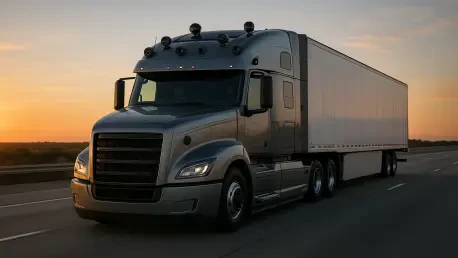

The sight of a heavy-duty trailer navigating a complex highway interchange without a driver touching the wheel has shifted from a futuristic novelty into a standardized industrial reality. At the 2026 Autonomous Mobility Industry Exhibition, the focus has moved decisively away from small passenger vehicles toward the massive, high-torque world of heavy-duty logistics. This transition is not merely about size; it represents a fundamental change in how artificial intelligence perceives and interacts with the physical world. By moving toward End-to-End (E2E) AI models, the industry is addressing the specific complexities of cargo transport that traditional modular systems have historically struggled to solve.
Evolution of End-to-End AI: Heavy-Duty Logistics
The evolution of autonomous freight has been defined by a move away from multi-step software stacks toward unified neural networks that handle everything from perception to control. In traditional systems, separate modules would detect an object, predict its path, and then calculate a steering response, a process that can introduce latency and cumulative errors. E2E AI simplifies this by processing raw sensor data into direct driving actions, effectively mimicking the holistic decision-making process of a human driver. This streamlined approach allows for faster response times and a more fluid driving style, which is essential when managing the immense inertia of a loaded semi-truck.
This technological shift is particularly relevant as global supply chains face an era of unprecedented pressure and labor shortages. While passenger vehicle automation focused on urban navigation and rider comfort, the development of E2E AI for trucking prioritizes consistency and safety over long distances. The context of this evolution is rooted in the need for a system that can handle the unique physics of a trailer, such as jackknifing risks and extended stopping distances, which require a more integrated understanding of vehicle dynamics than a standard sedan.
Core Technological Pillars of Mars Auto’s Autonomous System
MarsNet: The Proprietary Camera-Based E2E AI Model
The heart of this autonomous revolution is MarsNet, a proprietary model that challenges the industry’s long-standing reliance on expensive LiDAR sensors. By using a camera-centric approach, the system processes visual information to build a comprehensive understanding of the road environment. This is not just a cost-saving measure; it is a strategic choice based on the idea that cameras provide the semantic depth needed to interpret complex scenarios, such as temporary construction zones or nuanced hand signals from traffic controllers. The model learns through the analysis of millions of kilometers of driving data, allowing it to “understand” the relationship between visual cues and vehicle behavior.
Because heavy trucks operate with variable loads, the AI must constantly adjust its braking and steering logic based on the weight of the cargo. MarsNet manages these variables by integrating real-time telemetry with its visual processing, ensuring that a fully loaded trailer and an empty one are handled with appropriate caution. This replaces the rigid, rule-based programming of the past with a flexible intelligence that can account for the massive turning radiuses and long-range stopping needs inherent in heavy-duty logistics.
MarsPilot and Copilot: Level 2+ Hardware and Software Integration
Complementing the neural network is the MarsPilot hardware suite, which stands out for its ability to be retrofitted onto existing commercial vehicle fleets. In a sector where profit margins are thin, the ability to upgrade a standard Hyundai Xcient truck in a single day is a significant advantage over competitors requiring proprietary chassis. This hardware works in tandem with the Copilot software, a Level 2+ solution designed to assist drivers by managing lane-keeping and adaptive speed control. By reducing the cognitive load on long-haul drivers, these tools improve safety today while the industry moves toward higher levels of autonomy.
The integration of these systems allows for a gradual transition into autonomous operations, providing immediate value to logistics companies. While the hardware handles the heavy lifting of data collection and signal processing, the software provides a user-friendly interface that keeps human operators in the loop. This dual-layered approach ensures that even as the system gathers the data necessary for full Level 4 autonomy, it remains an “immediately applicable” asset that enhances the efficiency of current shipping routes.
Innovations in Scalability: Cost Efficiency
The most disruptive aspect of the current technological landscape is the drastic reduction in the cost of entry for autonomous trucking. By eliminating the need for LiDAR arrays that can cost hundreds of thousands of dollars, the hardware package for these E2E systems has dropped to approximately $7,500. This price point changes the economic calculus for fleet owners, making it feasible to modernize entire fleets rather than just a few experimental units. Such affordability ensures that autonomous technology is no longer a luxury for tech giants but a standard tool for mid-sized logistics providers.
Moreover, the speed of installation has reached a point where the digital transformation of a truck does not require significant downtime. In the fast-paced world of freight, a vehicle sitting in a garage is a liability. The current ability to install and calibrate an entire autonomous suite within twenty-four hours means that companies can begin seeing a return on their investment almost immediately. This focus on economic viability and ease of deployment is what separates the current generation of AI from the high-cost prototypes of the previous decade.
Real-World Deployment: Commercial Milestones
These systems have moved beyond controlled testing environments into the rigorous world of actual export cargo transport. In South Korea, the technology is already powering government-approved paid transport across three major domestic routes, proving its reliability in high-traffic corridors. These are not empty test runs; they are active components of the national infrastructure, carrying real products for paying clients. This level of commercial integration provides a continuous stream of data that further refines the AI’s performance in diverse weather and road conditions.
The reach of this technology extends across the Pacific, as evidenced by the participation in the “Team Korea” initiative in the United States. This involves navigating a 7,000-kilometer round-trip route between California and Georgia, a journey that tests the system against a wide variety of North American road types and traffic patterns. With over twenty million kilometers of accumulated driving data and millions of kilometers of purely autonomous operation, the system has reached a maturity level that allows it to navigate international routes with minimal human intervention.
Technical Hurdles: Market Obstacles
Despite the rapid progress, the industry still faces substantial technical and regulatory barriers that complicate global adoption. Navigating the complex web of international transport laws requires a level of adaptability that goes beyond simple driving logic. Each region has different rules for lane usage, speed limits for heavy vehicles, and cargo safety protocols. Furthermore, ensuring the stability of camera sensors in extreme environments—such as blinding snowstorms or desert heat—remains a focus for ongoing engineering efforts to prevent system degradation.
There is also the challenge of public perception and the legal framework surrounding liability in the event of an incident involving autonomous freight. While the data shows that AI-driven trucks are statistically safer than human-driven ones, the legal system is still catching up to the reality of unmanned vehicles on public roads. Development efforts are currently directed toward creating “fail-safe” hardware redundancies and more robust data-logging systems that can provide a clear account of the AI’s decision-making process for insurance and regulatory purposes.
The Future: Autonomous Supply Chains
The trajectory of autonomous trucking is leading toward a world of hyper-efficient, twenty-four-hour supply chains. As more vehicles join the network, the sheer volume of driving data will lead to exponential improvements in AI training, allowing the models to anticipate hazards long before they become visible to a human eye. The expansion of dedicated autonomous corridors across Europe, Asia, and North America will likely create a seamless global shipping network that operates with a level of precision and fuel efficiency that was previously impossible.
In the coming years, we can expect to see further breakthroughs in how these vehicles communicate with one another and with the road infrastructure itself. This V2X (Vehicle-to-Everything) communication will allow autonomous trucks to move in tight platoons, further reducing wind resistance and energy consumption. As the technology matures, the focus will shift from making the truck drive itself to optimizing the entire logistics ecosystem through AI-driven scheduling and real-time route optimization, fundamentally reshaping the global economy.
Summary of Clinical and Operational Impact
The implementation of End-to-End AI in the heavy-duty trucking sector successfully demonstrated that the industry was ready to move beyond the experimental phase. During the transition over the last year, operators reported a significant decrease in fuel consumption and a reduction in minor collisions, which validated the safety claims of camera-centric systems. The deployment of retrofitted hardware showed that the existing global truck fleet could be modernized without requiring a total overhaul of manufacturing processes. These results indicated that the path to full autonomy was through cost-effective, scalable solutions rather than high-cost, specialized sensors.
Stakeholders within the logistics chain realized that the integration of AI-driven trailers provided a crucial edge in a competitive market. The focus then shifted toward standardizing the data exchange between different autonomous platforms to ensure safety across international borders. By the end of the recent operational trials, the industry proved that autonomous trucks were no longer a niche technology but a vital participant in the global supply chain. The next steps for the sector involved refining the interaction between autonomous long-haul units and human-managed last-mile delivery services to create a truly integrated logistical network.