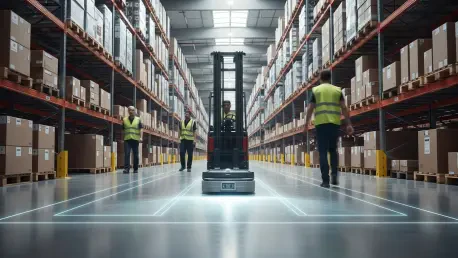

Behind the high-speed conveyor belts and humming automated sorting systems of the modern global supply chain lies a persistent, manual danger that claims lives and stalls productivity daily. Every week, an average of two warehouse workers in the United States lose their lives in forklift-related accidents, contributing to tens of thousands of injuries annually. Despite the rapid rise of automation, the vast majority of industrial facilities remain “digitally dark,” operating with manual vehicle fleets that leave managers blind to real-time movements and safety hazards.
This visibility gap does more than just threaten lives; it stunts productivity, leaving manual forklifts idle or underutilized for more than half of their operational life. Without a way to monitor movement, facilities cannot optimize workflows, resulting in massive inefficiencies that go unnoticed by supervisors. Consequently, the lack of real-time data makes it nearly impossible to distinguish between a functioning lane and a congested hazard before an accident happens.
The High Cost: Operating in the Dark
The financial toll of these blind spots extends far beyond medical bills and legal fees, impacting the entire logistics chain. Manual vehicles that operate without spatial data often crisscross paths inefficiently, leading to wasted fuel and unnecessary wear on equipment. This lack of transparency means that even the most advanced distribution centers struggle to justify the return on investment for their manual labor forces compared to automated counterparts.
Moreover, the human factor remains the most unpredictable variable in warehouse safety. Traditional sensors and alarms often fail to provide the context needed to prevent collisions in high-traffic zones where sound levels are already deafening. Without a holistic view of the floor, managers are forced to rely on reactive measures, which only address systemic problems after an incident has already disrupted the workflow.
Bridging the Gap: Manual Labor and Industrial Automation
The urgency to illuminate these blind spots fueled a significant $14 million funding round for Slamcore, led by ROKStar Ventures and supported by industry leaders like Toyota Ventures. With a total of $40 million in investment, the industry focus shifted toward scaling spatial intelligence to solve the “infrastructure-free” challenge. Modern warehouses need a way to track movement without the prohibitive costs of installing GPS, beacons, or magnetic floor markers.
Visual AI became the primary contender for modernizing legacy facilities because it requires no physical alteration of the environment. By avoiding complex hardware installations, companies can implement these systems across various global locations regardless of building age. This flexibility allowed for a much faster transition from manual guesswork to digital certainty in dynamic settings.
Turning Visual Data: Proactive Safety and Efficiency
Visual AI utilizes stereo cameras to grant machines and managers a precise understanding of their physical environment. By deploying systems like Slamcore Aware, operations managers moved past guesswork to track the behavior of every vehicle across a facility. This technology effectively identifies bottlenecks in real-time, allowing for immediate redirection of assets to high-demand areas to maximize throughput.
Simultaneously, safety-focused tools like Slamcore Alert monitored the proximity between heavy machinery and pedestrians, identifying “near-miss” scenarios that traditional reporting often overlooked. This dual approach ensured that spatial awareness served both the bottom line and the well-being of the workforce. By transforming cameras into sensors, warehouses turned passive surveillance into active, life-saving protection.
Industry Insights: The Future of Physical AI
Leadership at Rockwell Automation highlights a critical shift in industrial strategy: the need for a single technology platform that can manage both human-operated and autonomous vehicles. Expert consensus suggests that capturing real-world operational data is the essential first step toward building “physical AI.” This unified approach eliminates the data silos that often separate manual workers from robotic systems.
By utilizing OSHA injury statistics and real-time behavioral data, companies moved away from reactive safety measures toward a predictive model. This framework allowed managers to anticipate accidents before they occurred, creating a safer ecosystem for every worker on the floor. Furthermore, this data foundation paved the way for future autonomous transitions without requiring a complete overhaul of current protocols.
Strategies for Deploying Spatial Awareness: No Infrastructure Required
To successfully integrate visual AI into a modern warehouse, operators prioritized a phased implementation that avoided facility redesign. The first step involved equipping existing manual fleets with stereo cameras to map “digitally dark” zones and establish a baseline for vehicle utilization. This enabled companies to gather crucial data without interrupting existing workflows or requiring significant downtime for installations.
From there, managers applied behavior monitoring frameworks to flag high-risk zones where pedestrians and forklifts frequently intersected. This scalable approach allowed global distribution centers to transition from manual oversight to a data-driven safety ecosystem. Ultimately, the integration of these tools ensured that safety became a proactive constant rather than a reactive correction.