
Rohit Laila stands at the intersection of traditional logistics and the cutting edge of industrial automation. With a career spanning several decades, Laila has witnessed the supply chain evolve from manual ledgers to the sophisticated, data-driven ecosystems of today. As an expert who has managed complex delivery networks and spearheaded technological integrations, he offers a unique perspective on how physical AI is finally bridging the gap between digital records and warehouse reality. In this conversation, we explore the recent surge of capital into autonomous systems, the strategic leadership transition at the helm of Corvus Robotics, and the technical breakthroughs allowing robots to operate in the harshest environments, from deep-freeze storage to the high-velocity movement of forklifts.
With a fresh $20 million in funding bringing the total investment to $38 million, how do you see this capital infusion accelerating the shift from manual inventory tracking to truly autonomous “ground truth” visibility?
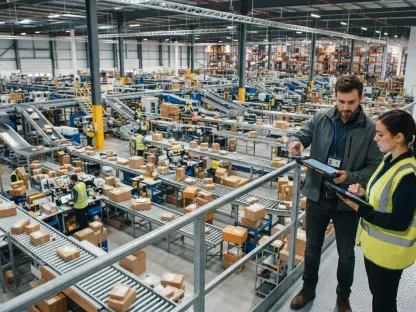
This significant investment, led by Catalyst Investors and supported by groups like S2G and Cibus Capital, signals a massive vote of confidence in the shift toward real-time data capture. For years, warehouses have relied on “estimated” records that are often delayed or reconciled by hand, leading to massive inefficiencies. By scaling a fleet that already analyzes over a million locations every month, this funding allows for the deployment of systems that replace guesswork with undeniable physical evidence. We are seeing a move away from static spreadsheets toward a living, breathing map of the facility that updates continuously. This capital will specifically help expand the footprint of over 300 devices currently operating across 26 U.S. states, Canada, and Mexico, ensuring that “ground truth” becomes the standard rather than the exception.
Mohammed Kabir has recently stepped into the CEO role after leading technology since the company’s inception in an MIT dorm room. How does having a founder-technician at the helm change the way a robotics company approaches the “punishing” environments of modern logistics?
Having Mohammed Kabir lead the company is a natural evolution because he has personally architected every piece of the technology that customers rely on today. Since 2017, when he and Jackie Wu built the first prototype in a dorm, the focus has been on solving the core problem that the physical world generates data that usually goes uncaptured. A CEO who understands the granular technical hurdles—like localization without infrastructure—is better equipped to navigate the brutal realities of a working warehouse. He isn’t just looking at the business metrics; he understands the sensory challenges a robot faces when navigating high-traffic aisles. This deep technical roots ensure that the product roadmap remains grounded in solving the actual physical constraints of logistics rather than just chasing abstract software goals.
The launch of the Corvus One for Cold Chain earlier this year was a major milestone. What makes operating in a -20°F environment such a significant technical hurdle, and why is it a game-changer for the industry?
Operating continuously from ambient temperatures down to a deep freeze of -20°F is an engineering feat that most standard robotics simply cannot handle due to battery drain and sensor failure. Launched in February 2026, Corvus One for Cold Chain is currently the only autonomous inventory robot capable of functioning in these extremes without needing specialized localization infrastructure. In these environments, manual counting is not just tedious; it is physically taxing and dangerous for human workers, leading to high turnover and frequent errors. By automating this process, companies can maintain 100% visibility in their most challenging zones without risking personnel. It transforms the cold chain from a “black box” of missed data into a transparent, measurable part of the overall supply chain.
We’ve seen the introduction of the Corvus Trident as an AI copilot for forklifts. How does mounting AI onto existing machinery like reach trucks help “close the loop” between inventory that is stationary and inventory that is currently in motion?
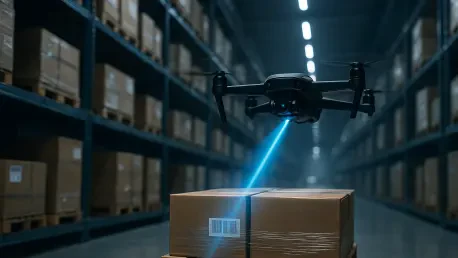
The Corvus Trident, introduced in April 2026, represents a shift from observing inventory at rest to capturing the logic of inventory in motion. While autonomous drones like the Corvus One handle the racks, the Trident copilot attaches to the forklifts that are doing the heavy lifting, documenting every pallet movement during normal operations. Both of these streams feed directly into the AIMS software platform, creating a holistic view of the warehouse floor that didn’t exist before. This integration means that if a pallet is moved from a dock to a high-bay slot, the system sees it in real-time without the driver needing to scan a barcode manually. It effectively eliminates the “data gaps” that occur between scheduled inventory counts, providing a 360-degree view of the facility’s pulse.
Looking at the results from companies like Southern Glazer’s Wine & Spirits, which identified 35,000 inventory discrepancies, what does this level of precision mean for the bottom line of global distributors?
The scale of impact we are seeing, such as Southern Glazer’s expanding to nine distribution centers with over 40 drones, is staggering because it uncovers losses that were previously invisible. Identifying 35,000 verified discrepancies isn’t just about cleaning up a database; it’s about recovering capital, improving order fulfillment, and reducing wasted labor. Similarly, seeing a brand like Dermalogica increase its inventory imaging frequency by 600% at its global headquarters shows that companies are hungry for more frequent, high-resolution insights. When you have that level of precision, you can optimize your stock levels and reduce the safety stock you keep “just in case” because you finally trust your data. This transition turns the warehouse from a cost center into a high-performance data engine that can be measured and improved daily.
What is your forecast for the role of physical AI in global warehousing over the next few years?
I believe we are entering an era where the “invisible” warehouse becomes a thing of the past, as every physical action will be mirrored in a real-time digital twin. Over the next few years, I expect the reliance on manual reconciliation to drop to near zero as systems like Corvus become standard infrastructure in any facility over 200,000 square feet. We will see the intelligence move beyond just “finding” things to “predicting” bottlenecks before they even happen on the floor. Data captured by these autonomous fleets will become the foundation for a much larger shift in how global supply chains are managed and optimized. Ultimately, the warehouses that thrive will be those that treat their physical space as a giant data set, using AI to bridge the gap between their shelves and their software systems.