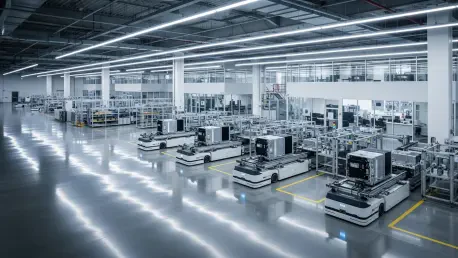

The rapid evolution of smart factory technology has fundamentally shifted the focus of industrial efficiency from the assembly line to the complex movement of materials across the production floor. Blue Ocean Robotics is currently redefining the manufacturing landscape by positioning its advanced solutions at the critical intersection of high-end logistics and intelligent mobile technology. As a primary developer of Autonomous Mobile Robots and Automated Guided Vehicles, the company effectively addresses the deep-seated inefficiencies that have historically plagued modern factory environments. By blending sophisticated mechanical hardware with proprietary software scheduling algorithms, the firm successfully converts manual-heavy, labor-intensive operations into streamlined, data-driven ecosystems. This strategic approach is especially vital for precision-heavy industries such as photovoltaic energy and lithium-ion battery production. These sectors require a sophisticated internal logistics framework that can match the relentless speed of global demand while maintaining absolute precision in material handling.
Overcoming the Challenges of Traditional Production
Identifying Logistical Bottlenecks: The High-Precision Crisis
Traditional manufacturing logistics are currently facing a significant crisis characterized by a widening gap between production capacity and the efficiency of material movement. Human-led material handling has increasingly become a liability in high-precision settings, where the slightest inconsistency can lead to costly delays or damaged components. In environments that operate on a 24/7 cycle, the physical limitations of manual labor create natural ceilings on throughput that technology must now address. Furthermore, legacy automated vehicles often lack the real-time intelligence required to navigate the complex layouts of modern factories. This lack of adaptability frequently results in traffic congestion and operational downtime, especially when multiple units are deployed simultaneously on the same floor. These physical bottlenecks prevent high-end facilities from achieving their full output potential while maintaining safety standards.
The inefficiency of manual transport is further magnified in sectors like semiconductor fabrication and battery assembly, where environmental control is paramount. Human intervention in cleanroom environments increases the risk of contamination, which can compromise entire batches of sensitive hardware. Robotic systems, however, operate with a level of cleanliness and consistency that humans cannot replicate over long shifts. Beyond cleanliness, the sheer volume of materials moved in a modern gigafactory requires a logistics system that never tires and never varies in its pace. Traditional methods struggle to provide the granular tracking needed to ensure that every part arrives at the correct station at the exact moment it is required. This timing is the difference between a high-efficiency operation and one plagued by constant micro-stops. Consequently, the push for automation is not merely about replacing labor but about reaching a level of precision that is physically impossible for a human workforce.
Bridging Operational Gaps: Beyond Physical Movement
Beyond the physical movement of goods, the industry continues to struggle with significant data fragmentation that creates isolated operational silos. When different stages of the manufacturing process fail to communicate effectively with one another, the result is a systemic lack of synchronization that drives up management costs and increases error rates. This disconnection prevents factories from reaching a true “smart” status, as the movement of materials remains unoptimized and detached from the broader digital framework of the facility. The inability to track material flow in real-time means that logistics remain a reactive component rather than a proactive driver of efficiency. Blue Ocean Robotics identifies these gaps as the primary barrier to the next generation of industrial performance. Solving this requires more than just better robots; it necessitates a comprehensive digital architecture that integrates every movement into the factory’s core intelligence system.
The transition toward a fully integrated logistical framework requires a departure from standalone machines toward a unified fleet management approach. Modern production facilities often utilize a variety of disparate systems that do not share information, leading to blind spots where materials are effectively lost to the tracking system during transit. By implementing a centralized scheduling platform, companies can ensure that every robot is aware of the status and location of its peers, as well as the immediate needs of the production line. This level of coordination transforms internal logistics from a series of independent tasks into a fluid, continuous process that adapts to real-time changes in production schedules. Such integration is essential in the automotive sector, where a single delay in material delivery can halt an entire multi-million dollar assembly line. Bridging these gaps allows for a level of transparency that was previously unattainable in large-scale manufacturing operations.
A New Standard for Intelligent Automation
Driving Industrial Growth: Proprietary Full-Stack Innovation
To solve the recurring issues of floor congestion and system lag, Blue Ocean Robotics utilizes a full-stack technology system that maintains complete control over both hardware design and software. Their proprietary scheduling system represents a standout innovation in the field, capable of coordinating massive fleets of over five hundred devices across thousands of unique loading points. This level of extreme synchronization is supported by flexible navigation options, including both laser and magnetic systems, which allow robots to adapt to diverse floor conditions without requiring expensive structural changes to the building. By owning the entire technology stack, the company can optimize the interaction between the robot’s physical sensors and its path-planning algorithms. This ensures that the fleet operates with the highest possible density and speed, maximizing the return on investment for high-growth industrial manufacturers looking to scale their operations quickly.
The business has experienced explosive growth recently, maintaining a 300 percent annual growth rate and surpassing a significant output value of 800 million yuan. By establishing a robust physical presence in major industrial hubs such as Guangzhou and Jiangsu, the company provides localized support and rapid deployment to top-tier leaders in the green energy and automotive sectors. This strategic positioning, combined with its status as a recognized high-growth Little Giant, has solidified its reputation as a dominant force in the industrial robotics market. The ability to offer tailored solutions that meet the specific environmental needs of lithium battery factories—such as high-load capacity—has set a new benchmark for what manufacturers expect from their automation partners. As these industries continue to scale, the demand for such specialized, high-performance logistics platforms is expected to grow alongside the global transition toward sustainable energy and electric vehicle production.
Strategic Expansion: Scaling for Global Demand
Sustained by significant venture capital from prominent firms such as Hillhouse and Matrix Partners, the company is now scaling its operations to meet the increasing global demand for smart logistics. A new round of financing is currently being utilized to upgrade core navigation algorithms and expand specialized robot designs into industries beyond the core markets of automotive and energy production. These efforts ensure the company continues to bridge the gap between traditional industrial practices and a fully automated future, focusing on the efficiency of material movement. By investing heavily in research and development, the firm is preparing for a landscape where autonomous logistics are the standard rather than the exception. This expansion is not merely about increasing robot counts but about enhancing the cognitive capabilities of each unit to handle more complex tasks, such as precise tool delivery and collaborative assembly support.
The integration of these advanced robotic solutions across diverse manufacturing sectors provided a clear roadmap for the future of industrial efficiency. Facilities that adopted these full-stack autonomous systems saw immediate improvements in both throughput and operational transparency. Moving forward, manufacturers should prioritize the synchronization of their internal logistics with their broader enterprise resource planning systems to maximize the value of these robotic fleets. Investing in flexible navigation technology proved to be a decisive factor for companies needing to adapt to rapidly changing production layouts. Furthermore, the focus on data-driven decision-making allowed logistics to evolve from a simple utility into a strategic asset. By embracing these intelligent mobile platforms, the industry moved closer to a state of total operational fluidity, ensuring that the physical movement of goods would never again be a bottleneck for technological progress and industrial growth.