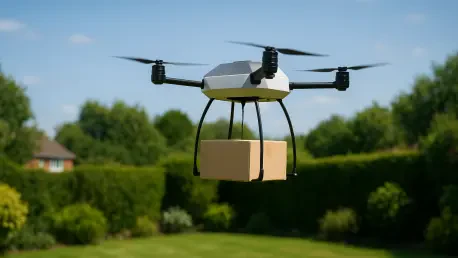

The sight of a small, hexagonal aircraft descending silently into a suburban garden in County Durham marks the definitive end of the traditional era of gasoline-powered delivery vans and crowded residential streets. This shift is not merely a pilot program but a foundational change in how global retail giants envision the movement of goods from fulfillment centers directly to the consumer door. Darlington has become the epicenter of this transformation, proving that aerial distribution is no longer a futuristic concept but a functional reality that is actively resizing the footprint of logistics infrastructure.
Since launching the initial trial in February, the operational success of Prime Air has been substantial, with over 500 flights completed from the local County Durham facility. The current phase of the rollout seeks to move beyond the initial 7.5-mile restriction, aiming for comprehensive town-wide coverage. This expansion signals a transition from experimental testing to a more integrated, commercialized delivery model that promises to redefine local commerce.
The Evolving Landscape of Autonomous Last-Mile Logistics
The transition from traditional courier services to automated aerial distribution represents a major strategic pivot in the logistics industry. For decades, the last-mile delivery leg has remained the most expensive and inefficient portion of the supply chain due to traffic and human labor costs. By moving these operations to the sky, logistics providers can bypass ground-level congestion entirely, ensuring that the final stage of fulfillment is as fast as the digital processing that preceded it.
The deployment of the MK30 drone technology is central to this revolution, offering a sophisticated platform designed for the complexities of modern neighborhoods. This specific aircraft is engineered to handle small-parcel delivery with unprecedented precision, making the UK a primary global testing ground for the technology. The operational shift toward aerial logistics also brings significant environmental advantages, as electric-powered drones significantly reduce the carbon emissions associated with traditional diesel delivery fleets.
Accelerating the Shift Toward Rapid Aerial Fulfillment
Emerging Technologies and the Consumer Push for Instant Delivery
The success of aerial logistics relies heavily on the integration of digital mapping and artificial intelligence to facilitate precise landings in varied residential zones. These drones utilize advanced sensors to identify safe landing spots in real-time, navigating around obstacles such as trees, power lines, and household pets. This technological sophistication ensures that the delivery process remains unobtrusive while maintaining the high safety standards required for operations in densely populated areas.
Consumer expectations have evolved rapidly, with a growing push for “two-hour or less” delivery windows that challenge the limits of traditional retail competition. Instant fulfillment has become a primary differentiator in the e-commerce market, forcing companies to adapt their logistics for all-weather conditions. The current generation of drones can operate in light rain and moderate winds, ensuring that the promise of rapid delivery remains consistent regardless of typical British weather patterns.
Market Growth Projections and Economic Indicators for Drone Logistics
Current data indicates that approximately 68% of orders qualify for drone transport based on their weight, specifically those under five pounds. This high percentage suggests that a vast majority of daily e-commerce transactions could eventually be migrated to aerial platforms. Financially, the announcement of the Darlington expansion has bolstered investor confidence, reflected in a positive uptick in share performance as the market recognizes the long-term value of automated fulfillment.
Cost-reduction strategies are also a major driver of this shift, as minimizing human intervention in the final delivery leg drastically lowers the overhead for every package sent. While the initial capital expenditure for drone fleets and infrastructure is significant, the operational savings over time are projected to be substantial. As the technology scales, the cost per delivery is expected to drop well below the rates currently charged by traditional ground-based courier services.
Navigating Operational Hurdles and Safety Incidents in Residential Airspace
Integrating autonomous aircraft into densely populated neighborhoods presents a unique set of complexities that require constant monitoring and refinement. Operating in tight residential airspace means that drones must be capable of split-second decision-making to avoid unforeseen hazards. The industry is currently focused on perfecting the interaction between these autonomous systems and the unpredictable nature of human environments to ensure a seamless co-existence.
Lessons learned from previous operational challenges, including a July incident where an aircraft made contact with a vehicle, have led to the refinement of fail-safe protocols. In that instance, the aircraft responded as designed by executing a controlled descent, demonstrating that existing safety systems are effective even during mechanical failures. Maintaining public trust is a priority, which involves not only proving the safety of the flight but also managing noise and privacy concerns within the local community.
The Critical Role of Civil Aviation Oversight in Scaling Air Delivery
The approval process with the Civil Aviation Authority is a vital component for achieving town-wide coverage in Darlington. This regulatory body ensures that every aspect of the operation meets rigorous safety standards before the service can expand beyond its current limits. Gaining official clearance for full town operations will mark a significant milestone, providing a template for how other towns and cities can integrate drone delivery into their local infrastructure.
Establishing standards for Beyond Visual Line of Sight (BVLOS) operations is particularly critical for the commercialization of this technology. These regulations allow drones to travel distances where they are no longer visible to a human operator, which is essential for scaling the service across larger geographic areas. The flexibility and proactive approach of UK regulators have made the country a global leader in drone technology, influencing how other nations approach the integration of autonomous aircraft.
Beyond Darlington: The Blueprint for a Global Prime Air Network
Darlington is being utilized as a scalable model for a nationwide and eventual international deployment of Prime Air. The insights gained from the County Durham facility are helping to refine the logistics network, ensuring that the system can be replicated in diverse environments. As drone autonomy continues to advance, the industry anticipates a future where expanded payload capabilities allow for the delivery of a wider range of goods, from groceries to medical supplies.
The potential for fully integrated robotic supply chains is becoming increasingly clear, with drones serving as the final link in a highly automated sequence. In both urban and rural environments, the ability to bypass traditional infrastructure creates new opportunities for global trade and local efficiency. Future market disruptors will likely focus on enhancing battery range and aircraft speed, further solidifying the role of drones as a permanent fixture in the global logistics landscape.
Transforming the Delivery Paradigm Through Robotic Innovation
The expansion in Darlington served as the definitive proof of concept for a fully automated last-mile logistics network. Stakeholders recognized that the successful deployment validated the long-term economic viability of drone technology, while the regulatory framework established with the Civil Aviation Authority provided a clear roadmap for international expansion. The transition toward a robotic supply chain offered a sustainable solution to the persistent challenges of urban congestion and high delivery costs.
Strategic recommendations for investors highlighted the necessity of supporting infrastructure that accommodated both aerial and ground-based autonomous systems. It was observed that the reduction in human labor requirements during the final delivery leg significantly improved the overall margins for e-commerce fulfillment. Ultimately, the Darlington project demonstrated that public acceptance grew as the benefits of rapid, low-impact delivery became a standard part of the local economic fabric.