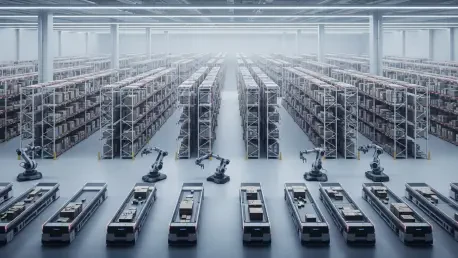

Modern logistics centers are no longer just storage spaces but high-velocity computational hubs where every millisecond of robotic movement translates directly into profit or loss. The AI warehouse simulation represents a significant advancement in the logistics and supply chain sector, moving beyond simple layouts to create living digital ecosystems. This review will explore the evolution of the technology, its key features, performance metrics, and the impact it has had on various applications. The purpose of this review is to provide a thorough understanding of the technology, its current capabilities, and its potential future development.
Understanding AI-Driven Warehouse Orchestration and Simulation
High-fidelity simulators like GreyMatter Foundry operate on the principle that a digital environment must mirror physical physics and logic perfectly to be useful. Traditional modeling often ignored the “micro-frictions” of human-robot proximity or battery depletion rates, leading to a gap between design and reality. AI bridges this gap by treating the warehouse as a single, orchestrated entity rather than a collection of independent machines.
The transition from static modeling to dynamic orchestration signifies a shift toward Industry 4.0 standards. In this new landscape, simulation is not a one-time setup phase but a continuous feedback loop. By using data-driven environments, operators can visualize how a surge in orders ripples through the sorting area, allowing for adjustments before the physical equipment even begins to move.
Core Components and Technological Capabilities
High-Fidelity Modeling and Dataset Integration
The power of modern simulators stems from their ability to ingest massive datasets from existing robotic ecosystems to achieve 95% accuracy. By drawing from the performance history of over 130,000 agents, the system moves beyond theoretical estimates. It creates a digital twin that understands the specific torque, speed, and sensor limitations of the hardware, ensuring that the simulated throughput is actually achievable on the floor.
AI-Powered Design Copilot and Conversational Logic
The introduction of the “Design Copilot” marks a shift toward human-centric AI tools that democratize complex engineering. Instead of manually inputting thousands of coordinate points, a supply chain manager can use natural language prompts to configure a new aisle or test a different picking strategy. This reduction in technical barriers means that strategic decisions are made by those who understand the business logic, not just those who can code.
Heterogeneous Multi-Agent Coordination
One of the most difficult technical hurdles is coordinating diverse environments where robots from different manufacturers must work alongside manual labor. A vendor-agnostic system provides a neutral “brain” that prevents traffic jams between disparate automation brands. While certified agent networks offer the highest precision, the ability to simulate third-party hardware is what makes these platforms essential for modern, mixed-fleet facilities.
Latest Developments in Simulation Fidelity
The industry has moved away from traditional CAD-based planning toward real-time “wall-to-wall” 3D visualization. This immersion allows stakeholders to see bottlenecks in high definition, rather than interpreting spreadsheets. Moreover, “What-If” scenario modeling has become a standard requirement for stress-testing facilities against peak demand surges, such as Black Friday or sudden seasonal shifts.
What used to take weeks of manual engineering can now be accomplished in hours through automated AI design. This speed allows for iterative testing, where hundreds of different layouts are compared by the AI to find the optimal balance of space and speed. This shift in standards has fundamentally changed how capital expenditure is justified in the logistics sector.
Real-World Applications and Industrial Impact
In large-scale fulfillment centers, these simulations are used to predict return on investment with surgical precision. By modeling complex SKU management and storage requirements, companies can see exactly how a change in inventory mix will affect picking speeds. This prevents the costly mistake of over-investing in hardware that does not solve the specific operational bottleneck.
Case studies in multi-vendor environments show that simulation is the only way to ensure safety and efficiency when different robotic languages interact. Beyond the machines, the technology is used for labor planning, helping managers determine exactly where human intervention adds the most value. This balancing act is crucial for global logistics networks trying to maintain consistency across multiple continents.
Challenges and Technical Hurdles
Despite the progress, integrating proprietary software across different hardware vendors remains a complex task. Many manufacturers are hesitant to share deep-level API access, which can limit the fidelity of the simulation for certain third-party robots. Furthermore, simulating human-robot interaction in high-density areas involves unpredictable variables that still challenge even the most advanced AI logic.
Maintaining high-fidelity accuracy as robotic fleets scale to hundreds of thousands of units requires immense computational power. There is also the persistent risk of the “simulation-to-reality” gap. If the physical floor is uneven or the Wi-Fi signal is inconsistent, the digital twin may fail to predict localized failures, reminding us that software is only as good as the physical data it receives.
Future Horizons in Logistics Automation
The industry is moving toward fully autonomous warehouse self-optimization, where the simulation runs in the background and suggests real-time layout changes. Long-term strategic forecasting now allows for 10-year horizon planning, helping enterprises build facilities that can evolve as shopping habits change. This predictive power is a cornerstone of global supply chain resilience.
As simulation nodes become more interconnected, the entire supply chain could eventually exist as a single, synchronized digital model. This transformation is turning warehouse management into a data science discipline. The workforce is shifting from manual labor to system oversight, requiring a new set of skills centered on interpreting AI-driven insights rather than just moving boxes.
Final Assessment of AI Simulation Technology
The integration of AI into warehouse simulation proved to be a decisive turning point for the logistics industry. By providing a unified environment for testing and orchestration, these platforms significantly reduced the financial risks associated with automation. The ability to visualize ROI and stress-test operations before a single robot was purchased allowed for a more aggressive yet calculated expansion of global supply chains. Enterprises that adopted these data-driven orchestration tools found themselves better equipped to handle the volatility of modern commerce. Ultimately, the technology shifted the focus from merely moving goods to mastering the flow of information that governs them.