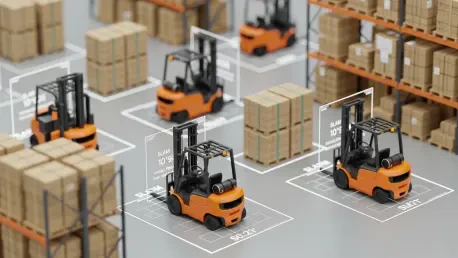

Modern warehouses lose thousands of hours and millions of dollars annually simply because the digital record of a pallet does not match its physical reality on the floor. While the industry has long sought a way to bridge this “data gap,” traditional methods have remained stubbornly manual, relying on distracted operators to scan barcodes at every transition point. The introduction of AI-driven pallet tracking, specifically through devices like the Corvus Trident, represents a move away from this fragmented approach toward a continuous, invisible layer of data capture. This technology does not just assist the operator; it fundamentally redefines the material handling equipment as a mobile data node within the broader supply chain.
The Evolution of Automated Inventory Monitoring
The core principle behind this technological shift is the transition from reactive scanning to proactive computer vision. In traditional environments, inventory data is only as good as the last manual scan. If a driver forgets to register a pallet move, that item effectively vanishes from the Warehouse Management System (MWS). AI tracking systems solve this by using real-time data capture to observe the environment constantly. This creates a digital twin of warehouse operations that updates without human intervention, ensuring that every movement is logged the moment it occurs.
This evolution is a critical component of the push toward Industry 4.0, where the goal is a fully digitized and autonomous supply chain. By eliminating the need for manual checkpoints, facilities can maintain a high velocity of movement without sacrificing data integrity. This context is essential because it moves the conversation from simple “tool improvement” to a complete overhaul of how information flows through a distribution center, turning a physical logistics hub into a smart, self-reporting ecosystem.
Technical Core and Key Features of AI Tracking Systems
Computer Vision and Onboard Artificial Intelligence
At the heart of these systems lies industrial-grade scanning combined with sophisticated onboard AI. Unlike a simple barcode reader, these systems process visual data locally on the forklift or reach truck. This allows the hardware to identify and read multiple barcodes simultaneously, even in low-light conditions or when labels are slightly damaged. By processing this information on the edge, the system avoids the latency issues associated with cloud-only processing, giving the driver instant confirmation of their actions.
Infrastructure-Free Spatial Positioning
One of the most impressive technical feats of this technology is its ability to determine precise spatial positioning without external hardware. Most legacy tracking systems require the installation of expensive GPS repeaters, Bluetooth beacons, or floor markers to know where a vehicle is located. Modern AI tracking uses simultaneous localization and mapping (SLAM) to understand its position relative to the warehouse’s existing structure. This allows for the tracking of pallet locations even in complex, multi-level stacks up to three tiers high, providing vertical granularity that was previously impossible without massive infrastructure investment.
Feedback Loops and System Integration
Operational success depends on how the system communicates with the human element. The inclusion of immediate audio and visual alerts serves as a critical safety net; if an operator picks up the wrong pallet or attempts to drop it in an incorrect zone, the system provides an instant correction. Furthermore, the use of standard APIs allows these devices to feed data directly into existing WMS platforms. This integration ensures that the technology acts as a transparent layer of accuracy rather than another siloed tool that requires its own management.
Emerging Trends in Warehouse Visibility Ecosystems
The current trend in logistics is moving toward a “hands-free” environment where data collection is a byproduct of movement rather than a separate task. We are seeing a significant shift toward integrated ecosystems where mobile tracking devices on forklifts work in tandem with autonomous drone systems. This creates a comprehensive view of the facility where drones handle cycle counts of stationary inventory while AI-equipped forklifts track every item in motion.
Real-World Applications and Industrial Impact
The practical utility of AI tracking is best observed in high-volume environments like the MSI Surfaces headquarters. In such settings, the sheer volume of goods makes manual tracking prone to failure. By deploying AI tracking, these facilities have seen a drastic reduction in shipping chargebacks and vendor disputes. Because the system maintains a visual and digital record of every pallet loaded onto a truck, the warehouse has undeniable proof of accuracy for every shipment, enhancing vendor accountability.
Overcoming Operational Challenges and Barriers
Despite the clear benefits, integrating AI hardware across diverse fleets of material handling equipment remains a technical hurdle. Different forklift models and aging fleets present varying mounting challenges and power requirements. Additionally, the initial cost of integration can be a barrier for smaller operations that are used to the low upfront costs of manual scanners. However, the industry is currently focusing on refining accuracy in high-traffic, chaotic environments where sensor noise can occasionally interfere with positioning.
Future Outlook for AI-Driven Logistics
The future of this field lies in predictive warehouse optimization. As AI continues to collect massive datasets on movement patterns, the software will eventually transition from tracking what happened to predicting what should happen. We are likely to see breakthroughs in sensor fusion where AI-driven platforms automatically reorganize warehouse layouts for maximum efficiency. This will lead to self-correcting supply chains that can anticipate bottlenecks before they occur.
Final Assessment of AI Pallet Tracking
The transition to AI-driven pallet tracking marked a significant departure from the error-prone era of manual inventory management. By prioritizing computer vision and infrastructure-free positioning, the technology successfully eliminated the “data gap” that previously hindered large-scale logistics. Organizations that adopted these systems realized substantial gains in labor productivity and audit traceability. Ultimately, the shift toward these autonomous platforms moved the global logistics industry closer to a state of total transparency, where the physical and digital worlds finally operated in perfect synchronization.