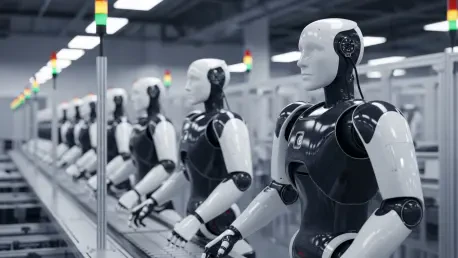

Rohit Laila has spent decades navigating the intricate web of global supply chains, witnessing firsthand how manual labor shortages can cripple even the most robust logistics networks. As Agility Robotics prepares to go public through a $2.5 billion merger with Churchill Capital Corp XI, the conversation around humanoid robotics is shifting from speculative science fiction to a massive operational reality. We sit down with Rohit to explore how this deal, backed by industrial heavyweights like Foxconn and NVIDIA, signals a turning point for the industry and what the influx of capital means for the future of the American workforce.
This interview explores the strategic implications of Agility Robotics’ public debut, the scaling of the “Digit” humanoid robot within the logistics sector, and the burgeoning $1 trillion market opportunity for autonomous labor.
With a valuation of $2.5 billion and $620 million in new proceeds, how do you see this capital infusion fundamentally shifting Agility’s ability to dominate the humanoid robotics market?
This capital injection is a massive vote of confidence, especially with $420 million coming from Churchill XI’s trust and another $200 million through a PIPE led by Foxconn at $10 per share. When you see names like NVIDIA, Amazon, and SoftBank on the cap table, you realize this isn’t just a pilot project; it’s a full-scale industrial launch into the public markets. The $620 million in gross proceeds allows the company to finally scale the production of Digit v5, moving from boutique manufacturing to high-volume commercial deployments across North America. It is about fulfilling that massive backlog of $300 million in multi-year orders and proving that humanoids can handle the gritty, repetitive tasks in warehouses. You can almost feel the momentum building as they prepare to list under the ticker “AGLT,” turning physical AI into a liquid, tradable asset for the first time on such a significant scale.
Agility often describes its flagship robot, Digit, as being “Made for Work.” Based on your experience in logistics, what makes a general-purpose humanoid more viable than the specialized automation we’ve seen in the past?
In my decades in the industry, we’ve mostly seen rigid, bolted-down machines that do one thing very well but fail the moment the environment changes or the task shifts. Digit is different because it’s human-centric and designed to walk right into existing facilities like those at GXO or Toyota Motor Manufacturing Canada without requiring a total, multi-million dollar redesign of the floor. Seeing a robot safely navigate a live production environment for over 65,000 hours across nine different customer facilities proves that it can handle the chaos of a busy distribution center. There’s a palpable sense of relief for warehouse managers when they realize these robots can fill chronic labor shortages without needing a specialized safety cage or complex infrastructure. By being “Made for Work,” Digit bridges the gap between traditional human labor and the high-tech future, offering a flexibility that traditional conveyors or robotic arms simply cannot match in a dynamic workspace.
The concept of a “data flywheel” is central to Agility’s strategy for physical AI. How does the real-world operational data from Digit’s 65,000 hours of work transform the software capabilities of these robots over time?
The beauty of physical AI is that the robot actually learns from the friction and unpredictability of the real world, much like a human apprentice would on their first day. Every one of those 65,000 hours spent in manufacturing and logistics environments serves as a critical lesson that sharpens the robot’s “brain,” making it more cooperative and safe for human interaction. When a robot encounters a misplaced pallet or a slick floor at a facility like Mercado Libre, that data is fed back into the integrated platform to improve the entire fleet’s performance. This proprietary data flywheel creates a massive barrier to entry for competitors because you simply cannot simulate that kind of real-world complexity or environmental stress in a isolated lab. You can feel the intelligence of the platform growing as it evolves from just moving boxes to understanding the subtle nuances and safety requirements of a high-pressure, live supply chain.
The list of strategic partners and investors—from DCVC and SoftBank to industrial giants like Schaeffler—is incredibly diverse. What does the involvement of such varied players tell us about the broader ecosystem Agility is building?
The breadth of this ecosystem suggests that the humanoid revolution is being tackled from every possible strategic angle—computing power from NVIDIA, logistics scale from Amazon, and manufacturing prowess from Foxconn. These partners aren’t just writing checks; they are providing the infrastructure for Digit to become the world’s first cooperatively safe humanoid that can actually function alongside humans. When a company like Schaeffler or Toyota commits to these robots, they are signaling that the $1 trillion market opportunity management is eyeing is very much a tangible target. It creates a powerful feedback loop where the Customer Acceleration Program helps more enterprises prepare for large-scale adoption by evaluating and testing these systems in real time. The synergy between these global leaders ensures that Agility isn’t just building a standalone machine, but an entire safety-first, AI-powered ecosystem designed to strengthen the resilience of our global supply chains.
What is your forecast for the adoption of humanoid robotics in the global logistics sector over the next five years?
I believe we are currently at a critical inflection point where humanoid robots will move from experimental novelties to essential infrastructure in every major distribution hub across the country. With a growing pipeline of over 30 customers already in place and $300 million in multi-year orders for the next-generation Digit v5, the scale of adoption is going to accelerate faster than many industry skeptics expect. We will see these robots becoming standard teammates in the American workforce, helping to mitigate the chronic labor shortages that have plagued our industry for years while increasing overall productivity. As the “physical AI” matures and the costs per unit begin to drop due to mass production at their specialized manufacturing facilities, I expect Agility to unlock a significant portion of that $1 trillion market. By the end of this decade, seeing a humanoid robot working safely alongside people in a warehouse will be as common as seeing a forklift or a conveyor belt is today.