
Relentless delivery windows, tighter audits, and rising energy costs have turned every minute of warehouse downtime into a measurable liability, and operators have responded by tightening workforce competency while installing access systems that fail safely and recover fast. The strategy has been visible on both the people and equipment fronts: a renewed push to standardize training for hardware professionals and a wave of high‑speed, impact‑tolerant, thermally efficient doors and dock systems designed to keep work moving. This blend of skills and engineered resilience is reshaping how facilities think about risk. Instead of treating doors as static fixtures, managers now view them as active assets that influence uptime, safety cases, and even carbon reporting.
Compliance, Safety, and Uptime Converge
A telling indicator came from the Door & Hardware Federation, which prepared to preview a new Building Hardware Training program at The Security Event this year, signaling that competence is being formalized across the supply chain rather than left to informal knowledge. The curriculum targeted product managers, customer service teams, and trade counter staff who influence specification and aftercare, not just installers. That mattered because misapplied products and vague advice often sit behind recurring faults, unsafe workarounds, and avoidable callouts. By grounding modules in practical tasks and current regulations, the program aimed to align everyday decisions with duty‑holder responsibilities, making conformity with PUWER, CE/UKCA documentation, and maintenance regimes easier to demonstrate during audits.
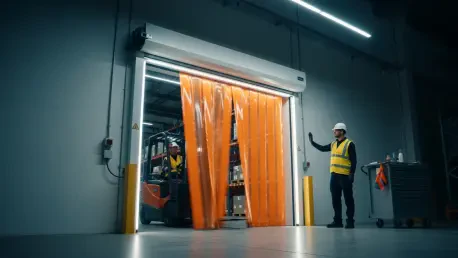
Building on this foundation, several recent deployments showed how design choices translate into continuity. Hörmann UK’s V 5025 Z high‑speed door, which uses a zip mechanism that disengages on impact and automatically re‑feeds into its guides, addressed one of the most common interruption causes: forklifts nudging curtains off track and calling maintenance. The self‑repairing feature restored service without tools, helping internal and external openings absorb knocks rather than becoming single points of failure. Where airflow between zones could not be sacrificed, BID Group delivered a bespoke Klimate door with roughly 30% mesh area, preserving ventilation and air quality while keeping cycle speeds and barrier benefits. For temperature‑controlled operations and robust daily use, Stertil Dock Products’ Thermadoor Level Access Doors paired with personal doors emphasized durable construction and thermal performance, reducing loss through frequently used bays. Large‑scale integration appeared at Schneider Electric’s Scarborough facility, where ASSA ABLOY supplied loading bay equipment and industrial doors within a net‑zero Scope 1 and 2 design powered by renewable energy and smart controls, tying movement, sealing, and energy data into a coordinated operational picture.
From Project Learnings to Playbook
The lessons from these implementations pointed to a practical playbook that had cut interruption risk while strengthening audit readiness. The most effective moves were deceptively simple: elevate baseline knowledge through consistent training; specify self‑recovering door systems where traffic is dense; use airflow‑rated curtains or mesh panels to avoid trading air quality for speed; select insulated, durable level‑access doors for temperature or noise‑sensitive areas; and procure integrated dock‑to‑door packages so controls, seals, and safety logic work together. Operators who tied these upgrades into site energy dashboards also gained a clearer view of leakage and idle‑time losses. Procurement teams were advised to require documented maintenance pathways and parts commonality, while health and safety leads mapped door behavior to traffic patterns and muster routes. Taken together, these steps made doors active contributors to uptime, compliance evidence, and carbon plans rather than passive background infrastructure.