
Rohit Laila is a seasoned veteran in the logistics industry, boasting decades of hands-on experience that bridges the gap between traditional supply chain management and the cutting-edge technological innovations currently reshaping the sector. As a passionate advocate for modernization, he has spent his career analyzing the flow of goods across international borders, focusing on how infrastructure and innovation can drive economic prosperity. Today, we sit down with him to discuss the massive transformation unfolding in Pharr, Texas. This border city is rapidly reinventing itself as a premier trade gateway, leveraging a strategic expansion of its international bridge and a surge in industrial investment to become a central pillar of the North American supply chain.
The discussion explores several critical themes, starting with the staggering $1 billion investment pipeline that is fueling the construction of massive industrial complexes and creating hundreds of competitive jobs. We examine the structural upgrades to the Pharr International Bridge, where the addition of four commercial lanes is set to double capacity and potentially eliminate the long-standing frustration of border wait times. The conversation also shifts toward the future of intermodal connectivity, detailing how Pharr plans to link maritime, rail, and air infrastructure to create a truly integrated logistics hub. Finally, we address the logistical hurdles of binational coordination and the strategic importance of increasing participation in trusted-trader programs to ensure a secure and efficient flow of commerce between the United States and Mexico.
How is the influx of nearly $1 billion in potential investment and the development of massive million-square-meter industrial complexes fundamentally altering the economic fabric of Pharr and its neighboring communities?
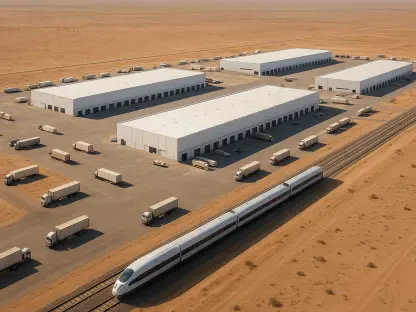
The sheer scale of the investment we are seeing right now is nothing short of transformative for South Texas. With more than $500 million in confirmed investment recorded by the Pharr Economic Development Corporation back in 2025, we have seen that momentum carry us toward a cumulative $1 billion milestone as of the first quarter of this year. These aren’t just abstract figures on a spreadsheet; they represent massive industrial complexes of approximately 1 million square meters that are physically reshaping the horizon. When you walk through these sites, you can see the hustle of developers from as far away as California and Dallas who have recognized the strategic value of this corridor. Beyond the steel and concrete, the human impact is profound, as each of these large-scale projects is expected to generate between 300 and more than 500 jobs, offering competitive wages that directly boost household incomes. This growth creates a powerful ripple effect that strengthens the entire region, turning Pharr into a central anchor for investment that benefits our neighbors in McAllen, Edinburg, San Juan, and Alamo.
With the expansion of the Pharr International Bridge currently 95% complete and set to double capacity, what does the move toward “eliminating” wait times mean for the day-to-day reality of cross-border logistics?
The expansion of the Pharr International Bridge is a landmark achievement that moves us away from the outdated goal of simply managing bottlenecks toward a future where we actually eliminate them. By adding four new commercial lanes, we are effectively doubling the operational capacity of the crossing, which is essential as nearshoring and manufacturing activity continue to surge in northern Mexico. We have reached a point where the project is more than 95% complete, and as operations ramp up in this first half of the year, logistics providers are finally getting the predictability they have been craving for decades. There is a palpable sense of excitement as we approach the official ribbon-cutting ceremony this November because 100% more capacity means the “stop-and-go” nature of border freight could become a thing of the past. For a manufacturer, being able to schedule a delivery without factoring in a three-hour border delay is a massive competitive advantage that changes the entire math of the regional supply chain.
There is a clear strategic vision to transform Pharr into an intermodal logistics hub. In what ways will connecting maritime, rail, and air infrastructure redefine how goods move across the North American continent?
The move toward becoming an intermodal port is a visionary step that recognizes that the future of foreign trade is not just about trucks on a road; it is about a seamless web of connectivity. By fostering close cooperation with the Port of Brownsville, Pharr is positioning itself as a vital node where cargo arriving by sea can be swiftly transferred to the road and moved into the heart of Mexico. This multimodal approach allows us to integrate airports and railroads into the existing infrastructure, offering companies a variety of routes to reduce transit constraints and bypass traditional logistics hurdles. It is a sophisticated strategy that leverages our direct connection to Reynosa, one of northern Mexico’s most important manufacturing centers, and links it to a broader international network. When we look at the logistics landscape today, the ability to pivot between different modes of transport is what will define the most resilient and successful trade corridors in the coming years.
As the new bridge capacity comes online, binational coordination remains a critical factor. How must the relationship between US and Mexican authorities evolve to ensure that operational differences don’t undermine this new infrastructure?
Infrastructure is only as good as the policy that governs it, and right now, the primary challenge is synchronizing the “pulse” of both sides of the border. One of the most pressing issues we face is the difference in operating hours between Mexico and the United States, which can create artificial delays even when we have the physical lane capacity to move thousands of trucks. To maximize our productivity, we must promote a culture of equality in our operational schedules, ensuring that when one side is open and ready for business, the other side is matching that pace. This level of coordination is becoming increasingly critical as we navigate the review of the United States-Mexico-Canada Agreement, or USMCA, which puts a spotlight on our ability to work as a unified economic bloc. We have to think of the border not as a line where operations stop and start, but as a shared workspace where binational productivity is the ultimate metric of success.
Security programs like CTPAT and OEA are targeted to grow from 35% to 60% participation in the coming years. Why is this shift toward “trusted-trader” status so essential for the long-term stability of the South Texas-Mexico corridor?
Strengthening our participation in trusted-trader programs like the U.S. Customs Trade Partnership Against Terrorism and Mexico’s Authorized Economic Operator program is the “secret sauce” for a high-functioning border. Moving from our current 35% participation rate to a target of 60% will drastically streamline the customs process, allowing certified companies to move through the crossing with a level of speed and security that uncertified firms simply cannot match. This isn’t just about cutting red tape; it is about building a high-integrity supply chain where security is baked into every step of the logistics process. When a majority of the cargo moving across the bridge is pre-cleared and trusted, it allows authorities to focus their resources on higher-risk shipments, making the entire border safer and more efficient for everyone. For the regional economy, this shift signals to global investors that Pharr is not just a high-volume gateway, but a high-security, high-reliability corridor that can support the most demanding manufacturing requirements.
What is your forecast for the Pharr-Reynosa trade corridor over the next two years?
My forecast for this corridor is one of unprecedented growth, as the convergence of the $1 billion industrial pipeline and the doubled bridge capacity creates a “multiplier effect” that will redefine North American trade. As the final four lanes reach full operational status following the November ribbon-cutting, we will see a dramatic surge in cargo volume that will likely exceed our current record-breaking trends. I expect that the successful integration of intermodal connections with maritime and rail will attract a new wave of high-tech manufacturing to the region, further diversifying the economic base beyond traditional logistics. By the end of this two-year cycle, Pharr will likely stand as the primary benchmark for how border cities can successfully leverage infrastructure, binational cooperation, and trusted-trader programs to become the beating heart of an integrated global economy.