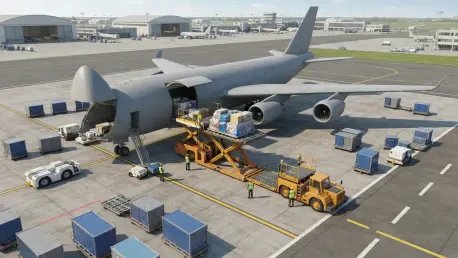

The Mammoth Freighters 777-200LRMF received FAA certification in early 2026, offering operators a viable alternative to waiting for new production deliveries. This milestone arrived at a critical juncture for the aviation world, marking a seismic shift in how heavy cargo moves across continents as the legacy of four-engine jumbo jets rapidly fades into the background. The logistics sector is currently caught in a fascinating tension between the promise of next-generation aircraft and the gritty, immediate reality of maintaining global supply chains. As we navigate the midpoint of 2026, the reliance on these high-capacity twin-engine airframes has transitioned from a temporary stopgap into a cornerstone of global logistics strategy. Carriers have realized that while the theoretical efficiency of a purpose-built future freighter is alluring, the operational availability of a proven, certified platform today holds significantly more weight in a market defined by volatile e-commerce surges and the high-stakes transport of specialized technology. This landscape is driving a radical re-evaluation of fleet diversity, where the “Big Twin” is no longer just an alternative but the primary instrument of global trade.
The Crisis of Timing: Navigating Production Setbacks
The current predicament facing major air cargo carriers stems from persistent delays plaguing the two most significant widebody programs currently in development. The Airbus A350F, which was once touted for a 2025 entry into service, has seen its timeline stretch further into the distance, with its inaugural test flight only occurring late in 2026. This delay forced Airbus to push back European Union Aviation Safety Agency certification targets into 2027, leaving launch customers like Atlas Air and Air China Cargo in a state of strategic suspension. Despite these technical hurdles, the appeal of the A350F remains strong, evidenced by a firm order book that continues to grow with over 115 commitments. Operators are essentially betting on the long-term environmental and economic benefits of the carbon-fiber platform, even if they must scramble to fill the capacity void in the intervening months. This delay is not merely a logistical hiccup but a catalyst that is reshaping the competitive dynamics between traditional manufacturers and third-party conversion specialists who are eager to fill the vacuum.
Boeing has faced a similar struggle with its next-generation heavy lifter, the 777-8F, which has seen its expected delivery window slide toward 2029. Originally launched in early 2022 to counter the Airbus offering, the 777-8F was intended to be the natural successor to the reigning 777F, yet certification complexities and supply chain constraints have pushed its arrival further out. For launch customers like Qatar Airways and Cargolux, these delays necessitate a careful balancing act of extending the life of current fleets while securing interim capacity. The mismatch between the industry’s initial enthusiasm and the reality of the late 2020s delivery schedule has created a lucrative window for the passenger-to-freighter market. This timing crisis has effectively bifurcated the market into two camps: those who can afford to wait for the technological leap of the 2030s and those who must modernize their operations immediately to stay competitive in an era of rapid digital trade expansion.
Engineering the Future: Technical Rivalries in the Sky
The rivalry between Airbus and Boeing in the freighter segment has evolved into a fundamental disagreement on the optimal balance of payload, volume, and fuel efficiency. The Boeing 777-8F holds a structural advantage in raw lifting capacity, offering a maximum structural payload of 118 tonnes, which remains the benchmark for heavy-lift twin-engine aircraft. Boeing’s design philosophy focuses on maximizing the density of cargo, allowing operators to carry heavy industrial equipment alongside general freight over vast transpacific distances. By contrast, the Airbus A350F targets a slightly lower payload of 111 tonnes but emphasizes the benefits of a lighter, composite airframe that reduces fuel burn and landing fees. This technical split forces airlines to choose between the sheer brute force of the Boeing platform and the refined network economics offered by Airbus, which claims superior efficiency on return legs where aircraft are often under-loaded.
Beyond raw weight, the battle for supremacy is being fought over cubic volume and loading flexibility. Boeing emphasizes that the 777-8F’s fuselage is optimized for a dual-purpose role, serving both dense general cargo and the lighter, bulkier shipments typical of modern express services. Airbus counters this with a strategic design choice focused on the rear of the aircraft: an exceptionally wide main-deck door measuring 4.3 meters. This width is specifically intended to accommodate the massive next-generation engines used in modern aviation, such as the GE9X and Rolls-Royce Trent XWB, which are notoriously difficult to load through standard side doors. The “all-new” cargo loading system on the A350F represents an attempt to future-proof the aircraft against the increasing size of aerospace components and industrial machinery. This engineering debate highlights a market that is no longer satisfied with general-purpose haulers, demanding instead specialized tools that can handle a diversifying array of global commodities.
Catalysts for Change: Artificial Intelligence and E-commerce
The demand for high-capacity freighters is being fundamentally reshaped by a shift in the nature of what the world produces and consumes. Global cargo growth has accelerated sharply throughout 2026, driven in large part by the explosive expansion of artificial intelligence infrastructure. High-value AI components, such as advanced semiconductors and server clusters, have become a dominant force in air-transported trade by value. While these items represent a relatively small fraction of total weight, their time-sensitive nature and extreme value require the reliability and security of dedicated freighter airframes rather than the unpredictable belly space of passenger planes. This trend toward high-tech logistics is favoring operators who can guarantee tight delivery windows and specialized handling, further cementing the role of the large widebody freighter as a critical link in the global technology supply chain.
Regional imbalances are also playing a critical role in the demand for dedicated aircraft, particularly in the Asia-Pacific corridor. Roughly 40% of global cargo demand currently originates in China, yet the region’s international passenger traffic has not fully recovered to the point of providing sufficient belly capacity for goods. This creates a structural deficit in cargo space that can only be filled by dedicated freighters operating on China-Pacific and China-Europe lanes. Furthermore, geopolitical disruptions in traditional transit hubs have forced carriers to seek longer, more direct routes that avoid volatile regions. This necessity for range and endurance plays directly into the strengths of the “Big Twins,” which can bypass intermediate stops and deliver goods directly to consumer markets. The convergence of these factors has created a market where capacity is at a premium, and the ability to move large volumes of e-commerce goods quickly has become a matter of national economic security for many regions.
The Battle of Reliability: Transitions from the Queen to the Twin
A historic milestone was recently surpassed as the global fleet of Boeing 777 freighters officially outnumbered the aging Boeing 747 fleet. For decades, the 747 “Queen of the Skies” was the undisputed leader of the industry, but the 777F has now claimed the throne, accounting for approximately 40% of all large widebody freighter capacity. This transition is driven by the relentless pursuit of operational reliability and cost reduction. The 777F has demonstrated an incredible 99.6% schedule reliability rate, a figure that four-engine aircraft struggle to match due to their higher maintenance requirements and greater mechanical complexity. For modern logistics providers, the predictability of a twin-engine platform is often more valuable than the extra lifting power of a jumbo jet, as missing a single connection in a global network can result in millions of dollars in liquidated damages and lost customer trust.
Despite the dominance of the twin-engine platforms, the Boeing 747 remains an irreplaceable asset for specific niche operations that the new generation cannot yet fully replicate. The unique nose-loading capability of the 747-400F and 747-8F allows for the transport of “extra-long” cargo, such as wind turbine blades and specialized oil and gas equipment, that simply cannot fit through any side-loading door. However, the aging 747-400F fleet is seeing a marked decline in utilization as rising fuel costs and expensive heavy maintenance checks make the aircraft increasingly difficult to justify on standard routes. This effectively reduces the total available market capacity even if the planes are not officially retired from service. Operators are now viewing the remaining 747s as specialized tools for project cargo, while the day-to-day heavy lifting of global trade has been firmly handed over to the more efficient 777 and the emerging A350 programs.
Strategic Alternatives: The Proliferation of P2F Programs
To bridge the substantial gap left by production delays, the industry has turned aggressively toward Passenger-to-Freighter conversions, with the Boeing 777-300ERSF emerging as a standout performer. Often referred to as the “Big Twin,” this conversion program offers a 100-tonne payload and a massive cargo volume that is particularly well-suited for the modern e-commerce landscape. By taking existing passenger aircraft that have reached the end of their primary service life and reinforcing the floors and installing large cargo doors, specialists are providing a vital second life for these airframes. The 777-300ERSF provides roughly 25% more volume than a standard production freighter, making it the ideal choice for light, bulky shipments that fill up space long before they reach maximum weight limits. This volumetric advantage has made it a favorite among express carriers and postal services worldwide.
The expansion of conversion infrastructure has become a global phenomenon, with new facilities coming online in strategic locations to meet the surging demand. From the established lines in Israel to new operations in Abu Dhabi, South Korea, and the United States, the industry is scaling up its ability to transform older passenger jets into competitive freighters. This trend is supported by a pragmatic philosophy that a “suboptimal” freighter available for service today is far more valuable than a perfect, next-generation aircraft that is still years away from delivery. This mindset explains why major leasing companies and global airlines are committing to multi-year conversion schedules. The success of these programs has demonstrated that the mid-life passenger airframe market remains a robust source of capacity, provided that the engineering and certification processes can keep pace with the urgent needs of the logistics sector.
Looking Ahead: Long-Term Projections through 2045
Market analysts remain bullish on the long-term growth of the air freighter fleet, though Airbus and Boeing offer slightly different visions of the next two decades. Boeing’s most recent forecast suggests that the global freighter fleet will expand to over 4,000 aircraft by 2045, necessitating nearly 3,000 new and converted deliveries to satisfy a 3.5% annual growth in cargo traffic. Airbus provides a more conservative outlook, projecting a fleet of approximately 3,460 aircraft by the same period. The discrepancy between these two forecasts largely hinges on how each manufacturer views the role of “belly capacity” in future passenger jets. While Airbus believes more cargo will be absorbed by passenger networks, Boeing maintains that the surge in specialized e-commerce and high-tech trade will necessitate a larger dedicated freighter fleet that can operate on schedules independent of passenger demand.
The horizon toward 2030 will be defined by a significant cycle of fleet modernization that will see hundreds of older aircraft retired and replaced by these “Big Twins.” While the net gain in the number of aircraft may appear modest, the increase in actual capacity and efficiency will be profound. The retirement of aging MD-11s and older 747s will remove some of the most fuel-intensive and maintenance-heavy units from the global grid, leading to a more sustainable and reliable logistics network. This shift indicates that the market is prioritizing quality and operational efficiency over mere numerical expansion. As the industry moves closer to the end of the decade, the focus will likely shift from simply acquiring any available airframe to optimizing the mix between new-production giants and the versatile converted twins that have proven their worth during this transitional period.
Mid-Sized Market Gaps: The Potential for a 787 Freighter
As the venerable Boeing 767 freighter nears the end of its production life due to tightening international emissions regulations, a significant question remains regarding the successor for the mid-sized segment. Boeing has identified the 787 Dreamliner as the most logical platform to fill this void, but the path to a 787 freighter is fraught with unique engineering challenges. Unlike traditional aluminum aircraft, the 787 features a composite fuselage made of large barrel sections. Cutting a massive main-deck cargo door into this structure requires significant reinforcement that could add substantial weight, potentially eating into the aircraft’s payload advantages. Engineers are currently working on innovative ways to maintain the structural integrity of the composite airframe while providing the necessary access for heavy cargo pallets, a task that has proven more complex than many initially anticipated.
Economic barriers also stand in the way of a widespread 787 freighter conversion program in the immediate term. The 787 remains a highly valuable asset in the passenger market, and as long as airlines are desperate for efficient widebody jets to meet travel demand, the cost of acquiring used “feedstock” airframes will remain prohibitively high for freighter conversions. Industry experts suggest it will likely be several more years before a significant number of early-build 787s enter the secondary market at a price point that makes the conversion financially viable. This leaves a potential gap in the market for a medium-capacity long-range freighter, a space that the Airbus A330P2F currently occupies with limited competition. The eventual arrival of a 787 freighter could redefine the mid-sized segment, but for now, the industry must wait for the economics of the passenger market to shift in favor of cargo conversion.
Navigating the New Normal: Strategic Implications for Operators
The evolution of the air cargo landscape during the mid-2020s reached a conclusion that favored agility and efficiency over traditional notions of scale. The industry successfully navigated a period of intense production delays by embracing a more diverse range of solutions, including the rapid adoption of Passenger-to-Freighter conversions and the continued maximization of existing twin-engine fleets. The dominance of the “Big Twin” became a settled reality, as the logistical and financial benefits of two engines over four proved to be an irresistible force for every major carrier. Reliability emerged as the primary metric of success, especially in an era where the transport of high-value artificial intelligence components and rapid e-commerce deliveries required flawless execution. The transition from the era of the 747 to the era of the 777 and A350 represented more than just a change in equipment; it was a fundamental modernization of global trade logistics.
By the time the industry looked toward the end of 2026, the strategic path forward had become clear for most major logistics providers. They prioritized the procurement of aircraft that offered the best balance of volumetric capacity and fuel efficiency, recognizing that the environmental footprint of their operations would only grow in importance. The successful certification of programs like the Mammoth Freighters 777-200LRMF provided the industry with the necessary tools to maintain growth despite the primary manufacturers’ struggles. These developments ensured that global supply chains remained resilient in the face of shifting trade patterns and technological revolutions. The lesson learned during this period was that the ability to adapt to manufacturing setbacks through innovative engineering and secondary market utilization was just as important as the development of next-generation platforms themselves. The air cargo industry moved forward with a leaner, more efficient, and more reliable fleet that was better prepared for the demands of the coming decades.