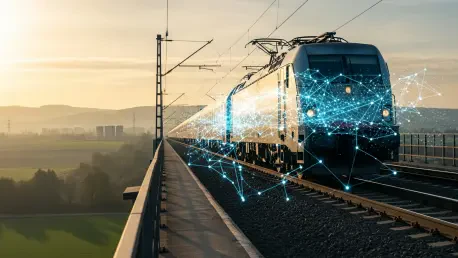

The screech of steel on steel has long defined the rhythm of the European railway, but today that sound is being synchronized with the silent, lightning-fast processing of high-performance data centers. As the demand for seamless cross-border logistics and high-speed passenger travel intensifies, the traditional locomotive is undergoing a fundamental metamorphosis. Siemens Mobility has responded to this shift by unveiling the Vectron X, an advanced platform that signals the end of the era of standalone heavy machinery. This launch marks a definitive move away from traditional vehicle manufacturing toward the creation of a comprehensive, software-integrated ecosystem.
The significance of this evolution cannot be overstated for an industry grappling with aging infrastructure and fragmented digital standards. The Vectron X is not merely a mechanical upgrade; it is a declaration that the future of rail lies in data connectivity rather than just tractive effort. By bridging the gap between hardware and software, Siemens provides operators with a tool that adapts to changing regulations and technological breakthroughs in near real-time. This transition addresses the core challenges of modern rail: reliability, efficiency, and the need for a unified digital language across the European continent.
Beyond Raw Horsepower: The Software-Driven Evolution of the Vectron Lineage
With more than 3,000 units already in active service, the original Vectron established itself as a workhorse of European rail, yet the Vectron X pushes the boundaries of what a locomotive can achieve. While the physical chassis remains a testament to robust engineering, the internal architecture has been completely reimagined to prioritize processing power. This shift reflects a broader industrial trend where the value of a machine is increasingly determined by its ability to generate and interpret data. The transition transforms the locomotive from a simple mover of freight into a scalable, data-driven service platform designed for a hyper-connected era.
This software-driven evolution allows the platform to function as a living entity within a larger network. Rather than being limited by the static capabilities of its hardware at the time of purchase, the Vectron X benefits from a modular digital spine. This design ensures that the vehicle does not become obsolete as new communication standards or automation levels are introduced. Consequently, operators are no longer buying a finished product; they are investing in a rolling piece of technology that matures over its decades-long lifespan.
Solving the Interoperability Challenge: The Siemens Xcelerator Platform
Modern rail operators navigate a fragmented landscape that demands seamless communication between diverse rolling stock, static infrastructure, and complex maintenance services. To solve this, the Vectron X utilizes the Siemens Xcelerator business platform, moving away from the proprietary, closed systems that have historically hindered cross-border efficiency. By adopting an open-interface architecture, Siemens has created a framework where third-party applications and cross-platform data streams can coexist without friction. This interoperability is essential for the smooth transit of goods across multiple national rail networks, each with its own specific safety requirements.
The integration of the Xcelerator platform ensures that the locomotive remains future-proof as artificial intelligence and new safety protocols emerge. This open ecosystem allows for the rapid deployment of software patches and feature updates, much like a smartphone operating system. For the rail industry, this means a significant reduction in the time required to comply with new European Union regulations or to adopt more efficient energy-saving driving profiles. The focus has shifted from the isolated vehicle to the interconnected ocean of the entire logistics chain.
Transforming the Human-Machine Interface: High-Definition Smart Screens
A central pillar of this digital overhaul resides within the driver’s cab, which has been reimagined as a high-tech control center centered on a high-definition 11.6-inch Smart Screen. This digital operating concept replaces cluttered analog gauges and secondary tablets with a unified, intuitive interface. By consolidating mission-critical data—such as route topology, signaling status, and vehicle health—into a single point of interaction, the system significantly reduces the cognitive load on the driver. This clarity is vital during long-haul missions where split-second decisions are influenced by a complex array of variables.
Beyond mere data visualization, the cockpit utilizes TrainPlay integration and a dedicated App Store to provide operator-specific functionality. This allows rail companies to mirror their own proprietary applications directly onto the central cockpit display, eliminating the need for external devices that often distract or complicate the workspace. The result is a more ergonomic and focused environment that prioritizes safety and operational precision. The interface acts as a translator, turning the massive stream of raw locomotive data into actionable insights for the human at the helm.
Maximizing Locomotive Uptime: Remote Activation and Predictive Maintenance
Operational efficiency is redefined through the inclusion of remote capabilities and near real-time data transmission. One of the most impactful features is the Remote Start function, which allows crews to prepare the locomotive for service from a distance before they even set foot in the cab. This capability eliminates the traditional startup lag, ensuring that the vehicle is conditioned, checked, and ready for departure the moment the driver arrives. For high-frequency freight corridors, these saved minutes accumulate into significant gains in overall network throughput and fleet utilization.
Furthermore, predictive maintenance algorithms represent a shift in the industry standard from scheduled repairs to targeted, data-backed interventions. The Vectron X constantly monitors its own mechanical components, identifying irregularities and wear patterns before they lead to unplanned failures. By transmitting this information to maintenance hubs in real-time, the system allows for the orchestration of repairs during natural downtime. This proactive approach minimizes the risk of a locomotive breaking down on a main line, which is one of the most costly and disruptive events an operator can face.
Real-World Validation: Expert Insights From the Munich-Allach Competence Center
The physical backbone of this digital strategy is the newly expanded Rail Service Center in Munich-Allach, where CEO of Customer Services Elmar Zeiler has overseen the implementation of fully digitalized workshop processes. This facility serves as a competence center that bridges the gap between digital data and physical maintenance. The capacity at Munich-Allach has been tripled to accommodate the growing fleet, ensuring that the sophisticated data collected on the tracks translates into predictable and minimized shop times. Here, the digital twin of a locomotive helped technicians diagnose issues before the vehicle even entered the hangar.
This facility demonstrates that a digital locomotive is only as effective as the infrastructure that supports it. The integration of digitalized workshop processes ensured a closed-loop system between the vehicle and the technician. When a Vectron X identified a potential fault, the workshop in Munich-Allach was alerted automatically, spare parts were prepared, and a repair schedule was generated. This level of synchronization ensured that the locomotive returned to revenue service as quickly as possible, validating the investment in high-end data sensors and connectivity modules.
Strategic Guidelines: Optimizing Modern Rail Fleet Lifecycle Costs
To fully leverage the capabilities of a digitalized platform, operators had to adopt a Software-as-a-Service (SaaS) mindset that prioritized regular architectural updates over hardware overhauls. Success in the competitive market required a framework that integrated real-time connectivity to lower the Total Cost of Ownership (TCO). Leaders across the sector recognized that the synchronization of physical maintenance networks with digital outputs provided a distinct advantage. This shift ensured that the lifecycle of the locomotive was no longer a period of slow degradation, but a cycle of continuous improvement and adaptation to new market pressures.
The industry moved toward a model where hardware became the vessel for ever-evolving software solutions. Decisions regarding fleet expansion were increasingly based on data transparency and the ability to integrate with the broader European rail network. The adoption of these digitalized platforms fostered a culture of predictive action rather than reactive correction. Ultimately, the successful deployment of the Vectron X proved that the future of transportation was rooted in the seamless flow of information, establishing a new benchmark for operational excellence in the modern rail era.