
In the dense, mechanical landscape of North American industrial railyards, the margin for human error is often measured in inches and fractions of a second, demanding a new level of technological intervention. Rail Vision Ltd. and Railserve Inc. recently finalized a memorandum of understanding to address these risks by integrating sophisticated artificial intelligence into daily switching operations. This collaboration expands an existing relationship, aiming to deploy advanced sensing technologies across a vast network of industrial rail services. By merging Rail Vision’s specialized AI expertise with the deep operational infrastructure of Railserve, the initiative seeks to modernize how rail cars are managed and monitored within high-risk yard environments. This strategic alignment represents a fundamental shift toward an interconnected, data-driven ecosystem where safety is prioritized through automated precision and real-time awareness.
Perception and Evolution: Advanced Platforms
Active Intervention: Semi-Autonomous Control
The current technological shift represents a move beyond basic driver assistance toward a more sophisticated, active intervention platform. Initially, safety systems in railyards functioned primarily as passive monitors, alerting operators to potential hazards via audible signals that still required human reaction to avoid a collision. However, the focus has now pivoted toward allowing artificial intelligence to take a more decisive role in machinery control, enabling the system to apply brakes or adjust throttle settings automatically when a critical threat is detected. This progression is a vital step toward semi-autonomous operations, where technology acts as a redundant safety layer that never fatigues or loses focus. By shifting the responsibility of emergency response from the human operator to a high-speed processor, the industry can significantly lower the frequency of accidents. This transition ensures that safety is baked into the machine’s logic rather than being an external consideration.
Maintaining a continuous operational flow is essential for the profitability of industrial rail sites, and semi-autonomous systems provide the consistency required to meet these goals. When AI manages safety protocols, it allows human crews to focus on higher-level logistical tasks, knowing that the equipment itself is programmed to respect strict proximity limits. This evolution also facilitates a more predictable environment, where the variables of human reaction time and varying experience levels are minimized by a standardized digital response. Such systems are designed to operate within the specific constraints of industrial yards, which are often crowded with stationary equipment and moving personnel. As these platforms evolve, they will likely incorporate more complex decision-making, allowing them to navigate intricate track layouts with minimal human guidance. The goal is to create a seamless interface between human strategy and mechanical execution, where the AI serves as a fail-safe.
The Core: Multi-Spectral Technology
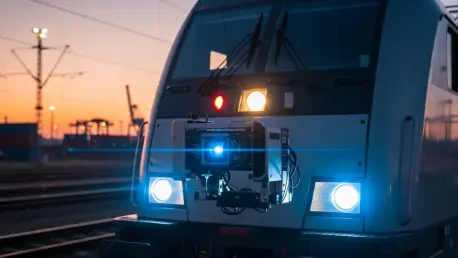
Central to this technological advancement is the implementation of multi-spectral electro-optic technology, which identifies obstacles by blending visual and non-visual light spectra. Traditional camera setups often struggle in the harsh environments of industrial railyards, where heavy rain, dense fog, or the lack of ambient lighting can obscure critical hazards. Rail Vision’s sensors overcome these limitations by utilizing thermal imaging and other advanced optics that provide extended-range situational awareness regardless of conditions. This capability allows the system to detect heat signatures from personnel or the metallic surfaces of obstacles that might be invisible to the naked eye. By providing a clear digital picture of the surroundings in 24/7 operations, these sensors ensure that the safety envelope remains intact during the most challenging shifts. This level of perception is foundational for true autonomy, as it provides the raw data necessary for AI to interpret the world with precision.
Interpreting the complex and chaotic environment of a busy railyard requires a system that can distinguish between relevant threats and benign background clutter. The multi-spectral sensors provide a high-resolution data stream that is processed locally, allowing for near-instantaneous hazard identification and distance calculation. This reliability is superior to legacy systems that often triggered false alarms or failed to recognize obscured objects in the path of a moving locomotive. By providing a safer foundation for industrial movement, this sensing suite enables operators to move cars with greater confidence in confined spaces. The ability to “see” through darkness means that productivity does not have to stall when conditions deteriorate, which is a major advantage for sites on tight schedules. Furthermore, the integration of these optics into the control system creates a closed-loop safety environment. This integration transforms the locomotive into a self-aware industrial asset.
Operational Scale: Strategic Integration
Machine Learning: Efficiency and Analytics
The true intelligence of these modern safety systems is driven by machine learning algorithms that classify obstacles in real-time while simultaneously utilizing cloud-based analytics to generate long-term insights. By training on vast datasets of railyard imagery, the AI can accurately distinguish between a piece of stationary equipment, a moving vehicle, and human personnel walking between tracks. This distinction is critical during the intricate process of coupling and uncoupling rail cars, where the proximity of workers to heavy machinery creates a high risk of injury. The technology ensures that responses are precise, only intervening when a genuine safety breach is imminent, thereby avoiding unnecessary disruptions to the workflow. As more data is gathered, the algorithms become increasingly refined, learning to navigate even the most unique site-specific challenges. This continuous learning cycle means that the safety system improves over time, adapting to the facility while maintaining protection.
Beyond immediate hazard detection, the data captured by these AI systems is uploaded to a centralized platform for analysis, helping companies optimize their overall performance. Managers can review historical safety data to identify “near-miss” hotspots within the yard, allowing them to redesign workflows or improve signage in areas where conflicts frequently occur. Furthermore, the system’s ability to monitor the mechanical behavior of the rail movers allows it to predict maintenance needs before a component failure leads to a costly derailment or operational shutdown. This proactive approach to asset management shifts the focus from reactive repairs to a strategy of predictive reliability, which is essential for maintaining the health of modern supply chains. By leveraging these actionable insights, industrial operators can reduce downtime and extend the lifespan of their locomotive fleet. The combination of real-time safety and diagnostic data creates a powerful tool for maximizing security and efficiency.
Global Safety: Corporate Synergy
Railserve’s extensive presence at more than 100 locations across North America provides an unparalleled platform for testing and standardizing these high-tech safety innovations. As a primary leader in rail switching and locomotive repair, the company offers the operational scale necessary to validate the commercial viability of autonomous technology in diverse industrial settings. This partnership ensures that Rail Vision’s safety solutions are not just concepts but are integrated into a vast industrial framework with the resources to support large-scale adoption. By deploying these systems across the wide network of the Marmon Rail Group, the collaborators aim to create networked safety environments that protect entire complexes. This broad implementation strategy is designed to reduce the risk of collisions on a systemic level, ultimately securing the reliability of the supply chains managed by Berkshire Hathaway. The synergy between a technology provider and an operator accelerates the transition to digital management.
The adoption of AI-driven safety protocols through this partnership established a new benchmark for industrial operations, proving that high-tech perception systems could be successfully integrated into busy railyards. Industry leaders recognized that semi-autonomy was the most effective method for reducing liability and enhancing worker protection in environments that had historically relied on manual observation. To sustain this progress, companies should have focused on comprehensive workforce training, ensuring that operators could effectively collaborate with these automated systems. Furthermore, establishing standardized data-sharing protocols across North American corridors was identified as a critical next step for fostering a cohesive safety ecosystem. The success of this multi-spectral implementation indicated that the future would likely involve full synchronization between networked locomotives and yard sensors. By prioritizing these technological solutions, industrial facilities ensured a more resilient and secure role within the global supply chain.