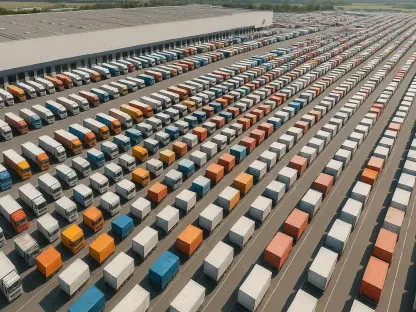

The rapid transformation of logistics from a secondary back-office function to a primary driver of competitive advantage is best exemplified by the seamless integration of digital ecosystems into physical distribution centers. Modern Warehouse Management Systems (WMS) have moved beyond simple record-keeping to become the operational heart of the supply chain. This technological shift enables retailers to manage inventory with surgical precision, responding to the volatility of consumer demand while maintaining the rigorous standards required for perishables.
The Evolution and Principles of Modern Warehouse Management
Modern WMS principles emphasize three core areas: real-time inventory accuracy, labor management, and the optimization of available cubic space. Moving away from legacy ledger-based tracking toward dynamic digital frameworks allows for a comprehensive view of stock movement across various regional hubs. This evolution has become essential in an environment where rapid delivery and high e-commerce volume are no longer luxuries but standard operational requirements for any competitive enterprise.
The transition to digital ecosystems has replaced manual guesswork with data-driven decision-making. By centralizing information, these systems provide a single source of truth that aligns procurement, storage, and fulfillment. This alignment is critical for scaling operations without a proportional increase in administrative overhead, allowing businesses to remain agile despite growing complexity in global trade patterns.
Technical Pillars of High-Performance Distribution
Lifecycle Tracking and Inventory Flow Control
Managing the journey of a product from receiving to shipping requires sophisticated automated protocols to maintain quality and prevent bottlenecks. Enforcing First-In, First-Out (FIFO) logic is not merely a preference but a necessity for ensuring inventory turnover and preventing the accumulation of expired stock. These protocols standardize how goods move through the facility, ensuring that every pallet is tracked with absolute transparency throughout its entire lifecycle.
Voice-Directed Picking and Hands-Free Operations
Voice-recognition technology has fundamentally changed the warehouse floor by removing the need for handheld scanners or paper lists. Modern solutions allow workers to receive verbal instructions, enabling a “hands-free” workflow that significantly boosts picking speed and accuracy. These “no-training” systems are particularly effective because they recognize diverse accents instantly, allowing a multi-lingual workforce to become productive within minutes of starting a shift.
Current Trends in Implementation and User Autonomy
A significant trend involves companies gaining implementation autonomy, where internal teams lead the software commissioning process. This shift reduces the long-term dependence on external vendors and allows businesses to cultivate deep in-house expertise. Furthermore, the push for localized distribution centers illustrates a commitment to sustainability, as shorter transport distances directly reduce carbon footprints while making the supply chain more resilient to regional disruptions.
Scalability is another hallmark of modern implementations, where modular software design allows for the rapid replication of successful logistics models. When a company masters a specific workflow at one site, the digital nature of the WMS enables them to deploy that same logic across other regional facilities. This consistency ensures that operational quality remains high, regardless of the geographic location of the distribution hub.
Industrial Application: Fresh Food and Cold Chain Logistics
Fresh food logistics presents a unique challenge, requiring facilities to operate under strict refrigeration standards between 2°C and 5°C. In such environments, integrated technology suites are vital for managing high-turnover products that supply hundreds of retail outlets daily. The ability to maintain a seamless cold chain through rapid digital coordination ensures that hygiene standards are met without sacrificing the speed needed for fulfillment.
The complexity of grocery logistics necessitates a system that can handle thousands of unique stock-keeping units with varying shelf lives. Integrated software ensures that the most time-sensitive items are prioritized during the picking process, reducing waste at the retail level. This level of control is what differentiates modern cold chain operations from traditional refrigerated storage.
Addressing Operational and Environmental Constraints
The hurdles of maintaining cold chain integrity during peak volumes are often mitigated by intuitive, multi-lingual interfaces that simplify complex tasks for workers. Operational success depends on the rapid onboarding of staff, which is achieved through software that minimizes the learning curve even in high-pressure environments. By optimizing logistics at the regional level, organizations can effectively reduce transport kilometers and manage the environmental constraints of modern commerce.
Environmental impact is also reduced through better space utilization within the warehouse itself. A WMS that optimizes put-away paths ensures that cooling energy is not wasted on poorly managed sections of the building. This synergy between software logic and physical resource management represents a crucial step toward achieving long-term sustainability goals in the logistics sector.
The Road Ahead for Digital Supply Chains
The road ahead involves the deep integration of WMS with fully automated robotics and predictive analytics. These tools will likely evolve from tracking current stock to anticipating future demand patterns, further streamlining regional sustainability efforts. As autonomous systems become more prevalent, the long-term impact on global retail efficiency will reshape labor dynamics and set new standards for operational agility across the industry.
Future developments will likely focus on hyper-local fulfillment, where WMS-driven micro-centers are embedded within urban environments. This will require even greater levels of automation and real-time data processing to manage the high frequency of small-batch deliveries. The integration of artificial intelligence will further refine these processes, allowing for self-optimizing warehouses that adapt to market shifts in real time.
Final Assessment of WMS Technology
The transition of WMS from a basic tracking tool to a strategic asset was clearly demonstrated by the efficiency gains achieved in recent logistics overhauls. Stakeholders recognized that future success would depend on shifting toward predictive modeling and deeper robotic integration to remain competitive in a volatile market. These developments proved that the path to a sustainable, high-speed retail network required a permanent commitment to continuous technological training and modular software design.