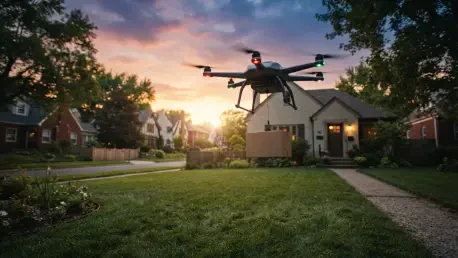

The once-silent airspace above the Massachusetts suburbs is rapidly transforming into a contested corridor where the convenience of lightning-fast shipping meets the traditional sanctity of residential life. As Amazon prepares to deploy its “Prime Air” fleet, the low-altitude environment has become the center of a legislative battle regarding how much of the sky should be surrendered to commercial interests. Sixteen bipartisan lawmakers have stepped forward to challenge the rapid rollout, calling for a statewide freeze on drone delivery approvals to ensure that public safety and privacy are not bypassed in the name of corporate efficiency.
This request to Governor Maura Healey represents a pivotal moment for state sovereignty in an era dominated by global tech expansion. The movement signals that Massachusetts leaders are no longer willing to let federal guidelines be the sole arbiter of what happens in local backyards. By demanding a pause, legislators are seeking the time necessary to construct a legal framework that addresses the unique challenges of the 2026-2030 digital landscape, where autonomous systems are becoming a daily reality for suburban families.
The Sky Above Westborough: Innovation or Intrusion?
The debate recently intensified as Amazon moved to launch its delivery service from a fulfillment center in Westborough, promising package arrivals within thirty minutes. While the tech giant highlights the reduction in road traffic and carbon emissions, many residents view the constant presence of humming rotors as a fundamental violation of their domestic peace. The prospect of 1,000 daily flights over a small geographic area has sparked fears that the quiet nature of residential neighborhoods will be permanently altered by industrial noise.
Bipartisan lawmakers argue that the rapid pace of this technological deployment has outstripped the ability of the public to adapt. They contend that the perceived benefits for a few consumers do not outweigh the collective loss of tranquility for the community at large. This tension between high-speed commerce and local quality of life is forcing a re-evaluation of how residential zones are protected from the encroachment of autonomous delivery fleets.
A Bipartisan Stand Against Unregulated Skies
The push for a statewide freeze is driven by a shared concern that current regulations are largely outdated for the complexities of 2026. State legislators are asserting their authority over the ground-based aspects of drone operations, such as takeoff and landing sites, to gain leverage where federal airspace laws remain rigid. This bipartisan coalition is not strictly anti-technology; rather, it is pro-oversight, arguing that the state must modernize its regulatory toolkit before allowing permanent changes to the skyline.
This movement highlights a significant national trend where state governments are reclaiming their role as protectors of local autonomy. By asserting control over the infrastructure that supports drone hubs, Massachusetts is attempting to set a precedent for how local jurisdictions can regulate the behavior of tech giants. The goal is to ensure that technological progress does not come at the expense of the legal protections that have traditionally governed land use and community standards.
The Core Conflicts of Commercial Drone Proliferation
The primary point of contention involves the persistent noise and environmental impact of high-frequency drone traffic. Unlike the occasional sound of a passing airplane, the high-pitched whine of delivery drones operating at low altitudes creates a constant auditory presence that many experts believe could affect mental health and property values. Furthermore, the density of these flight paths poses risks to local bird populations and disrupts the natural environment in ways that have not been fully studied.
Privacy and cybersecurity also remain at the forefront of the opposition’s argument. Drones equipped with high-resolution cameras and sophisticated sensors fly directly over private property, creating a potential for unauthorized data collection. Residents are increasingly wary of how this information is stored and used, prompting calls for strict state-level data protection laws that exceed current federal requirements.
Local Resistance and the Westborough Precedent
The town of Westborough has emerged as a leader in municipal resistance, utilizing local bylaws to create a defensive perimeter against unregulated expansion. During a recent Special Town Meeting, citizens voted overwhelmingly to establish 150-foot buffers between drone staging areas and public walkways. This move showcased how strategic zoning can be used to mitigate the physical footprint of autonomous systems, ensuring that industrial operations remain separated from pedestrian spaces.
Further legal hurdles remain as the Zoning Board of Appeals reviews whether Amazon’s operations fit within existing industrial permits. By forcing a more rigorous special permit process, local officials ensured that the corporation must provide transparent evidence regarding its impact on safety and noise pollution. This tactical use of local government authority has provided a roadmap for other Massachusetts towns looking to preserve their character in the face of rapid technological shifts.
A Framework for Regulating Autonomous Delivery Systems
The administration established a specialized task force that became the primary body for evaluating the integration of autonomous systems into the state’s infrastructure. This multidisciplinary group recommended a unified strategy that balanced the needs of the logistics industry with the fundamental rights of the citizenry. They prioritized the development of state-level safety protocols and mandated that any commercial permit be contingent upon a successful period of public engagement and transparent environmental impact assessments.
Specific zoning regulations were proposed to control the density of fulfillment centers, ensuring that flight paths were distributed in a way that prevented any single neighborhood from bearing the brunt of the noise. The state also implemented a comprehensive cybersecurity audit for all commercial drone operators to protect resident privacy. These proactive measures provided the necessary legal architecture to manage the transition toward automated logistics throughout 2026 and beyond, ensuring that innovation remained a benefit rather than a burden.