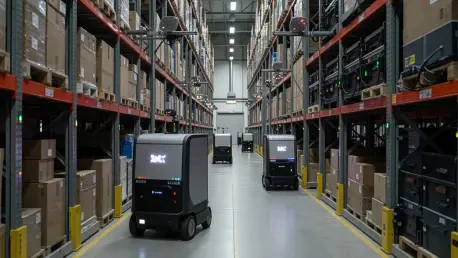

The transition from mechanical automation to truly intelligent, autonomous mobility represents a significant shift in how global logistics giants manage the relentless flow of consumer goods across vast distribution networks. Amazon has long utilized robotic assistance, but the emergence of Proteus marks a departure from static, caged automation toward a fluid, responsive environment. Unlike its predecessors that operated within restricted grid systems separated from human workers by tall fences, Proteus navigates the open floor alongside personnel. This robot was engineered specifically to lift and transport GoCarts, the heavy wheeled cages used to move packages through various stages of sorting. By utilizing proprietary computer vision and advanced machine learning, it identifies obstacles and adjusts its path in real time. This capability eliminates the need for segregated zones, allowing for a more flexible warehouse layout that can be reconfigured instantly to meet shifting demands. This technological leap serves as the foundation for a more integrated and scalable logistics infrastructure.
The Mechanics: Advanced Perception and Spatial Awareness
The sophisticated sensor suite integrated into Proteus allows it to perceive its surroundings with a level of granularity that was previously impossible for industrial mobile units. It employs a combination of light detection and ranging sensors alongside high-definition cameras to build a continuous three-dimensional map of its immediate environment. When a human worker steps into its projected path, the robot does not merely stop abruptly; it slows down, recalculates a safe bypass, and continues its mission without causing a bottleneck. This fluid movement is governed by an onboard artificial intelligence system that processes gigabytes of spatial data per second. Such responsiveness ensures that the high-speed nature of a fulfillment center is maintained even as the floor becomes more crowded with diverse activities. Furthermore, the green light emitted by the robot serves as a non-verbal communication tool, signaling its intended direction to nearby humans. This design philosophy prioritizes a seamless blend of machine efficiency and human safety, setting a new standard for industrial workplace dynamics.
Beyond simple obstacle avoidance, the AI backbone of these autonomous machines utilizes deep learning algorithms to predict the movement patterns of other robots and personnel. This predictive capability allows Proteus to optimize its route long before a conflict occurs, effectively reducing the energy consumption and wear on its mechanical components. The robot is also capable of self-charging, returning to dedicated docks when its power levels reach a certain threshold, which ensures that the fleet remains operational twenty-four hours a day. Because the system is cloud-connected, every individual unit benefits from the collective experience of the entire global fleet, receiving over-the-air updates that refine its navigation logic. This means that a solution discovered by a robot in a facility in Ohio is instantly available to a robot in California. Such a distributed intelligence network transforms a collection of individual machines into a cohesive, learning organism. This level of synchronization is essential for managing the sheer volume of parcels that move through the global supply chain every single minute.
Strategic Implementation: Scaling Productivity and Labor Synergy
Organizations must prioritize the development of robust data infrastructure to support the massive influx of information generated by autonomous fleets. This involves not only upgrading physical networking capabilities within fulfillment centers but also investing in advanced analytics tools to interpret robotic performance metrics. Furthermore, the human-centric aspect of this transformation cannot be overlooked; businesses should implement continuous education programs to prepare employees for collaborative roles with AI. This proactive approach ensures that the transition to automation is seen as an enhancement of worker capabilities rather than a replacement. By focusing on the synergy between machine precision and human intuition, companies can unlock new levels of operational agility. This strategy also necessitates a reimagining of warehouse architecture, moving away from rigid, fixed layouts toward modular designs that can be quickly adapted. Those who adopt these strategies early will find themselves better positioned to handle the increasing complexity and scale of modern consumer demands.
The initial implementation phases proved that the most effective way to integrate autonomous mobility was through a phased approach that balanced technical rollout with workforce adaptation. Decision-makers realized that success depended on more than just the hardware; it required a cultural shift within the organization to embrace a data-driven operational model. Looking toward future developments, the focus shifted to expanding the capabilities of these robots to include more dexterous tasks, such as individual item picking and packing. It was also determined that standardized communication protocols between different robotic systems would be essential to prevent interoperability issues as the fleet diversified. The lessons learned from the early adoption of Proteus provided the necessary evidence to justify larger capital investments in similar AI-driven technologies. Consequently, the industry moved toward a state where autonomous systems were integrated into every layer of the supply chain. These insights formed the basis for a more resilient and responsive logistics network capable of meeting the dynamic needs of the global marketplace.