
The global logistics network is a marvel of precision that can move a smartphone from a high-tech factory in Asia to a local distribution hub within days, yet it remains curiously defeated by the simple, uneven patch of grass leading to a suburban front door. This final stretch, often referred to as the “porch gap,” represents the remaining fifty feet between the delivery vehicle and the customer’s doorstep. While heavy machinery and automated sorting systems have streamlined the journey through shipping lanes and warehouses, this ultimate leg continues to rely on the agility and decision-making of human couriers. Boston Dynamics is now pivoting its most recognizable quadruped, Spot, to address this persistent inefficiency. By transitioning the robot from the structured, predictable environments of industrial facilities into the chaotic reality of residential neighborhoods, the company aims to redefine how goods arrive at their final destination. This shift signifies a major leap in robotics, moving beyond theoretical automation into a practical solution for the most expensive part of the supply chain.
Tackling the Physical and Financial Hurdles of Logistics
The Economic Impact: Why the Final Fifty Feet Matters
Last-mile delivery is widely recognized as a massive financial drain on the global logistics industry, accounting for more than half of all supply chain costs and totaling roughly $90 billion annually in the United States alone. Currently, this monumental burden falls almost entirely on human drivers who must navigate complex driveways, climb steep stairs, and carry heavy parcels to doorsteps thousands of times every single day. This heavy reliance on manual labor creates high operational expenses for companies because humans are inherently slower and more susceptible to fatigue than machines. Furthermore, the physical toll on the workforce leads to high turnover rates and rising insurance premiums, as couriers face constant risks of slips, trips, and repetitive strain injuries. By introducing a robotic element to this equation, logistics firms are seeking to mitigate these rising costs while simultaneously standardizing the speed and reliability of the final drop-off, ensuring that the last fifty feet no longer serves as a profit-killing bottleneck.
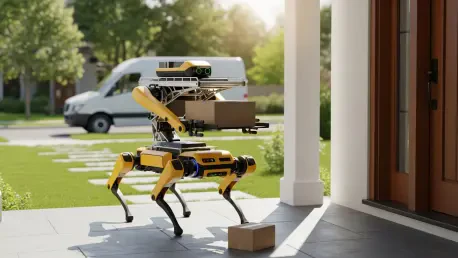
By integrating robotic assistance into the delivery loop, logistics firms aim to increase the volume of packages handled by a single van while simultaneously reducing driver fatigue throughout the workday. The proposed model creates a collaborative workflow where the robot manages the repetitive and physically demanding walk to the door while the driver focuses on the logistical oversight of the route and prepares the next set of deliveries. This partnership is specifically intended to maximize efficiency, allowing companies to add more stops to a single route without increasing the physical burden on their employees. Instead of a courier getting out of the truck at every house, the robot descends from the vehicle to execute the drop-off, allowing the vehicle to move closer to the next destination or stay idling in a safer position. This synergy not only speeds up the process but also transforms the role of the driver into a more technical and supervisory position, which could lead to better job retention and a more sustainable long-term business model.
Collaborative Workflow: Enhancing Human and Robot Synergy
The integration of quadruped robots into existing fleets requires a fundamental redesign of how delivery vehicles operate on a daily basis. Engineers have developed specialized docking systems that allow the robot to deploy and return to the van autonomously, ensuring that the human driver does not need to manage the machine’s physical positioning. This automation allows the courier to remain focused on sorting the next batch of parcels while the robot navigates the driveway, effectively doubling the speed at which a single stop can be completed. As the logistics industry looks toward 2027 and 2028, these collaborative systems are expected to become standard equipment for high-volume delivery providers. By shifting the most taxing physical labor to the robot, companies can hire from a broader labor pool, including individuals who might not have the physical stamina for traditional heavy lifting. This approach not only solves the immediate logistical bottleneck but also addresses the chronic labor shortages that have plagued the delivery sector for years.
Furthermore, the data collected by these robots during their daily rounds provides invaluable insights into route optimization and property accessibility. Every trip the robot takes across a lawn or up a set of stairs is recorded and analyzed to refine future delivery paths, making the entire network smarter over time. This continuous feedback loop allows the logistics company to identify problematic addresses where robotic delivery might be hindered, enabling them to preemptively offer alternative drop-off solutions to the customer. Over time, the reliance on human intervention for the physical drop-off will decrease as the robots become more familiar with the specific topography of each neighborhood. This transition represents a shift from reactive delivery management to a proactive, data-driven approach where the robot serves as both a tool for labor and a sensor for environmental intelligence. The end result is a highly resilient delivery network that can maintain peak performance regardless of the physical complexity of the residential environment.
Achieving Human Parity Through Advanced Robotics
Superior Mobility: Navigating the Unstructured World
While previous automation attempts in the logistics sector relied heavily on aerial drones or small wheeled robots, these platforms often fail in suburban settings where curbs, gravel paths, and porch stairs are common obstacles. Spot’s legged design offers a unique and decisive advantage by achieving “human parity” in mobility, allowing it to navigate the same unstructured and often treacherous terrain that a person encounters daily. This superior agility ensures the robot can reach the exact drop-off point intended for a package, succeeding where wheeled alternatives often get stuck or are turned away by a simple single-step entrance. The ability to dynamically adjust its gait and center of gravity allows the quadruped to maintain stability on wet grass or icy walkways, environments that typically render traditional automation useless. By mimicking the biological movement of four-legged animals, Boston Dynamics has created a machine that does not require the world to be paved or flattened before it can function effectively.
Beyond simple movement, the robot must handle goods with extreme care to maintain service standards and preserve customer trust during every interaction. Boston Dynamics has engineered a specialized conveyor payload that sits atop the robot, using a sophisticated array of sensors and a precision moving tray to ensure a “soft delivery” for every item. This mechanical solution prevents the jarring movements that might occur if a robot were to simply drop a box or tip it over. Extensive testing of this mechanism with delicate cargo, including cartons of eggs, has proven that the robot can deliver fragile goods just as safely as a trained human courier, respecting both the integrity of the package and the customer’s personal property. This level of finesse is critical for the widespread adoption of robotic delivery, as consumers are unlikely to accept automation if it results in damaged merchandise. The combination of rugged exterior mobility and delicate internal handling allows the system to bridge the gap between industrial strength and consumer gentleness.
Social Intelligence: Mapping the Future of Public Delivery
Moving from fenced-off factories into public neighborhoods requires the robot to interact safely and intelligently with pedestrians, pets, and children who may be sharing the sidewalk. To manage this social complexity, the robot utilizes a “save and repeat” methodology where it first maps a specific delivery route under the manual guidance of a driver during an initial visit to a property. Once the path to a particular address is saved in the system, the robot can execute future deliveries to that location with high-level autonomy, navigating around temporary obstacles like parked bicycles, forgotten toys, or trash bins. This approach balances the need for high-speed operation with the necessity of safety, as the robot is not wandering blindly but following a verified digital path. Furthermore, the onboard vision systems are designed to detect movement in its periphery, allowing the robot to pause or move aside when it encounters a living being, thereby minimizing the risk of accidents and fostering a sense of security for the residents.
Industry leaders emphasized that the successful integration of legged robots required more than just technical prowess; it demanded a shift in public perception. During the initial rollout, companies observed that transparency regarding data collection and robot intent was paramount for community acceptance. They also discovered that the use of specialized conveyor payloads significantly reduced the frequency of package damage compared to traditional manual handling methods. Strategic investments in remote monitoring centers proved to be a cost-effective safety net, allowing a small team of technicians to oversee dozens of autonomous units simultaneously. Looking ahead, the focus shifted toward establishing nationwide standards for sidewalk-based autonomous vehicles to ensure consistent operation across different municipalities. These coordinated efforts eventually allowed the logistics sector to overcome the financial hurdles of the porch gap. By the end of the trial, it was clear that the future of delivery would depend on a seamless blend of robotic agility and human-led management.