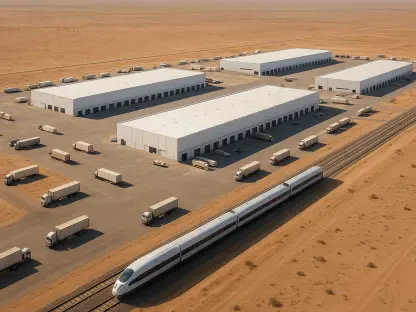

The global logistics industry is currently witnessing a seismic shift as China moves away from its traditional reliance on coastal passenger airports toward a more resilient and dedicated airfreight network centered in the heart of the country. For decades, the “Big Three” hubs in Shanghai, Guangzhou, and Shenzhen served as the primary conduits for international trade, but their inherent design limitations have become increasingly apparent as the volume of high-speed commerce continues to climb. The emergence of Ezhou Huahu International Airport represents a strategic departure from these passenger-centric models, offering a specialized alternative that prioritizes the movement of goods over people. This transition is not merely a response to capacity constraints; it is a fundamental reimagining of how a global manufacturing powerhouse should structure its supply chains to maintain agility. By establishing a central hub that bypasses the friction of coastal passenger terminals, China is creating a new blueprint for aviation logistics.
Structural Constraints: The Shift From Coastal Dominance
Historically, the reliance on Shanghai Pudong, Guangzhou Baiyun, and Shenzhen Bao’an created a structural bias that favored passenger travel over freight efficiency. These coastal facilities were originally conceived to handle massive volumes of travelers, with cargo often treated as a secondary byproduct relegated to the belly space of commercial airliners. While this model worked during the early stages of industrialization, it became a significant liability as the economy transitioned toward high-value, time-sensitive exports like semiconductors and specialized electronics. The erratic nature of passenger flight schedules often meant that critical shipments were delayed or offloaded during peak travel seasons, leading to unpredictable supply chains for international partners. Furthermore, the physical layouts of these older airports frequently forced freight operators to navigate complex and congested traffic patterns that prioritized airport terminal access for buses over the streamlined flow of trucks.
The explosive growth of cross-border e-commerce further exacerbated these bottlenecks, pushing coastal infrastructure far beyond its intended operational capacity. As consumers globally demanded faster delivery times, the traditional integrated hubs struggled to process millions of individual small parcels with the necessary speed. This congestion often resulted in significant price volatility for airfreight rates, as shippers competed for limited space during periods of high demand. Recent adjustments in global trade patterns have also highlighted the vulnerability of concentrating so much logistics power in a few coastal cities, which are susceptible to regional disruptions and rising operational costs. Consequently, the industry reached a consensus that a more diversified geographic approach was necessary to ensure long-term stability. By developing dedicated cargo hubs, the logistics sector sought to decouple its primary export engine from the fluctuations of the passenger travel market.
Technical Excellence: The Purpose-Built Cargo Infrastructure
Ezhou Huahu International Airport distinguishes itself as a purpose-built facility where every technical specification is tailored to maximize the throughput of dedicated cargo aircraft. Unlike traditional hubs that must balance the needs of thousands of travelers with freight operations, Ezhou focuses entirely on the rapid movement of pallets and containers. The implementation of a massive, automated sorting center allows the airport to handle up to 2.4 million tons of cargo annually with minimal human intervention. This automation is powered by sophisticated AI-driven software that optimizes the flow of goods from the moment a plane lands until the final truck departs the facility. By reducing the time required for ground handling, the airport provides a competitive edge to express delivery companies that operate on razor-thin margins and strict delivery windows. This specialized design ensures that even during peak seasons, the facility can maintain consistency that was previously impossible.
Beyond pure speed, the airport incorporates highly specialized infrastructure designed for the sensitive requirements of the pharmaceutical and high-tech sectors. State-of-the-art cold-chain facilities offer precise temperature control for life-saving medicines and perishable biological components, ensuring that the cold chain remains unbroken throughout the transit process. Additionally, the airport features secure, climate-controlled environments for high-value electronics and precision machinery, which are increasingly manufactured in the surrounding Hubei Province. These facilities allow for the safe handling of lithium batteries and other hazardous materials that often face strict regulations and limited space on passenger aircraft. By providing a secure and specialized environment, Ezhou has become a preferred gateway for companies that require more than just transportation. The ability to offer tailored logistics solutions for complex products makes the airport a critical asset in the global supply chain.
Strategic Outcomes: Regional Integration and Global Resilience
The strategic placement of this new hub in Central China addresses a significant geographic imbalance that has historically hindered the growth of the country’s interior regions. As manufacturing costs in coastal provinces like Guangdong and Jiangsu continued to rise, many high-tech firms moved their production lines inland to take advantage of lower overhead and a large, skilled labor pool. However, these companies previously faced a logistical nightmare, as their products had to be trucked for days to reach coastal seaports or airports for international export. This extra leg added substantial costs and increased the risk of damage or delays during transit. Ezhou serves as a primary gateway for these inland clusters, effectively bringing the global market to their doorstep. By significantly shortening the distance between production and export, the airport has transformed Central China into a highly competitive region for international trade, attracting new investments.
The successful integration of Ezhou’s cargo-centric model demonstrated that dedicated infrastructure was the most effective solution for decoupling freight from passenger volatility. Organizations that prioritized these inland hubs in their logistics planning achieved significantly lower lead times compared to those that relied solely on traditional coastal gateways. This strategic pivot not only optimized the movement of high-tech goods but also reinforced the stability of the entire national supply chain during periods of high demand. By moving away from general-purpose airports, the industry established a more specialized and reliable framework that better served the needs of global trade. The adoption of advanced automated sorting and specialized climate-controlled facilities proved to be a catalyst for economic growth throughout the interior regions. Ultimately, the transition to specialized airfreight hubs like Ezhou provided a new standard for efficiency and resilience, ensuring that the network remained robust.