
The global shipping industry has witnessed a profound metamorphosis where container gantry cranes are no longer viewed as mere mechanical workhorses but as the central intelligence of the maritime ecosystem. This transformation represents a fundamental shift toward an environment where automation, artificial intelligence, and environmental sustainability converge to create integrated systems. Historically, these massive steel structures were designed for the singular purpose of moving cargo, yet the current landscape has redefined them as connected nodes within a broader management framework. The primary driver behind this rapid adoption is the intensifying pressure on global hubs to manage unprecedented cargo volumes with higher precision and lower overhead. Traditional manual operations are increasingly relegated to the past, as they are now viewed as bottlenecks prone to human error and fatigue. Major shipping hubs in Asia, Europe, and North America now treat automation as a baseline requirement for market survival.
Advancing Operational Precision: The Impact of Intelligent Algorithms
Perhaps the most critical advancement in this current era of maritime logistics is the implementation of AI-powered anti-sway control systems across major shipping terminals. In the years leading up to today, the speed of a crane was significantly limited by the pendulum effect, which is the natural swinging of a container as it moves through the air. Stabilizing this load once required years of operator experience and a considerable amount of time, often slowing down the entire supply chain. Today, intelligent algorithms perform this task autonomously by detecting micro-movements and applying real-time corrective adjustments to the hoist and trolley. This capability has led to a consistent twenty percent reduction in cycle times across automated terminals while significantly mitigating the risk of collisions that could damage expensive cargo or port infrastructure. These systems allow for a level of precision that was previously unattainable, ensuring that safety and speed coexist.
Maintenance strategies have also undergone a radical transition, moving from a reactive model to a proactive, data-driven strategy facilitated by the Internet of Things. Modern cranes are now outfitted with comprehensive multi-point sensor arrays that monitor everything from hydraulic pressure and wire rope tension to structural vibrations in real time. This continuous stream of data allows port authorities to identify potential failures weeks before they actually manifest, preventing the sudden breakdowns that once plagued the industry. Industry reports indicate that this predictive maintenance capability has successfully reduced unplanned downtime by as much as thirty percent. For large-scale facilities, where even a single hour of inactivity can result in hundreds of thousands of dollars in lost revenue, this reliability is indispensable. By leveraging this granular data, operators have shifted their focus from fixing broken parts to optimizing the lifecycle of their assets.
Optimization of Terminal Throughput: Sustainability Meets Scalability
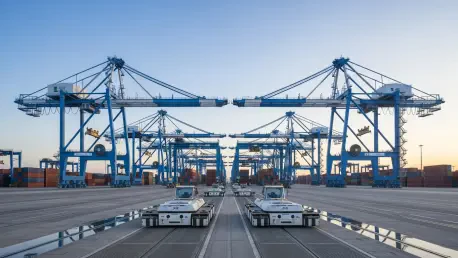
The current terminal model relies heavily on the seamless interaction between Rail-Mounted Gantry cranes, Rubber-Tired Gantry cranes, and Automated Guided Vehicles. This smart terminal concept ensures a fluid movement of containers from the vessel to the yard stack and finally to the truck gate with minimal interruption. By minimizing human touch points and optimizing the path of each container through algorithmic routing, terminals have realized throughput increases ranging from twenty-five to thirty-five percent. This efficiency effectively expands the capacity of existing port footprints without the need for the expensive and environmentally taxing process of physical land expansion. Furthermore, the integration of these machines into a unified software layer allows for real-time adjustments to changing yard conditions. When a vessel arrives ahead of schedule, the system automatically re-prioritizes crane tasks to maintain a steady flow of goods without manual intervention.
Environmental mandates have also become a dominant force in shaping modern port equipment, with regulatory frameworks now demanding a drastic reduction in carbon footprints. This shift has led to the overwhelming dominance of electric and hybrid container gantry cranes over traditional diesel-powered models that once defined the industry. A standout feature in the current fleet is regenerative braking technology, which captures energy during the container-lowering process and feeds it back into the terminal power grid for immediate reuse. Ports that have committed to this electric transition report energy cost savings ranging between thirty and forty percent, aligning environmental responsibility directly with the bottom line. Beyond the financial benefits, the reduction in noise pollution and local emissions has improved the relationship between major ports and the urban communities that surround them. Sustainability is no longer a corporate talking point but a core operational metric that determines the long-term viability of a terminal.
Strategic Deployment Models: Redefining Infrastructure and Labor
A key theme in modern port planning involves the strategic selection of crane configurations based on the specific operational needs of each individual terminal. Rubber-Tired Gantry cranes are currently favored for their operational flexibility, as they can be easily repositioned across different sections of a yard to handle fluctuating container flows or seasonal surges. In contrast, Rail-Mounted Gantry cranes have become the gold standard for high-density, high-throughput terminals, offering superior precision for massive, fixed stacking operations where space is at a premium. Manufacturers now offer highly customizable versions of both crane types, featuring lifting capacities up to sixty-five tonnes and full integration with modern Terminal Operating Systems. This level of customization allows port operators to tailor their infrastructure to the unique demands of their regional trade routes. The choice between mobility and density is no longer a compromise but a tactical decision supported by data.
The transition to these highly automated operations has not led to the mass displacement of workers but rather a significant and necessary evolution of their roles. The physical demands of manual crane operation, often performed in cramped cabs high above the ground, have been replaced by the cognitive demands of system management. Employees are now required to possess high levels of digital literacy to navigate the complex software interfaces that govern port activities. These professionals serve as supervisors of automated fleets, handling complex exceptions and edge cases that the AI cannot resolve on its own. Furthermore, the industry has widely adopted Digital Twin technology, allowing engineers to simulate and optimize port operations in a virtual environment before implementing changes in the physical world. This shift has transformed the port into a high-tech workplace, attracting a new generation of talent interested in the intersection of robotics, data science, and global trade.
Mastering Integrated Systems: The Path Toward Resilient Supply Chains
The transformation of maritime logistics reached a pivotal point where the integration of automated hardware and predictive software became the standard for global trade. Logistics providers moved toward a landscape where every movement within a terminal was accounted for by a digital oversight system, ensuring that the volatility of previous years was mitigated through data. Port authorities recognized that the investment in automation was not merely an equipment upgrade but a fundamental restructuring of how goods reached the consumer. The success of these initiatives was measured by the stability they provided to the global economy, as terminals became more resilient to labor shortages and sudden shifts in demand. Organizations that prioritized early adoption found themselves at the forefront of a new era, while those that hesitated were forced to reconcile with the inefficiencies of outdated models. Moving forward, the industry prepared for further refinements in autonomous technology to ensure that the maritime sector remained the backbone of international commerce.