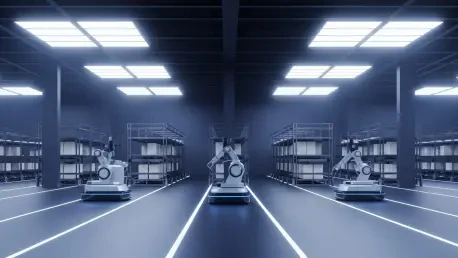

The rapid decentralization of global production networks has forced a fundamental rethink of how materials move through a facility, marking a definitive shift from static machinery to fluid, autonomous systems. As manufacturing and logistics hubs strive for greater agility, the limitations of traditional fixed-path automation have become increasingly apparent, paving the way for the rise of Autonomous Mobile Robots (AMRs). These intelligent machines represent a departure from the predictable, track-bound movements of their predecessors, offering a level of spatial awareness and decision-making capability that was once confined to the realm of science fiction. The current industrial climate, characterized by a persistent need for speed and accuracy, has placed AMRs at the center of the automation conversation.
The transition from rigid Automated Guided Vehicles (AGVs) to flexible AMRs is a cornerstone of the modern industrial revolution. While AGVs provided a reliable way to transport goods, they remained tethered to magnetic strips or wires embedded in facility floors, making them vulnerable to environmental changes. In contrast, AMRs function as independent entities, capable of navigating dynamic workspaces without physical guides. This flexibility allows facilities to reconfigure their layouts overnight without the prohibitive costs of tearing up concrete or reinstalling tracks. This adaptability is exactly what distinguishes a modern smart factory from a traditional manufacturing plant, allowing the Industry 4.0 ecosystem to flourish through interconnected, responsive systems.
High-volume manufacturing, healthcare logistics, and retail fulfillment remain the primary drivers of this autonomous wave. In a hospital setting, AMRs are tasked with the delicate transport of medications and waste, while in retail, they handle the complex orchestration of micro-fulfillment centers. The technological foundation of these machines rests on Simultaneous Localization and Mapping (SLAM) and LiDAR technology. By using laser pulses and sophisticated algorithms, AMRs create a real-time digital map of their surroundings, allowing them to detect a misplaced pallet or a moving worker and calculate an alternative route in milliseconds. Key market players are now focused on refining this non-linear material handling, ensuring that the movement of goods is no longer a bottleneck but a competitive advantage.
Analyzing Market Forces and Technological Evolution
Key Drivers Accelerating AMR Adoption and Integration
The exponential growth of e-commerce has fundamentally altered the DNA of the modern warehouse, shifting the operational focus from bulk shipping to individual piece-picking. This transition requires a level of granularity and speed that human labor alone cannot sustain, particularly as consumer expectations for same-day delivery become the standard. AMRs have emerged as the primary solution to this challenge, enabling facilities to automate the most time-consuming aspect of fulfillment: travel time. By bringing items directly to workers at picking stations, these robots eliminate miles of walking, significantly increasing the throughput of existing facilities without requiring an expansion of the physical footprint.
Addressing global labor shortages has moved from a secondary benefit to a primary strategic driver for robotic integration. Industries are struggling to fill repetitive, high-risk manual positions that often lead to high turnover and workplace injuries. AMRs take over these burdensome tasks, allowing companies to reallocate their existing human talent to more complex, value-added roles. Furthermore, the rise of Robotics-as-a-Service (RaaS) has revolutionized the financial landscape for automation. By allowing small and medium-sized enterprises (SMEs) to lease robotic fleets rather than committing to massive upfront capital investments, RaaS has democratized access to high-end technology, ensuring that even smaller players can compete in a highly automated global market.
Technological advancements in mobile manipulation are pushing the boundaries of what these robots can achieve on the shop floor. The integration of collaborative robotic arms with mobile bases creates a hybrid system capable of not just moving items, but also interacting with them. These mobile manipulators can pick parts from a bin, transport them to a workstation, and perform light assembly or inspection tasks. This move toward end-to-end automation reduces the need for human intervention at multiple points in the production cycle, creating a more seamless flow of materials and information. This evolution signifies a shift from robots that simply carry to robots that actually work.
Market Growth Projections and Long-Term Performance Indicators
The economic outlook for the autonomous mobile robotics sector remains exceptionally strong, with projections suggesting the global market will reach a valuation of approximately $7 billion by 2032. This growth trajectory is supported by a compound annual growth rate (CAGR) of 14.4%, reflecting a steady and significant increase in adoption across international borders. From 2026 to 2032, the industry is expected to witness a rapid acceleration in deployment as the technology matures and the cost per unit continues to decrease. Industrial investment is no longer concentrated solely in pilot programs; rather, organizations are now moving toward fleet-wide implementations that encompass entire supply chains.
Measuring the return on investment (ROI) for these systems has become more sophisticated, moving beyond simple labor cost calculations to include a broader range of performance metrics. One of the most significant indicators is the realization of 24/7 uptime, as AMRs do not require breaks and can return to charging stations autonomously. This constant productivity ensures that manufacturing lines never wait for materials, drastically reducing idle time. Moreover, the reduction in workplace accidents associated with heavy forklift traffic has led to lower insurance premiums and fewer disruptions, further enhancing the financial viability of the technology.
Increased throughput and inventory accuracy serve as the final metrics in evaluating AMR performance. By integrating these robots with facility management software, organizations can maintain a real-time view of inventory movement, reducing errors and shrinkage. The ability of AMRs to collect data as they move through a facility transforms them into mobile sensors that provide insights into workflow bottlenecks. Consequently, the performance of an AMR fleet is measured not just by the weight it carries, but by the data it generates and the operational clarity it provides to the broader enterprise.
Navigating the Operational Hurdles and Technical Barriers
Interoperability remains one of the most significant challenges for organizations attempting to scale their robotic operations. As facilities adopt robots from multiple vendors to perform different tasks—such as floor scrubbing, heavy lifting, and light picking—the lack of a unified communication protocol can lead to traffic jams and data silos. Synchronizing an AMR fleet with legacy Warehouse Management Systems (WMS) or Manufacturing Execution Systems (MES) requires a level of software integration that often exceeds the internal capabilities of many firms. Overcoming this barrier involves the development of middle-ware solutions that can orchestrate diverse robotic assets under a single operational umbrella.
The physical and digital infrastructure of a facility must often be upgraded to support a high-performing AMR fleet. While AMRs are more flexible than AGVs, they still require a robust 5G connectivity layer to handle the massive amounts of data generated for real-time navigation and fleet coordination. Low-latency communication is essential for preventing collisions and ensuring that task assignments are updated instantly. Furthermore, specialized floor conditions, such as specific floor flatness and cleanliness, can impact the accuracy of the robot sensors and the longevity of its mechanical components. Organizations often find that the initial phase of deployment involves more facility preparation than originally anticipated.
Managing the transition from small-scale pilot programs to full-fleet deployment is a complex logistical task that often reveals unforeseen scaling issues. The capital intensity of a full-scale rollout, combined with the need for specialized maintenance staff, can strain an organization’s resources. Moreover, the “Human Element” presents a cultural challenge that must be managed with care. Employees may harbor concerns about job security, leading to resistance or a lack of engagement with the new technology. Successful companies have found that prioritizing employee upskilling and involving the workforce in the integration process helps to mitigate these fears and creates a more collaborative environment where humans and robots work in tandem.
The Regulatory Framework and Security Standards for Mobile Autonomy
Navigating the landscape of international safety standards is a critical requirement for any organization deploying AMRs in shared workspaces. Standards such as ISO 3691-4 provide the framework for ensuring that autonomous vehicles can operate safely alongside human workers without the need for physical barriers. These regulations dictate everything from the necessary sensor redundancy to the maximum allowable speeds in pedestrian zones. Compliance is not merely a legal requirement; it is a prerequisite for fostering trust between the workforce and the automated systems. As AMRs become more prevalent, these standards are evolving to address increasingly complex scenarios, such as the interaction between robots and manually operated machinery.
Cybersecurity has emerged as a top priority for industrial automation, as every connected robot represents a potential entry point for data breaches or remote hijacking. Protecting the network of robotic nodes requires a multi-layered security strategy that includes encrypted communication, regular software updates, and rigorous access controls. A single compromised robot could theoretically disrupt an entire production line or leak sensitive operational data, making the security of the fleet an enterprise-level concern. As AMRs collect more detailed environmental data, the need to protect this information from external threats becomes even more pressing for maintaining competitive advantage and operational integrity.
The intersection of emerging industrial data privacy laws and environmental regulations is also shaping the development of AMR technology. In many jurisdictions, the data collected by a robot cameras and sensors may fall under strict privacy protections, necessitating localized data processing or anonymization protocols. Additionally, as companies strive for sustainability, the energy efficiency of robotic fleets and the recyclability of their components are becoming key selection criteria. Standardizing communication protocols to allow multi-vendor orchestration is a collaborative effort currently underway among industry leaders, aimed at creating a more open and secure ecosystem for all participants.
Looking Ahead: The Next Frontier of Autonomous Industrial Ecosystems
The evolution of Edge AI is fundamentally changing how AMRs process information, shifting decision-making power from centralized servers directly to the machine itself. By performing complex calculations locally, robots can react to environmental changes with split-second precision, which is vital for operating in high-speed, unpredictable settings. This localized intelligence reduces the burden on the facility Wi-Fi network and allows the robot to continue functioning even if connectivity is temporarily lost. As onboard processing power increases, the distinction between “smart” robots and truly autonomous agents will continue to blur, leading to a generation of machines that require almost zero human oversight.
Digital Twins are becoming an indispensable tool for optimizing robotic workflows before a single machine is ever deployed on the physical floor. By creating a high-fidelity virtual replica of the facility, managers can simulate thousands of different scenarios to identify potential bottlenecks and test the efficiency of various fleet configurations. This predictive modeling reduces the risk associated with large-scale automation projects and allows for continuous optimization throughout the life cycle of the fleet. The ability to visualize the impact of a change in real-time within a digital environment ensures that physical implementations are as streamlined as possible, saving both time and financial resources.
The concept of hyper-automation positions AMRs as the connective tissue for self-optimizing supply chains. In this vision of the future, robots do more than move goods; they act as mobile IoT sensors that constantly gather and analyze data on facility conditions, machine health, and inventory levels. This information is fed into AI-driven management systems that can predict maintenance needs before a failure occurs or adjust warehouse layouts dynamically based on incoming order patterns. The result is a highly resilient, autonomous ecosystem that can adapt to global market shifts with minimal human intervention, creating a level of operational flexibility that was previously unattainable.
Strategic Perspectives on the Future of Robotic Integration
The transition from isolated automated tasks to fully integrated autonomous environments signaled a profound shift in the industrial landscape. Stakeholders realized that the true value of mobile robotics lay not just in the replacement of manual labor, but in the creation of a more responsive and data-driven operational model. Early adopters discovered that the most successful implementations were those that focused on the long-term scalability of the software platform rather than the immediate hardware costs. By prioritizing interoperability and flexible infrastructure, these organizations prepared themselves for a future where robotic assets would be as common and as critical as the factory floor itself.
The economic impact of this shift moved beyond the factory walls, effectively decoupling business scalability from the local availability of labor. This allowed companies to maintain high production levels even in regions facing significant demographic shifts and aging workforces. The investment timing proved to be a critical factor; those who waited for the technology to reach absolute perfection often found themselves trailing behind competitors who had already integrated autonomy into their core business strategies. Strategic technology selection focused on systems that offered a clear path toward hyper-automation, ensuring that today’s investments would remain relevant in the rapidly evolving landscape of 2026 and beyond.
The outlook for a resilient global supply chain depended heavily on the continued advancement of intelligent mobility. Stakeholders were encouraged to view AMRs as part of a holistic digital transformation rather than a standalone purchase. By fostering a culture of continuous learning and technical upskilling, organizations ensured that their human workers were capable of managing and optimizing the autonomous systems. Ultimately, the successful integration of AMRs proved that the future of industry did not belong to machines alone, but to the seamless collaboration between human ingenuity and robotic precision within a fully connected and intelligent ecosystem.