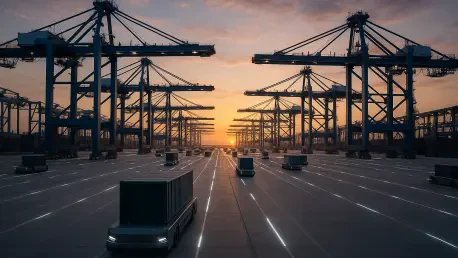

The global maritime landscape in 2026 presents a striking contradiction where the most advanced automated container terminals remain a statistical minority despite their overwhelming influence on international trade volumes. These high-tech facilities, though few in number, act as the central nervous system of global logistics, utilizing sophisticated driverless technology and remote-controlled machinery to dictate the pace of modern commerce. While traditional manual ports still handle a significant portion of local regional traffic, the critical arterial flows of the world’s largest economies are now almost exclusively managed by these silicon-driven behemoths. This shift toward automation has not been a universal wave but rather a surgical concentration within the industry’s most vital hubs, establishing a new global benchmark for reliability and throughput that was previously thought unattainable without massive human intervention. The transition has redefined the role of land use in maritime shipping, prioritizing density and precision over expansion.
Geographic Leadership and Regional Dominance
Regional leaders have realized that the geography of automation is not evenly distributed across the globe but is instead clustered in specific corridors of high-value trade. This geographic leadership is defined by a commitment to heavy infrastructure spending and a regulatory environment that favors technological disruption over historical labor models. As the competition between major transshipment hubs intensifies, the ability to offer automated services has become the primary differentiator for ports seeking to attract the latest generation of ultra-large container vessels.
Moreover, the dominance of these terminals is reflected in how they have reorganized regional logistics networks to favor centralized automated processing. This concentration of power in a few key locations has forced neighboring manual ports to adapt their own schedules to match the rapid pace of the automated giants. The result is a tiered global system where high-capacity hubs serve as the primary entry points for global goods, while smaller ports focus on feeder services and specialized cargo.
The Strategic Concentration: Capacity Over Quantity
The scale of automation is best understood by looking at capacity rather than just the number of facilities. As of 2026, the 76 operational automated terminals worldwide account for nearly 15 percent of total terminal area, despite making up only 3 percent of the global count. This concentration suggests that automation is almost exclusively used in massive transshipment hubs that handle primary trade routes between the world’s largest economies. For shippers operating on these major lanes, automated systems are now the expectation rather than the exception.
This densification of capacity allows terminal operators to maximize the utility of every acre of expensive waterfront property. By utilizing automated stacking cranes that can pack containers more tightly than human-operated reach stackers, these facilities have significantly increased their TEU-per-hectare metrics. This efficiency is critical in land-constrained environments where physical expansion is either impossible or prohibitively expensive. Consequently, the world’s most valuable real estate in the shipping sector is now almost entirely under the control of automated management software.
Asian Leadership: The Influence of China
Asia remains the dominant force in the drive toward port automation, containing approximately one-third of the world’s automated facilities. China is the primary engine of this growth, with dozens of facilities utilizing 5G connectivity and autonomous trucking to streamline operations. While international inventories and national reports often differ on the exact number of smart terminals, the impact of Chinese facilities like Shanghai’s Yangshan Phase IV is undeniable. These sites have set the bar for high-volume, fully automated operations.
Furthermore, the Chinese model of port development integrates automation with a broader national strategy of digital infrastructure. By embedding 5G networks and edge computing directly into the port’s physical layout, these facilities can coordinate thousands of moving parts in real time. This level of technological saturation ensures that the ports are not just automated islands but integrated nodes in a larger, data-driven supply chain. This approach has allowed China to maintain its status as the world’s manufacturing hub by ensuring that its export gateways never become bottlenecks.
Singapore’s Strategic Benchmark: The Rise of Tuas
Singapore’s Tuas Port serves as a definitive global benchmark for automated ambition in 2026. The project’s first phase alone features over 20 deep-water berths designed to handle 20 million containers annually, utilizing hundreds of automated gantry cranes to improve productivity. Once fully completed, the facility is projected to manage 65 million containers, making it the largest automated port in the world. This massive scale allows for a significant improvement in berth performance, demonstrating the potential of robotics to transform global transshipment.
The facility’s reliance on automated guided vehicles to transport containers between the quay and the yard has eliminated the variability associated with human drivers. By standardizing the speed and path of every move, Tuas Port can predict its daily throughput with nearly 100 percent accuracy. This predictability is passed on to shipping lines, which can now optimize their fuel consumption by timing their arrivals to the exact minute their berth becomes available. This synergy between port robotics and vessel navigation is the new gold standard for global maritime efficiency.
European Models: Integration and Efficiency
In Europe, the Netherlands continues to lead the region through high-performance hubs like Rotterdam’s Maasvlakte II and Rotterdam World Gateway. These facilities serve as essential models for Western automation, focusing on the seamless link between stacking yards and horizontal transport systems. By prioritizing the integration of quay cranes and automated yards, these terminals have achieved peak performance levels that far exceed traditional manual operations. They provide a vital, high-speed connection between international shipping lanes and the European hinterland.
Moreover, these European hubs have pioneered the use of automated systems to meet stringent environmental regulations. By electrifying their entire fleet of cranes and transport vehicles, Rotterdam’s automated terminals have virtually eliminated local carbon emissions from their yard operations. This dual focus on efficiency and sustainability has made them the preferred choice for eco-conscious shippers and retailers. The success of the Dutch model proves that automation is not just a tool for volume, but also a necessary component of the industry’s transition to a green economy.
Technical Standards and Performance Reliability
The maturation of port technology has led to a standardized classification system that helps industry stakeholders evaluate the capabilities of different facilities. This technical evolution has moved beyond simple experimentation and into a phase of robust, enterprise-grade reliability. Operators are no longer asking if the technology works, but rather how deeply it can be integrated into their existing legacy systems. This shift has created a clear hierarchy of terminals based on their level of machine autonomy and software sophistication.
Standardization has also extended to the data protocols used by these machines to communicate with one another. In 2026, the interoperability between different brands of cranes and carrier systems has improved, reducing the “vendor lock-in” that previously slowed down the adoption of automation. This open-architecture approach allows terminal operators to mix and match the best hardware from different global suppliers, provided they adhere to the established technical standards for safety and communication.
Classifying the Tiers: Levels of Integration
To navigate the modern landscape, one must distinguish between the three primary levels of automation used in 2026. Semi-automated terminals represent the majority, typically automating vertical container movements within the stacking yard while relying on human drivers for horizontal transport. Fully automated facilities add horizontal transport to the mix, moving containers between the yard and the quay with driverless vehicles. This distinction is critical for shippers who need to understand the potential for bottlenecks in different parts of the terminal.
The final frontier of automation includes remote-controlled or fully autonomous ship-to-shore cranes, which remain the most difficult technical hurdle to clear. These systems must account for the constant movement of the vessel and the complexities of container lashing, tasks that require high-fidelity sensors and low-latency processing. While still less common than automated yard cranes, these advanced quay systems are becoming more prevalent in the world’s leading mega-ports. They represent the peak of maritime engineering, combining heavy machinery with artificial intelligence.
Measuring Success: The Value of Consistency
The value proposition of automation has shifted toward operational consistency rather than just peak crane speed. Unlike human operators, automated systems maintain a steady output regardless of the time of day, weather conditions, or visibility. This predictable performance allows shipping lines to model their supply chains with greater precision, reducing the need for “slack” in vessel schedules. In an industry where reliability is paramount, the ability of a terminal to provide a consistent performance floor is often more valuable than occasional bursts of high speed.
Furthermore, this consistency significantly reduces the wear and tear on terminal equipment. Automated systems operate within strict mechanical tolerances, avoiding the abrupt movements and over-corrections that can lead to premature machine failure. This leads to longer equipment lifespans and lower maintenance costs over the long term. By removing the “human factor” from the equation, terminal operators have turned the volatile business of port operations into a predictable, industrial process that functions with the regularity of a Swiss watch.
Market Obstacles and Strategic Planning
While the benefits of automation are clear, the path to implementation is often blocked by complex market and social factors. Strategic planning in 2026 requires a deep understanding of local labor laws, economic incentives, and the specific needs of the regional supply chain. Not every port is a candidate for full automation, and many operators are finding that a hybrid approach is more sustainable in the current economic climate. The global divide in automation adoption is as much about politics and sociology as it is about technology.
Moreover, the high capital expenditure required for these projects means that only the most financially stable operators can afford to make the leap. This has led to an increased level of consolidation in the industry, as smaller ports struggle to compete with the efficiency of the automated giants. Strategic alliances between terminal operators and shipping lines have become more common, as both parties seek to share the risks and rewards of massive infrastructure investments.
The American Exception: Labor and Infrastructure
While much of the world has embraced robotics, the United States remains a notable laggard due to long-standing labor agreements. Contracts between port workers and management along the East and Gulf Coasts specifically protect manual jobs and limit the introduction of driverless machinery. These agreements, which extend through the end of the decade, prioritize wage increases over technological implementation. Consequently, productivity gains in the American market are driven by infrastructure improvements rather than widespread automation.
This has created a unique operational environment where American ports focus on “soft” automation, such as digital gate systems and appointment software, to manage congestion. While these improvements are beneficial, they do not offer the same quantum leap in capacity seen in Asia and Europe. For international shippers, the American market remains a point of relative volatility, where manual labor disputes can still bring entire regions to a standstill. This disparity has forced global logistics planners to build extra buffers into any supply chain that touches United States soil.
Strategic Navigation: The Path to Integration
Industry leaders recognized that the path forward required a holistic view of the maritime ecosystem rather than isolated technological upgrades. They found that the most successful implementations occurred when stakeholders balanced technical innovation with rigorous workforce retraining programs and adaptive management strategies. As the industry looked toward the next decade, the priority shifted from simply building automated yards to ensuring that these hubs could communicate seamlessly with inland logistics networks and trucking fleets.
By establishing standardized data protocols across different terminal operating systems, operators began to eliminate the friction points that previously hindered the full potential of robotics. The reliance on legacy systems was largely abandoned in favor of cloud-based architectures that allowed for real-time adjustments to global shipping disruptions. Ultimately, the successful integration of automated capacity became the defining factor for any port hoping to remain competitive in an increasingly digitized global economy. This proactive approach turned automation from a disruptive threat into a foundational pillar of trade stability.