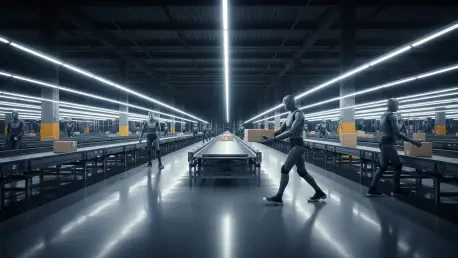

The rhythmic hum of a conveyor belt in a cavernous Shenzhen distribution center often signals the relentless pace of global commerce, but lately, that sound is accompanied by the silent, calculated movements of humanoid machines. This transformation within the logistics sector marks a pivotal transition from theoretical laboratory research to the gritty, unscripted reality of active warehouse floors. While public interest often focuses on staged demonstrations in pristine environments, companies such as Xingdong Jiyuan are actively pioneering the integration of embodied intelligence into the chaotic environment of late-night sorting operations. These machines are no longer mere curiosities designed for tech expositions; they are becoming functional assets tasked with managing the immense volume of packages that flow through global supply chains every hour. Led by industry veterans like Chen Jianyu and Xi Yue, the push for commercialization focuses on identifying sectors with high technical barriers where autonomous agents can provide immediate and measurable value. By moving these humanoid systems into the demanding “night shift,” the industry is testing the limits of robotic endurance and adaptability, aiming to prove that the age of the robotic colleague has finally arrived in a meaningful and scalable way.
The Strategic Landscape of Robotic Sorting
Market Validation: Testing in Real-World Environments
Logistics sorting has emerged as the premier proving ground for humanoid technology because it offers a level of complexity that far exceeds the capabilities of traditional fixed automation. In a typical distribution center, robots must navigate a world of unpredictable variables, including irregular package shapes, shifting lighting conditions, and the frantic pace of inbound and outbound deliveries. Xingdong Jiyuan has moved beyond the initial verification phase, transitioning from small-scale pilots to a phase of rapid industrial deployment. Current data indicates that these humanoid units are already achieving approximately 90% of the efficiency of experienced human sorters, capable of processing more than 1,000 individual packages per hour without the need for breaks or shifts in focus. This level of performance is critical for maintaining the high-speed throughput required by modern e-commerce giants. As these systems continue to refine their computer vision and motor control through constant exposure to new scenarios, the gap between human and machine performance is closing rapidly, suggesting that autonomous systems will soon set the baseline for warehouse productivity.
The deployment of these robots is not merely a technical experiment but a calculated business move to address the increasing volatility of the global supply chain. Unlike the idealized conditions found in promotional videos, actual warehouse floors are often cluttered with discarded packaging, reflective surfaces that confuse standard sensors, and a dizzying variety of items ranging from soft-sided mailers to heavy, rigid boxes. To survive in this environment, a robot must possess a high degree of “embodied intelligence,” which allows it to perceive its surroundings and make split-second decisions about how to grip and move an object. The success of these initial deployments provides the necessary validation for logistics providers to consider larger investments. By demonstrating that a humanoid robot can operate reliably for eight or more hours in a facility designed for humans, developers are proving that the technology is ready to transition from a niche solution to a foundational element of industrial infrastructure, paving the way for a future where robotic labor is a standard utility.
Financial Support: Scaling Production and Investment
The financial sector has recognized the immense potential of this shift, leading to a surge of capital investment into companies that can bridge the gap between AI and physical labor. Major venture capital firms and global technology leaders have funneled billions into the development of humanoid systems, driven by the realization that the software-only AI boom is reaching a point where physical “bodies” are required to unlock further economic value. This influx of funding has enabled Xingdong Jiyuan and its contemporaries to scale their manufacturing capabilities, moving from hand-assembled prototypes to standardized production lines capable of churning out thousands of units. The goal is to expand the current fleet from a handful of experimental machines to a massive workforce of thousands of robots by 2028. This scale is necessary to achieve the cost-efficiency required for widespread adoption, as the price per unit must eventually fall to a level that competes directly with the long-term costs of human labor and traditional mechanical sorting systems.
Market confidence is further bolstered by the involvement of seasoned engineers and visionaries who have successfully navigated the complexities of the tech industry over the past decade. These leaders understand that the value of a humanoid robot lies not just in its ability to mimic human form, but in its capacity to handle diverse, unscripted tasks that would baffle a traditional robotic arm. The integration of advanced neural networks with robust mechanical hardware has created a new class of industrial asset that is highly attractive to institutional investors. As these robots begin to show a clear return on investment through reduced error rates and consistent operational speeds, the financial argument for automation becomes undeniable. This economic momentum is essential for sustaining the long-term research and development needed to tackle the remaining technical challenges, ensuring that the robotic workforce continues to evolve and expand its capabilities across the global logistics network.
Navigating the “Sweet Torment” of Field Deployment
Technical Hurdles: Bridging the Lab-to-Warehouse Gap
Transitioning a sophisticated humanoid robot from a climate-controlled laboratory in Beijing to a sprawling, dusty warehouse in Shenzhen is a process often described by engineers as a “sweet torment.” When the first units arrived at a 6,000-square-meter sorting facility, their performance initially suffered as they encountered environmental factors that were never fully captured in simulation. The cognitive load placed on the AI models was immense; dim evening lighting, the glare from plastic-wrapped packages, and the sheer unpredictability of human movement in the vicinity caused the robots to hesitate or miscalculate grips. This period of on-site debugging required technical teams to work in tandem with the machines, collecting vast amounts of data to understand why a system that performed flawlessly in a test environment was struggling in the field. These real-world puzzles are essential for the growth of embodied intelligence, as they force the software to become more resilient and adaptable to the “noise” of a functioning industrial site.
Environmental variability remains the primary obstacle to achieving full autonomy in logistics. For instance, a robot might be trained to recognize a standard cardboard box, but in a real warehouse, it will encounter boxes covered in reflective tape, crushed corners, or obscured labels. Each of these variations presents a new challenge for the robot’s perception system. To overcome this, engineers have implemented a process of relentless data collection, feeding the failures and successes of the night shift back into the training loop every morning. This iterative process has allowed the robots to learn from their mistakes in real-time, gradually increasing their “environmental IQ.” By refining the algorithms that govern spatial awareness and tactile feedback, the development teams have been able to improve sorting accuracy to meet and eventually exceed industrial standards, proving that the chaotic nature of a warehouse can be mastered through persistent exposure and advanced machine learning.
Deployment Logistics: Moving Toward Plug-and-Play Systems
One of the most significant benchmarks for the commercial success of humanoid robots is the speed at which they can be deployed in a new facility. In the early stages of development, setting up a robot to perform sorting tasks in a new environment could take months of custom programming and physical adjustments. However, recent advancements in cross-site deployment techniques have slashed this timeline significantly. The objective is to create a “plug-and-play” system where a robot can be unboxed, connected to the local network, and become productive within a matter of days rather than weeks. This requires the robot’s “brain” to have a high level of generalizability, allowing it to apply the lessons learned in one warehouse to the unique layout and package flow of another. Proving that these machines can adapt to a new site with minimal human intervention is a crucial milestone for companies looking to scale their automated workforce across different geographic regions.
The ability to rapidly integrate robots into existing workflows is what will ultimately separate the winners from the losers in the robotics race. As the industry moves toward 2028, the focus is shifting from basic task completion to the seamless orchestration of entire robotic fleets. This involves developing sophisticated fleet management software that can coordinate the movements of dozens of robots simultaneously, ensuring that they do not interfere with each other or with the human workers who remain on-site. The goal is to reach a state where a robot requires only about an hour of local data collection to understand its specific surroundings before it begins its first full shift. This level of agility is essential for logistics providers who need to scale their operations up or down based on seasonal demand. By reducing the friction of deployment, humanoid robot manufacturers are making it easier for traditional companies to embrace automation without the need for a total overhaul of their existing infrastructure.
Engineering the Mechanical Brain and Body
Hardware Evolution: Designing for Durability and Dexterity
The physical construction of a humanoid robot is a masterclass in modern mechanical engineering, particularly when it comes to the development of a “dexterous hand” that can replicate the nuance of human touch. Xingdong Jiyuan has pioneered a move away from traditional rope-driven mechanical designs, which are often prone to wear and lack the necessary precision for delicate sorting tasks. Instead, they have pivoted toward direct-drive motors that offer greater stability, a longer operational lifespan, and more granular control over grip strength. This shift in hardware philosophy has been so successful that these specialized components have become a standalone product sought after by other technology firms building their own AI systems. A robot’s ability to pick up a heavy, rigid object one second and a soft, fragile envelope the next is entirely dependent on the quality of its tactile sensors and the responsiveness of its motor controllers, making hardware innovation just as critical as software development.
Pragmatism has also played a major role in the structural design of these industrial humanoids. While the “humanoid” label implies a two-legged form, many logistics tasks do not actually require the complexity of bipedal walking. Recognizing this, some developers have introduced “functional” designs that utilize a stable, column-based lower body or a wheeled chassis while retaining the sophisticated dual-arm system and head-mounted sensors of a standard humanoid. This design choice reduces the overall cost of the robot by approximately one-third, making it a much more attractive option for budget-conscious logistics firms. By prioritizing task mastery and mechanical reliability over strict anatomical mimicry, companies are creating a faster path to a positive return on investment. These hybrid designs allow the robot to operate in spaces designed for humans—such as reaching into the back of a delivery van or sorting at a standard-height table—without the energy consumption and balance issues associated with two-legged locomotion.
Software Agility: The Continuous Learning Loop
On the software side, the true power of the modern humanoid robot lies in its ability to undergo a rapid, daily evolution of its “mental” capabilities. The robots are powered by sophisticated embodied models that allow for a continuous feedback loop between the physical world and the digital training environment. During a typical night shift, the robot’s sensors record every interaction, noting where it struggled to identify a package or where a grip was suboptimal. This data is uploaded and processed in the morning, and by the start of the following evening’s shift, an updated and more capable model is often deployed across the entire fleet. This speed of iteration represents a primary competitive advantage, as the robot’s “brain” can evolve much faster than traditional software development cycles would ever permit. This constant refinement ensures that the system is always at the cutting edge of what is technically possible, adapting to new challenges as quickly as they arise.
This rapid learning process is supported by the integration of large-scale neural networks that can handle the massive amounts of sensory data generated during a shift. These models are designed to recognize patterns and make inferences that go beyond simple “if-then” programming. For example, if a robot encounters a new type of packaging that it hasn’t seen before, it can use its previous experience with similar materials to determine the best way to handle it. This “generalization” is the holy grail of robotics, as it allows the machine to function effectively in an ever-changing environment without needing to be manually programmed for every possible scenario. As these models become more sophisticated, the robots are gaining a sense of “common sense” regarding physical interactions, such as knowing not to squeeze a box too hard or understanding how to move a package to avoid a collision. This software agility is what allows humanoid robots to move from being static tools to dynamic, intelligent participants in the logistics process.
Reshaping the Global Labor Dynamic
Addressing the Demographic Crisis in Logistics
The accelerating drive toward robotic integration is largely a response to a global demographic shift that has left many regions struggling with a dwindling and aging labor force. In many industrial hubs, the willingness of the younger generation to work in the physically demanding and repetitive environment of a warehouse has reached an all-time low. Logistics facilities are often characterized by extreme temperatures, high noise levels, and the constant strain of lifting and sorting, making them unattractive places for long-term employment. This labor vacuum is particularly acute during the night shift, where the difficulty of finding and retaining reliable staff often leads to operational bottlenecks and increased costs. Humanoid robots are perfectly suited to fill these roles, as they are immune to the physical fatigue and environmental discomfort that can lead to human error and injury in such demanding conditions.
By deploying robots to handle the most “boring” and “strenuous” tasks, logistics companies are not just replacing workers but are fundamentally restructuring the nature of warehouse employment. The goal is to reach a point where humans are moved into supervisory or maintenance roles, overseeing fleets of autonomous machines rather than performing the manual sorting themselves. This transition is essential for the survival of high-demand supply chains that must operate 24 hours a day to meet consumer expectations for rapid delivery. Robots provide a level of operational consistency that is impossible to maintain with a human-only workforce, ensuring that packages continue to move through the system regardless of labor availability or shift timing. This stability allows firms to plan for long-term growth with a degree of certainty that was previously unattainable, turning the logistics night shift from a management headache into a streamlined, autonomous operation.
Transitioning to a New Era of Industrial Automation
The integration of humanoid robots into the logistics sector followed a rigorous path of testing and refinement that eventually proved the technology’s readiness for widespread use. Industry leaders recognized early on that the primary value of these machines was their ability to function within existing human-centric infrastructure without requiring massive capital expenditures for specialized conveyors or sorters. This pragmatic approach allowed for a smoother transition, as the robots were able to step into existing roles and prove their worth through direct performance metrics. By focusing on high-frequency, high-variability tasks like package sorting, developers established a clear economic case for automation. The successful deployment of these systems across multiple facilities demonstrated that the initial hurdles of environmental perception and mechanical durability could be overcome through relentless iteration and a commitment to data-driven improvement.
The strategic shift toward autonomous night shifts was facilitated by the rapid evolution of both hardware and software, which worked in tandem to create a resilient industrial asset. Developers utilized the vast amounts of data gathered during early pilots to fine-tune the motor control and computer vision systems, resulting in robots that could navigate the complexities of a modern warehouse with minimal supervision. This progress was supported by a robust financial ecosystem that provided the capital necessary to scale manufacturing and lower the cost per unit. As these machines became more accessible, the focus shifted toward optimizing fleet management and ensuring that robotic systems could be integrated into the global supply chain with “plug-and-play” ease. The lessons learned during this period of transition provided a blueprint for other sectors, showing that with the right combination of embodied intelligence and mechanical engineering, humanoid robots could successfully take on the world’s most demanding industrial roles.