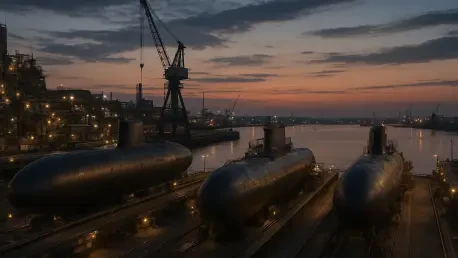

The vast stretch of industrial wasteland along the Patapsco River is undergoing a substantial metamorphosis that will transform Maryland into a central hub for nuclear-powered undersea warfare technology. This resurgence at Sparrows Point, the former home of Bethlehem Steel, represents a pivotal shift toward high-tech industrialism. Anduril Industries recently announced a $3.7 billion private investment to construct “Arsenal-2,” a sprawling two-million-square-foot facility designed to modernize the way the United States builds its most complex vessels. By reclaiming this historic ground, the project sought to bridge the gap between Baltimore’s gritty manufacturing legacy and the sophisticated requirements of modern defense.
The importance of this development cannot be overstated, as the American maritime industrial base has reached a critical inflection point. For years, the inability to produce submarines at a rate that matches global threats has created a dangerous bottleneck for the Navy. Arsenal-2 is not just a factory; it is a calculated response to a national security crisis. By integrating advanced manufacturing techniques and a massive private capital infusion, Anduril aims to solve the logistics failures that have plagued the sector. This move signals a transition away from traditional, slow-moving construction models and toward a more agile, technology-driven approach.
A Historic Return: Steel and Sea Power at Sparrows Point
This massive venture turned a derelict industrial graveyard into a vital asset for national security, marking one of the largest private bets on defense manufacturing in current history. The Sparrows Point site once defined American industrial dominance, and its resurrection serves as a physical manifestation of a renewed commitment to domestic production. Arsenal-2 is not merely a construction project; it is a signal that the era of deindustrialization in the Chesapeake region has officially ended, replaced by a vision of automated, efficient shipbuilding.
The scale of the site allows for a level of production density that is currently unavailable at existing naval yards. With two million square feet of space, the facility provides the room necessary to implement sprawling robotic assembly lines and heavy-lift logistics systems. This transformation at Tradepoint Atlantic has effectively linked the region’s storied past with a future defined by high-stakes maritime superiority. The site’s deep-water access and proximity to existing naval infrastructure make it the ideal location for a project that requires both massive space and strategic geographical positioning.
Strategic Necessity: Solving the Submarine Production Crisis
The United States Navy encountered a significant strategic deficit, struggling for years to meet the mandate of producing two Virginia-class submarines annually. Persistent supply chain failures and labor shortages left the fleet vulnerable, creating a logistics nightmare that traditional shipyards could not solve alone. By focusing specifically on these systemic bottlenecks, Anduril positioned itself as the necessary catalyst for change. This initiative addressed a critical vulnerability in the national security infrastructure by providing a dedicated source for the components that had long delayed fleet expansion.
Moreover, the strain on the existing industrial base had reached a breaking point, with older shipyards operating at maximum capacity while falling behind schedule. The introduction of Arsenal-2 provides a release valve for this pressure, allowing for the offloading of complex sub-assemblies to a specialized, modern facility. This strategy was designed to ensure that the Navy can maintain its undersea advantage during an era of heightened global competition. By stabilizing the production of Virginia-class vessels, the project secures the long-term readiness of the fleet.
Inside Arsenal-2: Modernizing the Maritime Supply Chain
The facility functioned as a high-capacity production engine, engineered to manufacture critical components like torpedo tubes—a major technical hurdle—before scaling up to hull sections. To ensure operational readiness by the 2030 target, a 160,000-square-foot feeder facility in Orange County, California, began refining manufacturing workflows earlier this year. These refined systems allowed the company to test quality controls before implementing them on a massive scale in Maryland. Ultimately, these components fed into the final assembly lines of industry leaders like General Dynamics Electric Boat and HII’s Newport News Shipbuilding.
This modular approach to shipbuilding represents a significant departure from the linear processes used in the past. By manufacturing complex modules in a controlled environment, Anduril can maintain higher quality standards and faster turnaround times. The California site serves as a vital laboratory, ensuring that by the time the Maryland shipyard is fully operational from 2026 to 2030, the production techniques will be perfected. This phased rollout minimizes the risk of delays and ensures that the shipyard can hit the ground running with proven technology.
Economic Impact: The Navy’s Performance Mandate
A dual-funding structure supported this initiative, including a $2.9 billion performance-based contract from the Navy that emphasized the urgency of the mission. Locally, Maryland and Baltimore County pledged to match 13% of the private investment through various incentives, such as a proposed $210 million property tax break. This partnership highlighted a growing trend of utilizing public-private collaboration to rebuild industrial capacity while providing a significant economic boost to the Baltimore region. The investment ensured that the financial burden was shared between the government and private sector, aligning their interests toward a common goal.
The fiscal commitment from the Navy is tied directly to production milestones, ensuring that the taxpayer investment translates into tangible results for the fleet. This performance mandate forced a level of accountability that was often missing in traditional defense procurement. Furthermore, the local incentives acted as a catalyst for broader infrastructure improvements at Sparrows Point, benefiting other commercial tenants at Tradepoint Atlantic. This collaborative financial model demonstrated how local, state, and federal entities could work together to foster a high-tech industrial ecosystem.
Human Capital: Bridging the Skills Gap in Shipbuilding
To staff a project of this magnitude, the company planned to create 3,100 jobs, recruiting from vocational schools and the aerospace and automotive sectors. Because traditional shipbuilding expertise remained in short supply, a specialized training framework provided accelerated learning for workers who lacked maritime experience. This strategy involved cross-applying manufacturing techniques from other high-tech industries to meet the rigorous quality standards required for nuclear-powered components. By focusing on workforce versatility, the project established a sustainable model for future industrial growth that prioritized skill acquisition and long-term economic stability for the Maryland labor market.
The establishment of this facility offered a clear path toward maritime dominance. It identified the need for specialized training and secured the necessary infrastructure for the coming decade. State leaders remained committed to these goals, as the project successfully integrated diverse talent pools into the defense sector. These efforts ensured that the regional economy thrived while the nation’s strategic interests were protected through a modernized and resilient supply chain. The focus on human capital transformed the local labor force into a vital component of the national security apparatus.