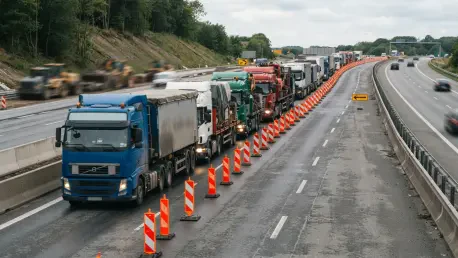

The long-term nature of the bridge joint replacement initiative means that the current disruptions on the M6 represent a permanent operational shift rather than a temporary delay. As National Highways proceeds with its extensive maintenance program on the Thelwall Viaduct, the logistics landscape for Irish hauliers faces a period of instability slated to persist from 2026 to 2028. This massive structure, spanning the Manchester Ship Canal and the River Mersey, serves as a critical link near Warrington, facilitating the movement of vital goods between Holyhead ferry terminals and major industrial hubs. To manage the ongoing repairs, a mandatory 24-hour contraflow system and a strict 40mph speed limit have been established. While authorities aim to maintain four lanes during peak hours, the reality of overnight single-lane closures creates a fluctuating environment that challenges even the most seasoned logistics managers across the Irish Sea.
The Strategic Importance: A Vital Gateway for Irish Trade
For the Irish transport sector, the M6 motorway functions as much more than a standard roadway; it serves as the central spine of the “land bridge” connecting Dublin to the wider markets of Britain and mainland Europe. The Thelwall Viaduct occupies a high-stakes position within this network, acting as a strategic bottleneck where any maintenance-related friction can instantly trigger a massive ripple effect throughout the international supply chain. Because this specific section of the M6 handles the vast majority of freight entering via the Holyhead ferry service, its reliability is directly tied to the economic health of manufacturers and retailers alike. The complexity of the bridge joint replacement project highlights just how dependent the modern logistics industry has become on this aging infrastructure. Without the viaduct, the flow of goods toward northern heartlands would cease, making these prolonged works a necessary but painful intervention for the long-term safety of the network.
Logistical Bottlenecks: Navigating Limited Route Alternatives
Beyond its role as a physical crossing, the viaduct represents a point of no return for heavy goods vehicles moving toward Lancashire and the Scottish border regions. There are very few alternative routes in the North West of England that possess the capacity to handle the volume of traffic diverted from the M6 without causing secondary gridlock on local networks. Consequently, the ongoing disruptions have forced hauliers to accept that the primary transit route for Irish goods is now a high-risk zone for delays. The current timeline, stretching from 2026 to 2028, means that temporary workarounds are no longer sufficient to maintain delivery schedules. Transport companies have had to reconsider their entire routing logic, acknowledging that the predictability once offered by the English motorway system has been replaced by managed constraints that require constant monitoring and a high degree of operational flexibility to survive this multi-year infrastructure overhaul.
Economic Impacts: The True Cost of Construction Congestion
The financial repercussions of the Thelwall Viaduct project extend beyond the inconvenience of longer transit times, as the constant “stop-start” nature of traffic through the construction zone significantly inflates fuel consumption. For Irish hauliers operating on razor-thin margins, the increased wear and tear on heavy-duty vehicles navigating the mandatory 40mph zones and contraflow systems represents a direct hit to profitability. Productivity is also suffering; when a vehicle is delayed by several hours at a single bottleneck, it may be unable to complete its scheduled delivery rotation within a standard working week. This decrease in vehicle utilization means that firms are essentially paying more in labor and fuel costs to move the same amount of freight. These cumulative expenses, when added to existing pressures like fluctuating energy prices, create a sustained economic burden that threatens the long-term viability of many smaller and medium-sized transport operators.
Nighttime Restrictions: Challenges for Overnight Freight Models
Furthermore, the specific timing of lane restrictions presents a unique challenge for the Irish logistics model, which frequently relies on overnight transit to meet early-morning deadlines. The decision by National Highways to reduce the northbound lanes to a single lane during off-peak hours directly conflicts with this efficiency-driven strategy. When combined with strict legal requirements regarding driver rest periods, these nighttime bottlenecks become a major compliance risk. A driver caught in an unexpected queue at the viaduct may be forced to stop for a mandatory rest period just miles from their destination or the Holyhead port, leading to missed ferry connections and cascading failures in the supply chain. This regulatory pressure adds a layer of stress to the workforce and complicates the task of dispatchers who must now account for unpredictable delays during what used to be a highly reliable window for essential freight movement across the northern English corridor.
Long-Term Mitigation: Planning for a Disrupted Reality
Since the maintenance program is scheduled to remain active until the winter of 2027–2028, the industry has shifted its perspective to view these roadworks as a permanent fixture of the regional landscape. Successful transport managers have begun integrating real-time traffic intelligence and National Highways’ digital updates into their core scheduling models to mitigate the worst effects of the construction. The use of advanced telematics and route-optimization software is no longer a luxury but a fundamental requirement for maintaining any semblance of service reliability. By building significant “contingency time” into every journey plan, hauliers are attempting to buffer their operations against the volatility of the Warrington corridor. This buffer time itself carries a cost, as it effectively reduces the number of trips a driver can make, further highlighting the need for data-driven decision-making to balance the twin demands of schedule adherence and operational efficiency.
Resilient Adaptation: Future Strategies for Logistics Success
In response to these challenges, the most resilient firms established clearer lines of communication with their clients to manage expectations regarding delivery windows for time-sensitive cargo. They recognized that transparency was the only way to maintain trust when external factors beyond their control dictated the pace of transit. Moving forward, the logistics sector focused on adopting more agile fleet management practices and exploring storage solutions closer to key delivery points to bypass the daily uncertainty of the M6. These proactive steps allowed businesses to stabilize their operations despite the persistent structural repairs on the Thelwall Viaduct. By prioritizing flexibility and investing in sophisticated planning technologies, the industry successfully navigated the period from 2026 to 2028, ensuring that the vital flow of goods between Ireland and the UK remained intact. This period of adaptation ultimately fostered a more robust and technologically integrated logistics network.