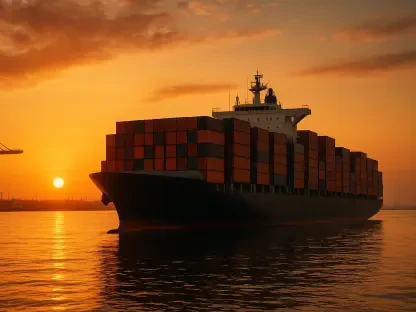

The delicate equilibrium of global maritime commerce has been shattered by a persistent combination of strategic territorial conflicts and a massive shift in how retailers manage their inventory levels across the world’s major shipping lanes. Even as 2026 progresses, the logistics sector continues to grapple with extreme volatility that has effectively erased the cost-efficiency gains achieved during the brief post-pandemic stabilization. Shipping lines have found themselves navigating a maze of restricted waterways and mandatory reroutes around the Cape of Good Hope, which has fundamentally restructured the mathematics of oceanic transit. These prolonged voyages do not merely add days to the schedule; they absorb a significant portion of the global vessel capacity, creating an artificial shortage that keeps spot rates hovering at levels once considered unthinkable for non-emergency periods. Consequently, the standard seasonal fluctuations have been replaced by a baseline of high costs that force businesses to rethink their entire procurement strategies to survive.
Regional Instability and Shifting Trade Corridors
The enduring crisis in the Red Sea has fundamentally altered the operational landscape for the world’s largest carriers, forcing a permanent reallocation of assets to maintain reliable service schedules. By bypassing the Suez Canal, ships are now traveling thousands of additional miles, a reality that has spiked fuel consumption and increased the environmental footprint of every container moved between Asia and Europe. This shift has also triggered a surge in insurance premiums and war risk surcharges that are passed directly to the cargo owners, further inflating the final price of consumer goods in Western markets. Moreover, the increased steaming time has necessitated the introduction of additional vessels on major loops just to maintain weekly frequency, which has sucked the excess capacity out of the market that many analysts expected to see this year. This tight supply-demand balance remains the primary driver behind the sustained elevation of freight rates as 2026 continues to present new challenges.
Beyond the immediate geographical bottlenecks, the strain on global port infrastructure has reached a critical juncture as diverted traffic overwhelms alternative hubs in the Mediterranean and Southeast Asia. Ports like Algeciras and Tanger Med have seen record-breaking volumes, leading to significant berthing delays and terminal congestion that ripple across the entire logistics network. When vessels are stuck waiting for a spot to unload, the availability of empty containers at manufacturing hubs in China and Vietnam plummets, creating a secondary price spike driven by equipment scarcity. This scarcity is exacerbated by the fact that many shippers are now holding onto equipment longer to use as mobile warehouses, a defensive move against further supply chain disruptions. The result is a fractured system where the cost of moving a forty-foot equivalent unit is no longer determined by distance alone, but by the complex interplay of geopolitical risk and the physical limitations of port throughput.
Seasonal Pressures and the New Inventory Paradigm
Traditional peak season dynamics have been completely upended as retailers increasingly adopt a just-in-case inventory model to insulate themselves from the threat of sudden border closures or maritime blockades. In 2026, the typical August surge in shipping activity moved forward to late spring, as major importers sought to secure their holiday stock well before potential disruptions could materialize during the winter months. This front-loading of cargo has created a persistent high plateau for freight rates throughout the summer, leaving no room for the usual softening of prices that historically occurred in the shoulder seasons. Large-scale importers are now competing fiercely for guaranteed space on vessels, often entering into long-term contracts at premium prices to avoid the volatility of the spot market. This behavior effectively locks in high freight costs for the foreseeable future, as the psychological shift toward risk aversion among supply chain managers appears to be permanent.
The logistics industry eventually recognized that the era of low-cost, predictable ocean freight had transitioned into a period of strategic resilience and high-cost reliability. Companies that succeeded in this environment shifted their focus toward near-shoring and regionalized production to reduce their reliance on long-haul maritime routes that remained vulnerable to geopolitical shocks. Technological investments in real-time visibility and predictive analytics became the standard, allowing firms to pivot their cargo between different modes of transport as conditions on the water shifted. Logistics managers prioritized the diversification of port entries, avoiding heavy reliance on single gateways that were prone to labor disputes or sudden congestion. These proactive measures transformed the supply chain from a cost center into a strategic asset, ensuring that goods reached their destinations despite the ongoing pressures of peak demand and global instability. The industry moved toward a more agile framework that balanced the necessity of international trade with the harsh realities of a fragmented world.