
As the logistics landscape of 2026 continues to evolve, the recent $6 billion acquisition of RXO by C.H. Robinson stands as a watershed moment for the freight brokerage industry. To navigate the strategic implications of this massive deal and the broader shifts in supply chain technology, we sat down with Rohit Laila, a veteran with decades of experience in logistics innovation and corporate strategy. In this discussion, Laila explores the vital role of scale and density, the reasoning behind the structural breakup of massive conglomerates, and why even as autonomous vehicles and tech giants dominate the headlines, the “human element” and small-scale players remain remarkably resilient. Our conversation touches on everything from the intricacies of stock-and-cash deal structures to the untapped potential of the building supplies market.
How does the pursuit of scale and density fundamentally change the competitive advantage for a modern freight broker in today’s market?
In the high-stakes world of freight brokerage, scale isn’t just a metric of size; it is the engine of speed. When you are operating a platform of this magnitude, the primary goal is to find a truck faster than the other guy, and that requires a massive, dense network of carriers and shippers. By integrating RXO into C.H. Robinson, they aren’t just adding revenue; they are creating a marketplace where a broker can identify a backhaul for a driver “right this second,” minimizing the time wheels spend turning without profit. This density is what allows a company to survive the razor-thin margins of the spot market because it eliminates the friction of the search. If you can’t provide that immediate match, you lose the carrier to someone who can, and in this industry, bigger is undeniably better when it comes to matching capacity with demand.
What was the strategic logic behind shifting away from the conglomerate model to create pure-play entities like RXO, and how does that influence investor confidence?
The decision to split the original XPO conglomerate into distinct pieces—moving LTL into XPO, contract logistics into GXO, and brokerage into RXO—was driven by the cold reality of market multiples. For a long time, investors struggled to value a massive “everything” company because it was too complex to understand and didn’t offer a clear narrative for growth in specific sectors. By breaking it up, the leadership was able to unlock huge value, as each entity could be judged on its own merits and operational efficiency. Even though the original plan was to build the biggest trucking company ever by buying up fleets and hiring thousands of drivers, the realization set in that being asset-heavy had a limited upside. Shippers don’t necessarily care if a company owns 10,000 trucks or one; they care about the one truck that is available to move their freight right now, which is why the light-asset brokerage model proved to be the more valuable path.
The RXO acquisition involved a complex payout structure including stock and cash options. Why is it beneficial for shareholders to have a significant portion of their payout in C.H. Robinson stock?
The structure of this $6 billion deal is fascinating because it offers RXO shareholders a choice: they can take $30.25 per share in all cash, or they can opt for a combination of $17.25 in cash plus 0.0856 shares of C.H. Robinson stock. There is even an all-stock option at 0.1992 shares, which reflects a deep belief in the long-term potential of the combined company. Taking a “big chunk in stock” allows shareholders to actually participate in the synergies that are expected to materialize over the next few years as these two giants integrate. It creates an alignment of interest where the people who built RXO can benefit from the increased efficiency and market dominance that C.H. Robinson expects to achieve. It turns a simple exit into a long-term investment in a dominant market leader.
As autonomous trucking moves closer to widespread adoption, how do you see it reshaping the balance between contract freight and the spot market?
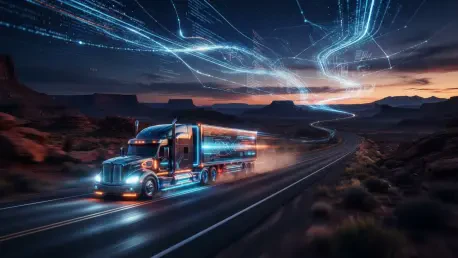
Autonomous vehicles are going to fundamentally change the “smell and feel” of the highway, turning long-haul trucking into something that functions much more like an Uber-style spot business. Currently, the industry is plagued by “deadhaul”—the quiet, expensive frustration of empty trailers burning fuel while returning from a delivery—but autonomous networks will be significantly more efficient at filling those gaps. We are going to see the percentage of linehaul handled by the spot market rise dramatically because the technology will be able to optimize routes and schedules in real-time without the constraints of human driving hours. However, a major question remains unanswered: who will actually own these massive autonomous fleets? Whether it ends up being big corporations, the government, or decentralized networks, the increase in efficiency will make the logistics world feel much smaller and more immediate.
Your new focus involves consolidating the building products industry through QXO. What makes this specific sector so ripe for a logistics-driven overhaul?
After evaluating 55 different industries, it became clear that building products are uniquely “real and durable,” but the industry itself is stuck in a technological time warp. While the broader supply chain world has embraced advanced TMS and scanning, many building supply companies are still operating with manual processes that feel decades old. Despite a recent 41% dip in stock value over the last year and a 14.4% drop last month, the fundamental model is sound because the demand for roofs, windows, and plumbing isn’t going away—ten years from now, people will still be meeting in physical buildings. By taking a tech-enabled, customer-centric approach and stripping out unnecessary costs, there is a massive opportunity to roll up this $5 billion revenue market. It’s about taking the sophisticated logistics lessons we’ve learned in freight and applying them to a sector that desperately needs to modernize its efficiency.
In an era of $6 billion mergers and massive tech investments, why do smaller brokerages continue to survive and even thrive against the giants?
There has been a running joke in the industry for years that the “little guys” are on the verge of extinction, yet they are still standing and doing just fine. While the big brokers always predict consolidation will wipe out the small players, the reality is that many shippers still value the personal, high-touch service that a smaller firm can provide. Even as we see companies like Echo Global buy ITS, the fragmented nature of the American trucking market means there is always a niche for a broker who has a specific relationship or a local expertise that a giant corporation can’t replicate. The “big guys” have the scale and the density, but the smaller brokers have the agility and the personal honesty that clients crave. It turns out that being a “nice guy” who never exaggerates or tells a fib—much like the qualities seen in the leadership at RXO—is a competitive advantage that no amount of software can fully replace.
What is your forecast for the freight brokerage industry?
I expect that by 2028, we will see a two-tiered market where the “middle class” of brokerage has largely disappeared, leaving only the massive, tech-driven aggregators and the highly specialized boutique firms. The giants will handle the high-volume, autonomous-ready lanes with surgical precision, while the smaller players will survive by managing the complex, non-standard freight that requires human problem-solving. We will see a continued push toward “uberization,” where the distinction between a contract and a spot load becomes almost invisible to the shipper. Ultimately, the winners will be those who can harness the massive scale of a $6 billion network while maintaining the integrity and transparency that keeps carriers loyal. The industry will become more efficient, less wasteful of “deadhaul” space, and more integrated into the digital fabric of the global economy.