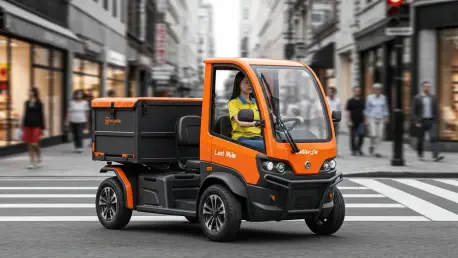

Picture a chaotic urban landscape where delivery trucks clog narrow streets, exhaust fumes cloud the air, and frustrated drivers honk in gridlock while packages sit delayed just blocks from their destinations. Now imagine a sleek, electric quadricycle weaving effortlessly through bike lanes, bypassing the mess to drop off goods right on time. This isn’t a distant dream but a reality introduced by Honda through its fleet-as-a-service division, Fastport, with the groundbreaking Fastport eQuad. Recently launched in the U.S. after making waves in Europe, this vehicle redefines last-mile delivery by combining sustainability with street-smart design. Showcased at the Los Angeles Auto Show, the eQuad has sparked intense interest among logistics companies and city planners alike. It’s not just a vehicle; it’s a bold statement on how urban delivery can evolve to meet the demands of densely packed cities while cutting down on pollution and inefficiency. Let’s dive into how Honda is steering toward a new era of mobility with this innovative solution.
Redefining Mobility with a Visionary Approach
Honda has long been synonymous with automobiles, but the company is now carving out a broader identity as a mobility innovator, and the Fastport eQuad stands at the forefront of this transformation. Designed specifically for the critical last-mile delivery segment, the eQuad tackles the pain points of urban logistics where traditional vans often falter. Its electric powertrain aligns with global pushes for sustainability, reducing carbon footprints in crowded city centers. Moreover, the vehicle’s ability to operate in bike lanes sidesteps the need for conventional road registration, offering a clever workaround to traffic snarls. This isn’t just about delivering packages; it’s about reimagining how goods move in spaces where every inch and minute counts. Honda’s shift through Fastport signals a commitment to adaptable, eco-friendly solutions that could reshape urban environments for businesses and residents alike, proving that a legacy automaker can pivot with purpose.
Beyond the environmental benefits, the strategic intent behind the eQuad reflects Honda’s deeper ambition to integrate into the fabric of modern urban life. The fleet-as-a-service model under Fastport caters directly to businesses, providing not just vehicles but a full support system tailored to delivery needs. This approach ensures companies can scale operations without the burden of vehicle ownership, a game-changer in an era where efficiency dictates success. Additionally, the focus on last-mile challenges highlights Honda’s grasp of a growing market—e-commerce continues to surge, and with it, the demand for swift, reliable delivery in tight spaces. While many competitors scramble to adapt, Honda positions itself as a forward-thinker, betting on modular, green tech to lead the charge. This vision, however, isn’t without hurdles, as the real test lies in how seamlessly the eQuad fits into the daily grind of city streets.
Cutting-Edge Design for Real-World Needs
At the heart of the Fastport eQuad’s appeal is a design that prioritizes both functionality and flexibility for urban delivery personnel. Available in two sizes, the smaller model suits narrower European bike lanes with a compact frame, while the larger version accommodates the broader infrastructure often found in American metro areas. Both variants boast dual Honda Mobile Power Pack batteries, delivering a range of up to 23 miles on a single charge for the heftier model. These batteries are hot-swappable, accessible through convenient side doors, and backed by Fastport’s maintenance and charging services for business clients. Features like regenerative braking, customizable cargo spaces, and optional heated handlebars elevate rider comfort and utility. With a capacity of up to 320 pounds for the smaller eQuad and 650 pounds for the larger (including rider weight), this vehicle is built to handle the rigors of daily deliveries with impressive practicality.
Delving deeper into the design, the eQuad’s thoughtful details reveal a keen understanding of the delivery worker’s environment. The smaller model offers side-hinged doors for easy cargo access, while the larger variant includes a sliding door behind the driver and a roll-up rear door, complete with adjustable shelving to meet specific client demands. A built-in display provides essential vehicle data at a glance, and an RFID key system ensures security for both storage and battery compartments. Such innovations suggest that Honda isn’t just creating a vehicle but crafting a tool tailored to the nuances of urban logistics. However, while the specs impress on paper, the true measure of success depends on how these features hold up under the unpredictable conditions of city streets, where every turn and stop presents a new challenge. This balance of innovation and application sets the stage for a closer look at real-world performance.
Performance Insights from the Urban Frontline
Testing the larger Fastport eQuad in a controlled setting offered a glimpse into its potential as a delivery powerhouse, with immediate electric assist kicking in to make navigation feel intuitive and responsive when unloaded. The vehicle’s handling proved nimble for its size, suggesting that in less cluttered scenarios, delivery riders could zip through bike lanes with ease. This responsiveness hints at a design that prioritizes efficiency, allowing businesses to cut down on transit times in urban cores where delays are costly. The inclusion of pedals, which can double as a generator when pedaled backward while stationary, adds a layer of versatility for maintaining power on long shifts. Such elements point to a vehicle engineered not just for movement but for sustained operation in demanding environments, a crucial factor for companies relying on consistent delivery schedules to maintain customer trust.
Yet, not every aspect of the eQuad’s performance inspires unqualified confidence. The absence of power steering emerged as a noticeable drawback during multi-point turns, hinting at potential fatigue for drivers navigating tight alleys or crowded drop-off zones, especially with a full load. While the electric assist mitigates some physical strain, the effort required in confined spaces could slow down operations over extended routes. This limitation raises questions about the vehicle’s adaptability under peak stress, a common reality in urban delivery where obstacles are the norm rather than the exception. Though the eQuad shines in open stretches, its ergonomic constraints suggest that Honda might need to refine certain elements to ensure it meets the full spectrum of real-world demands. These mixed impressions pave the way for a broader discussion on how the vehicle meshes with existing city infrastructure.
Confronting Urban Infrastructure Realities
Despite its innovative edge, the Fastport eQuad faces significant challenges when slotted into the complex puzzle of U.S. urban infrastructure. The larger model, measuring nearly 48 inches wide, poses a stark issue in bike lanes that, per U.S. Department of Transportation standards, should span at least four to five feet but often barely meet this minimum in reality. Occupying most or all of a lane, the eQuad risks forcing cyclists into vehicular traffic to overtake, creating safety hazards and potential friction with motorists. This spatial mismatch isn’t just a minor inconvenience; it’s a fundamental barrier to seamless integration. As cities strive to balance the needs of diverse road users, a vehicle that inadvertently disrupts this equilibrium could face pushback, no matter how eco-friendly or efficient it aims to be. Honda’s design team must grapple with these physical constraints to avoid unintended consequences.
Compounding the spatial dilemma is the eQuad’s speed cap of 12 mph, a deliberate choice favoring torque for heavier loads over velocity, as dictated by customer input. In contrast, many urban electric bike-sharing programs allow speeds up to 15 mph, meaning the eQuad could lag behind cyclists, further clogging bike lanes during peak hours. This discrepancy underscores a disconnect between the vehicle’s intended role and the dynamic pace of city cycling ecosystems. While torque ensures the eQuad can haul substantial cargo, the slower pace might frustrate both riders and other lane users, diminishing its effectiveness as a quick delivery solution. Addressing this mismatch—whether through design tweaks or operational adjustments—remains a critical next step for Fastport. The tension between innovation and practicality highlights the broader challenge of fitting new tech into established urban frameworks without causing more problems than it solves.
Charting the Path Forward for Last-Mile Innovation
Reflecting on the broader implications, Honda’s Fastport initiative marked a pivotal moment in redefining urban delivery through subscription-based fleet services, targeting businesses hungry for sustainable last-mile options. The European rollout prioritized the smaller eQuad for tighter infrastructure, while the U.S. introduction leaned toward the larger model to match bigger delivery demands. This tailored approach showcased Honda’s awareness of regional differences, yet it also exposed gaps between visionary design and practical urban constraints. The test runs demonstrated the vehicle’s promise under ideal conditions, but ergonomic and spatial issues lingered as reminders of the work still needed. Fastport’s journey underscored that true innovation requires not just bold ideas but relentless adaptation to the messy realities of city life.
Looking ahead, the path to success for the eQuad hinged on actionable refinements. Adjusting the vehicle’s dimensions or boosting its speed to align with urban bike lane dynamics emerged as potential fixes to enhance safety and efficiency. Collaborative efforts with city planners to designate specific corridors or delivery zones could also ease integration, minimizing conflicts with cyclists and drivers. Beyond design tweaks, expanding Fastport’s support services—such as real-time route optimization or enhanced rider training—offered another avenue to bolster operational impact. Honda’s commitment to mobility transformation stood firm, but the real triumph would come from bridging the gap between concept and execution. As urban delivery demands continue to evolve, Fastport’s ability to iterate and respond will define whether the eQuad became a true game-changer or a well-intentioned experiment in the annals of logistics history.