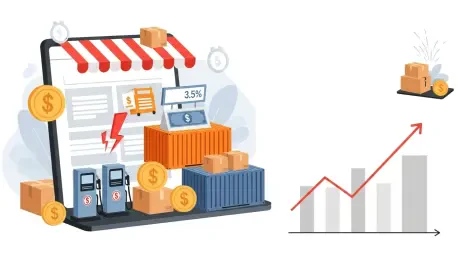

Margins already felt thin across marketplace businesses, and now a 3.5% fuel and logistics surcharge on Amazon fulfillment fees forces sellers to decide whether to nudge prices up, rework assortments, or absorb another bite from unit economics to stay competitive.
Why a 3.5% Fee, and Why Now? Setting the Stage on Costs, Coverage, and Stakes
Marketplace operators, shipping analysts, and brand aggregators converge on one point: transportation costs have stayed stubbornly high. Their read is that elevated fuel prices—linked by many to geopolitical strain and continued instability around Iran—made a pass-through inevitable, especially as UPS and FedEx lifted fuel indices and USPS prepared an 8% package hike this month.
However, perspectives diverge on scope and fairness. Seller groups argue the fee lands broadly across essential programs—FBA, Remote Fulfillment with FBA, Buy with Prime, and MCF—amplifying pressure on price-sensitive categories. Logistics consultants counter that a 3.5% rate, applied only to fulfillment fees, is restrained relative to carrier surcharges and reflects real cost exposure rather than opportunism.
Inside the Surcharge: Mechanics, Impacts, and the Industry Backdrop
What Flips on April 17 and May 2: Services Affected, Routes, and How the Math Works
Operators tracking implementation outline two phases. On April 17, the surcharge hits FBA in the U.S. and Canada and Remote FBA shipments from the U.S. into Canada, Mexico, and Brazil. On May 2, it extends to Buy with Prime in the U.S. and to MCF in the U.S. and Canada, closing most loopholes for sellers who rely on Amazon’s network.
Finance leads underscore how it calculates: the 3.5% sits atop fulfillment fees, not retail prices. Several agencies modeled the U.S. FBA average at about $0.17 per unit, yet they caution that small, light items see pennies while bulky or dimensional products can rise meaningfully more, reshaping break-even thresholds.
From Oil Shocks to Parcel Pricing: Connecting Fuel Markets to Amazon’s Decision
Carrier watchers frame the move within a synchronized industry pattern. As fuel benchmarks climbed, UPS and FedEx escalated surcharge tables, and USPS layered temporary increases, setting a reference point that normalized pass-throughs. Against that backdrop, Amazon’s step looks less like a one-off and more like alignment.
Even so, e-commerce veterans note a distinct calculus for Amazon’s mix of trunk, middle mile, and last mile. Unlike pure-play carriers, Amazon balances marketplace competitiveness with cost recovery, which explains the uniform percentage rather than volatile fuel indices that change week to week.
Efficiency Versus Pass-Through: How Amazon’s Network Redesign Shapes the 3.5%
Operations specialists credit recent efficiency gains—streamlined inbound, smarter cartonization, and a more regionalized U.S. network that shortens linehaul—to keeping the surcharge lower than some peers. In their view, these steps reduced baseline miles and fuel exposure before any fee reached sellers.
Yet procurement teams caution that structural savings do not nullify variable inflation. They argue that even with tighter zones and fewer touches, diesel and jet fuel volatility can outrun productivity. Thus, a contained surcharge coexists with genuine progress on cost per package.
Temporary in Name? Seller Skepticism and Lessons From Past Fee Moves
Brand owners surveyed accept the “temporary” label cautiously. Past experience with add-ons across logistics suggests that once embedded, surcharges often linger, even if rates later drift down. The absence of a firm end date heightens planning uncertainty.
Trade consultants add historical context: the 2022 fuel and inflation surcharge set a precedent, and this year’s earlier FBA adjustments already lifted per-unit averages. Layering another 3.5% compounds the effect, prompting a sharper focus on contribution margin by size tier and dimensional weight.
What Sellers Should Do Next: Key Takeaways and Practical Playbook
Retail strategists recommend immediate modeling by ASIN: apply 3.5% to the fulfillment fee line, stress-test price elasticity, and flag low-margin SKUs for packaging or size-tier optimization. Where feasible, right-size cartons and tweak inserts to shave dimensional weight before the new effective dates bite.
Inventory planners advise reevaluating placement and inbound cadence to match the regional network. Shorter transfers and fuller outbound waves can offset part of the increase. Meanwhile, finance teams suggest setting guardrails for promotional activity so discounts do not erase the added per-unit expense.
The Road Ahead: Evolving Costs, Competitive Positioning, and Decisions That Can’t Wait
Analysts broadly expect fuel pass-throughs to remain a fixture while energy markets stay tight. In that climate, Amazon’s claim of a lower-than-peer rate, underpinned by internal efficiencies, could preserve marketplace draw even as sellers digest higher costs.
For decision-makers, speed matters. Pricing updates, packaging adjustments, and inventory routing need to lock in before April 17 and May 2 to avoid margin surprises. Competitive positioning will hinge on who adapts fastest—finding a balance between maintaining buy-box relevance and defending unit economics. In closing, this roundup emphasized aligning cost models to the new fee structure, prioritizing dimensional optimization, and staging phased price changes, while pointing readers toward carrier fuel tables, Amazon’s fee documentation, and recent network design analyses for deeper guidance.