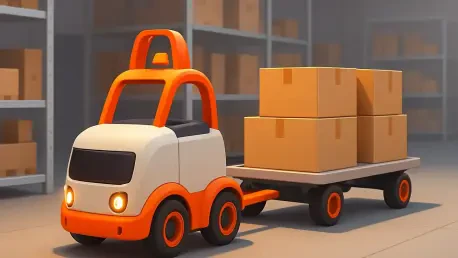

Horizontal transport through tuggers and tow tractors remains the most popular entry point for companies beginning their journey into warehouse automation. This specific shift in 2026 marks a broader transition within the logistics sector, where the once-speculative concept of driverless pallet handling has evolved into a fundamental operational strategy. As global supply chains continue to face pressures from fluctuating consumer demands and the need for precision, the automated forklift has emerged as the cornerstone of the modern high-throughput facility. This evolution is characterized by a significant increase in technological sophistication, where machines are no longer tethered to fixed paths but are instead capable of navigating dynamic, busy environments using advanced 3D perception and artificial intelligence. The growth of this market is evidenced by the sheer number of vendors currently competing for shelf space, creating a dense ecosystem of solutions ranging from converted manual trucks to ground-up robotic designs. Consequently, the industry stands at a pivotal crossroads where the promise of complete facility autonomy is being tested against the practical realities of system integration and organizational readiness.
Defining the Bifurcated Supplier Landscape
The current marketplace is distinctly divided into two philosophical camps, each offering a unique value proposition to organizations looking to automate their material handling. On one side are the legacy original equipment manufacturers (OEMs), including industry heavyweights such as Toyota, Raymond, Hyster-Yale, and Linde. these companies have built their reputations on the structural durability and mechanical reliability of their manual equipment over decades. Their strategy in 2026 involves integrating autonomous stacks into their existing, time-tested hardware, effectively creating a “hybrid” model that allows for both manual and autonomous operation. The primary advantage of these established giants is their comprehensive service network; a warehouse manager knows that if a robotic truck malfunctions, a technician with specialized parts is usually just a few miles away. This logistical safety net remains a major selling point for risk-averse corporations that prioritize long-term uptime and equipment longevity over pure software novelty.
Conversely, the market has seen the rapid ascent of robotic-native specialists who approach the material handling challenge from a software-centric perspective. Firms such as Seegrid, Vecna Robotics, and Fox Robotics do not view the forklift as a traditional vehicle but as a sophisticated mobile robot. These specialists have pioneered the use of Simultaneous Localization and Mapping (SLAM) and deep learning algorithms to allow trucks to “see” and “understand” their surroundings in real-time without the need for magnetic tape or floor-mounted reflectors. While they often partner with hardware manufacturers for the chassis, their core intellectual property lies in the navigation and orchestration layers. This “software-first” mentality often results in more agile, faster-learning systems that can adapt to changing warehouse layouts with minimal downtime. However, these newer entrants often face the challenge of scaling their physical service infrastructure to match the global reach of the traditional OEMs, creating a competitive tension that drives continuous innovation across the entire sector.
Specialization: Adapting Machinery for Diverse Operational Tasks
Automation in the warehouse is no longer limited to simple, repetitive movements along a straight line; it has become highly specialized to handle the unique bottlenecks found in modern distribution centers. Horizontal transport vehicles, specifically automated tuggers and tow tractors, continue to dominate sales because they solve the most straightforward problem: moving large volumes of goods across sprawling million-square-foot facilities. These machines excel in long-range hauls where a human operator would otherwise spend hours driving back and forth, a task that offers little value-add compared to the cost of labor. By automating these “highway” routes within the warehouse, facilities can significantly tighten their internal material flow, ensuring that goods arrive at packing stations or shipping docks with predictable regularity. This foundational layer of automation provides the immediate throughput gains necessary to justify further investment in more complex robotic systems.
Beyond the floor-level transport, the industry is seeing a surge in specialized automated reach trucks and pallet stackers designed for vertical storage. Companies like Crown and Jungheinrich are deploying machines that can handle full-pallet putaway and retrieval at varying rack levels, utilizing AI to manage the precise movements required for high-elevation tasks. A particularly significant breakthrough in 2026 is the advancement of trailer loading and unloading automation, a task long considered the “holy grail” of warehouse robotics. Specialized loaders from vendors like Gideon and Fox Robotics are now tackling the chaotic environment of the shipping dock, where trailers may be poorly parked or loaded with shifted, irregular pallets. These machines utilize advanced computer vision to navigate the narrow confines of a container, effectively automating one of the most physically demanding and dangerous jobs in the entire supply chain. This move toward task-specific specialization ensures that automation can be surgical, targeting the exact areas where human labor is most strained or inefficient.
Evaluating Current Market Maturity and Adoption Metrics
Despite the ubiquitous presence of autonomous forklifts at industry trade shows and the impressive growth in vendor counts, the actual state of market adoption in 2026 reveals a landscape that is still maturing. While industry leaders like Linde and Seegrid report thousands of units in active operation, the vast majority of current customer engagements are still categorized as “pilot programs” or limited-scale deployments. For many medium-sized enterprises, the transition to automation is being handled with extreme caution, often starting with just two or three units to prove the business case before committing to a facility-wide overhaul. This gap between technological availability and large-scale operational use is largely due to the complexity of the “orchestration” required to make robots work in harmony with human-driven equipment. A robot is only as efficient as the data feeding it, and many facilities are still upgrading their internal digital infrastructure to support real-time robotic management.
The data suggests a bifurcated adoption curve where the top tier of the market—comprised of Fortune 500 retailers and third-party logistics (3PL) providers—is successfully scaling fleets of 50 to 100 units. These organizations have the capital and the engineering talent to handle the rigorous process changes required for successful automation. In contrast, the “average” warehouse is still navigating the learning curve, often finding that their manual processes are too inconsistent for a robot to handle without significant refinement. Industry experts emphasize that the technology has largely moved past the “can it work?” phase and into the “how do we scale it?” phase. The challenge for 2026 and beyond is not the capability of the individual machine, but the integration of those machines into a cohesive, software-driven ecosystem that can handle the unpredictability of a 24-hour shipping cycle. As these integration hurdles are overcome, the industry expects a massive shift from isolated pilot projects to standardized, fully automated material handling fleets.
The Labor-Safety-Efficiency TrifectPrimary Drivers of Demand
The overwhelming push toward automated forklifts is driven by a structural shift in the global labor market that has made manual operation increasingly unsustainable. In 2026, the shortage of qualified forklift operators is no longer a temporary fluctuation but a permanent reality, with turnover rates in some high-volume regions reaching as high as 200% annually. This instability forces warehouse managers to spend a disproportionate amount of time and capital on constant recruiting and training, only to lose workers to competitors for marginal pay increases. Automated trucks provide a level of operational stability that is impossible to achieve with a human workforce; they do not call in sick, they do not require breaks, and they perform with the same level of precision at the end of a shift as they do at the beginning. By delegating repetitive, high-turnover roles to autonomous machines, companies can reallocate their limited human talent to more cognitive tasks, such as exceptions handling and complex order picking.
Safety remains an equally compelling catalyst for the adoption of robotic material handling, as the data regarding workplace accidents continues to favor automation. Manual forklift operation is inherently risky, with thousands of OSHA-recorded injuries occurring annually due to operator fatigue, distraction, or blind spots. Autonomous forklifts are equipped with a redundant array of lidar sensors, ultrasonic detectors, and emergency stop systems that provide a 360-degree safety envelope. These systems are programmed to stop instantly when an obstacle is detected, and unlike human operators, they never “cut corners” or ignore speed limits. In many facilities, the introduction of even a small fleet of automated trucks has resulted in an immediate and dramatic reduction in product damage and racking repairs. This improvement in the safety profile not only protects the workforce but also significantly reduces insurance premiums and the high costs associated with workplace litigation and equipment downtime.
Navigating the Financial and Technical Barriers to Implementation
While the benefits of automation are well-documented, the initial financial hurdle remains a significant barrier for many organizations looking to modernize their fleets. An automated forklift can carry a price tag ranging from $100,000 to $200,000, which is often three to four times the cost of a standard manual truck. This upfront capital expenditure (CapEx) must be weighed against the long-term savings in labor and safety, but for smaller businesses with tight margins, the initial investment can be difficult to stomach. Furthermore, the cost of the hardware is only one part of the equation; companies must also factor in the “soft costs” of systems integration, facility mapping, and the potential disruption to ongoing operations during the transition period. In 2026, the most successful implementations are those that view automation not as a simple equipment purchase, but as a comprehensive infrastructure project that requires a long-term financial and strategic commitment.
Technical integration presents another layer of complexity, as merging new robotic software with legacy warehouse management systems (WMS) often requires significant IT resources. For a robotic fleet to be truly effective, it must be able to communicate seamlessly with the facility’s “brain,” receiving real-time updates on pallet locations and order priorities. Many older warehouses lack the robust Wi-Fi or 5G coverage necessary to maintain a constant data link with a fleet of mobile robots, leading to “dead zones” where machines may stall or lose their positioning. Additionally, the physical environment of the warehouse itself often needs refinement; while 2026-era sensors are highly advanced, they still perform best in environments with clear signage, consistent floor quality, and organized racking. Companies that fail to address these technical and environmental prerequisites often find that their expensive robotic investment leads to “automated chaos,” where the machines are constantly stopping due to environmental inconsistencies that a human operator would easily navigate.
Strategic Financial Models and Holistic Return on Investment
To address the high entry costs of automation, the industry has shifted toward more flexible financial structures that align with the “as-a-service” economy. Robotics as a Service (RaaS) has become a dominant model in 2026, allowing companies to lease automated forklifts and the accompanying software for a predictable monthly fee. This OpEx-focused approach effectively shifts the risk of technological obsolescence from the end-user to the vendor, as software updates and hardware maintenance are typically included in the service agreement. For many 3PLs with short-term customer contracts, this flexibility is essential; it allows them to scale their automation up or down based on current volume without being locked into a decade-long depreciation schedule for expensive hardware. This democratization of the technology is enabling a broader range of companies to participate in the automation revolution, moving beyond the elite tier of mega-corporations.
Furthermore, forward-thinking organizations are adopting a more holistic view of return on investment (ROI) that goes beyond simple labor replacement. While the reduction in headcount is the most visible saving, the “hidden” benefits of automation—such as increased inventory accuracy, reduced product damage, and lower recruitment costs—often represent the larger portion of the financial gain. In 2026, companies are using sophisticated data analytics to track the performance of their robotic fleets, correlating automated precision with a decrease in shipping errors and a reduction in customer churn. By quantifying the value of process predictability and the elimination of safety-related fines, businesses can build a much more robust case for automation. This shift in perspective allows the conversation to move away from “how much does the truck cost?” to “how much value does a stable, safe, and predictable material flow create for the entire enterprise?”
Future Industry Trajectory and the Imperative for Consolidation
The trajectory for the automated forklift market suggests a decade of rapid expansion, with projections indicating a global market value exceeding $14 billion by the mid-2030s. This growth is expected to be fueled by deeper integrations of the Internet of Things (IoT) and edge computing, which will allow forklift fleets to operate with even greater autonomy and less reliance on centralized processing. However, industry veterans in 2026 anticipate a significant “shakeout” period for the hundreds of vendors currently operating in the space. The historical pattern of emerging technologies suggests that as the market matures, customers will move away from experimental startups toward vendors that can provide a total solution, including national service networks and long-term hardware support. It is estimated that a vast majority of the current “automation-only” firms will either be acquired by larger OEMs or exit the market as the demand for localized, hands-on support becomes the primary differentiator.
The survivors of this consolidation will be those companies that successfully marry high-level robotic intelligence with the “boots-on-the-ground” reliability required by heavy industry. The focus of innovation is shifting from individual machine navigation to fleet-wide orchestration, where AI-driven systems manage the movement of hundreds of robots across multiple facilities in real-time. This level of complexity requires a vendor to be more than just a software provider; they must be a strategic partner capable of managing the entire lifecycle of the automation project. As 2026 progresses, the industry is increasingly moving toward a standard of “universal interoperability,” where robots from different manufacturers can share the same floor space and communicate via standardized protocols. This shift will further lower the barriers to entry, allowing warehouses to mix and match specialized equipment to create a bespoke automated ecosystem tailored to their specific operational needs.
Final Considerations for Achieving Long-Term Industrial Autonomy
The strategic evolution of the automated forklift market reached a critical juncture as organizations moved past the initial excitement of technology toward the rigorous demands of large-scale execution. Successful companies took decisive steps to align their internal physical infrastructure with the digital requirements of autonomous fleets, ensuring that floor quality and connectivity supported high-performance robotics. They recognized that the value of automation was maximized only when it was integrated into a wider culture of operational discipline, where data-driven insights informed every aspect of the material flow. By transitioning from a “product” mindset to a “project” mindset, these early adopters transformed their warehouses into resilient, high-throughput hubs that remained unaffected by the volatility of the external labor market. The emphasis shifted toward selecting partners who offered not just cutting-edge navigation software but also the comprehensive service networks necessary to maintain 24-hour industrial operations over the long term.
Organizations that effectively navigated this transition found that their investments paid dividends far beyond simple labor cost reductions. They achieved a new standard of safety that virtually eliminated workplace incidents, while simultaneously boosting their throughput and accuracy to levels that were previously unattainable with manual processes. Looking ahead, the focus for the industry involved the expansion of these automated systems into the most complex corners of the warehouse, including dynamic trailer unloading and high-density vertical storage. Leaders in the space prioritized the development of an “orchestration layer” that allowed for seamless interaction between human workers and robotic fleets, proving that the future of logistics was not a choice between people and machines, but a synergistic combination of both. As the market continued to consolidate, the survivors were those who provided a stable, scalable path toward full facility autonomy, turning the strategic evolution of 2026 into a permanent standard for global supply chain excellence.