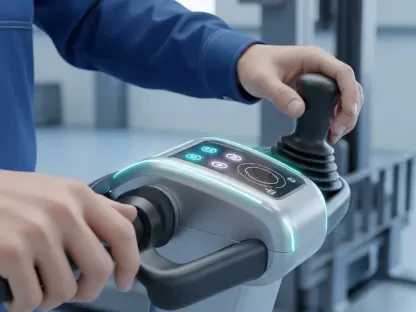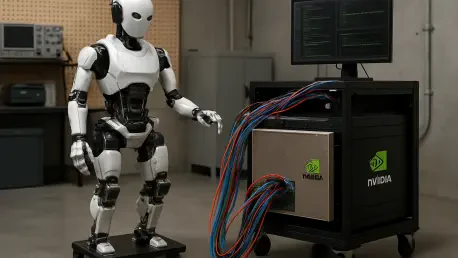

The complex and resource-intensive journey of bringing advanced humanoid robots from concept to real-world application is being fundamentally reshaped by a new development paradigm centered on powerful AI and simulation. At the forefront of this transformative shift is the UK-based AI and robotics company, Humanoid, which is strategically leveraging a comprehensive suite of NVIDIA technologies to accelerate the creation and deployment of its HMND 01 Alpha robots. These sophisticated platforms exist in two distinct forms to address different market needs: a wheeled system designed for immediate integration into industrial environments and an advanced bipedal version intended for research and development into future service applications. The company’s approach has already demonstrated tangible success through a notable proof-of-concept with the industrial supplier Schaeffler, validating the efficiency and real-world viability of its technology stack and development methodology. This progress signals a pivotal moment for the robotics industry, where the deep integration of virtual development and physical hardware is rapidly closing the gap between design and functionality.
Virtual Proving Grounds for Real World Robots
The core of Humanoid’s accelerated development cycle is a “simulation-first” strategy, made possible by the robust capabilities of NVIDIA’s Isaac software platform. Humanoid extensively utilizes NVIDIA Isaac Lab to apply advanced reinforcement learning techniques, a method that allows the robots to learn and refine complex behaviors through trial and error in a safe, virtual space. This process is instrumental in mastering intricate skills such as stable locomotion and precise object manipulation, tasks that would be prohibitively slow and risky to teach on physical hardware alone. Simultaneously, NVIDIA Isaac Sim is employed to create sophisticated, physics-accurate digital twins of the HMND 01 robots. These digital replicas serve as the perfect environment for hardware-in-the-loop validation, enabling engineers to rigorously test and debug middleware, control systems, and navigation policies before they are ever deployed on the physical machines. This seamless pipeline from virtual training to real-world execution dramatically streamlines the entire development process.
A Blueprint for Future Robotics
The operational intelligence of the HMND 01 Alpha was powered by the NVIDIA Jetson Thor, a compact supercomputer that served as the robot’s onboard brain. This integration proved to be a critical architectural decision, as it provided the necessary computational power to run the industry’s largest and most capable robotic AI foundation models directly on the edge. This capability not only enhanced the robot’s autonomy and responsiveness but also simplified the overall system architecture, reducing complex wiring and improving long-term serviceability. Looking beyond its own platform, Humanoid entered into a collaboration with NVIDIA to define a new open networking standard for AI-enabled, software-defined robotics. This forward-looking initiative, built upon the foundation of Jetson Thor and the Holoscan Sensor Bridge, aimed to establish a new benchmark for interoperability and performance across the industry, potentially creating a lasting impact that would guide the development of intelligent robots for years to come.