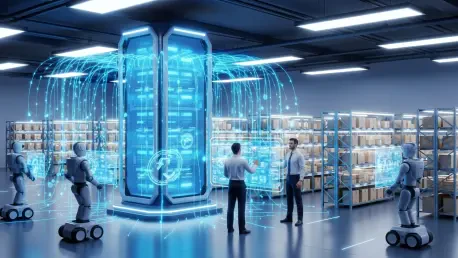

Rohit Laila is a veteran of the logistics industry with decades spent navigating the complexities of supply chain management and last-mile delivery. His deep-seated passion for technology has led him to champion warehouse automation as a bridge between operational efficiency and human safety. In this discussion, we explore how seamless integrations between management software and robotics are redefining the modern fulfillment landscape and solving the industry’s most persistent labor challenges.
How does the direct integration between a warehouse management system and autonomous robots simplify the initial setup for companies?
The direct integration between EPG’s warehouse management system and Locus Robotics removes the typical technical friction by providing a ready-to-use setup that doesn’t require months of custom coding. By bridging the gap between the software “brain” and the robotic “muscle” from day one, companies can avoid the hurdles that usually stall automation projects. This “plug-and-play” nature allows businesses to scale up their order picking and fulfillment without tearing down their existing infrastructure or stopping production. It effectively transforms a daunting technological leap into a practical, manageable step forward for everyday warehouse operations.
When robots handle long-distance travel while workers remain at fixed picking stations, what shifts occur in daily productivity metrics?
The most immediate shift is the drastic reduction in “dead time” where workers are simply walking across vast distances instead of actually picking items. By letting the robots handle the long treks across the warehouse floor, the speed of order processing increases significantly because the human touch is reserved for high-value tasks. Employees feel the difference in their bodies by the end of a high-volume shift, as the physical strain of walking miles on hard concrete is replaced by a more ergonomic, stationary workflow. This shift doesn’t just boost the fulfillment numbers; it fosters a safer, more sustainable environment where workers aren’t physically exhausted halfway through their day.
How does real-time task allocation between the software and robots help a facility manage sudden spikes in order volume?
Real-time allocation acts as the central engine that keeps the warehouse humming even when order volumes skyrocket during peak seasons. The EPG system tracks every single order and instantly broadcasts tasks to the Locus robots, ensuring there is never a lag between a customer clicking “buy” and a robot moving toward the item. This constant synchronization means that human pickers are always met by a robot exactly when they need to be, moving items through various zones with surgical precision. It creates a fluid, rhythmic movement within the building where technology and people act as a single, cohesive unit rather than separate, disjointed parts.
Why is it beneficial for businesses to test these systems in a live simulation environment before a full rollout?
Testing at a dedicated facility like the Logistics Solution Center in Germany allows leaders to see the tactile reality of robots interacting with storage systems and software. It takes the abstract promises of a sales pitch and turns them into a visible, moving operation where customers can witness exactly how automation fits into a real warehouse environment. Companies gain critical operational insights into how different technologies work together, which helps reduce the “intimidation factor” that often prevents firms from adopting new tools. Seeing a robot stop precisely at a picking station and interface with the software provides a level of confidence that a standard spreadsheet simply cannot offer.
Given the ongoing labor shortages in the logistics sector, how does a software-driven fulfillment strategy provide long-term stability?
A software-driven approach acts as a stabilizer in an increasingly volatile labor market where finding and keeping staff has become a constant struggle for many firms. By integrating powerful software with robotics, businesses can maintain high fulfillment standards without being entirely dependent on an overextended or unavailable workforce. The partnership between a software provider and a robotics firm offers far more value than isolated tools because it creates a unified ecosystem designed specifically for scalability. It is about building a future-proof foundation that can absorb the pressures of rising order volumes while simultaneously protecting the well-being of the current staff.
What is your forecast for warehouse automation?
I predict that the line between warehouse software and robotic hardware will continue to blur until they are viewed as a single, inseparable entity by logistics managers. We are moving toward a global standard where automation is no longer a luxury for giants, but a baseline requirement for any company that wants to remain competitive and safe. In the coming years, we will see these integrated systems become even more intuitive, allowing warehouses to respond to global market shifts in minutes rather than weeks. The ultimate goal is a seamless “human-technology” synergy that turns the warehouse into the most efficient and reliable link in the entire global supply chain.