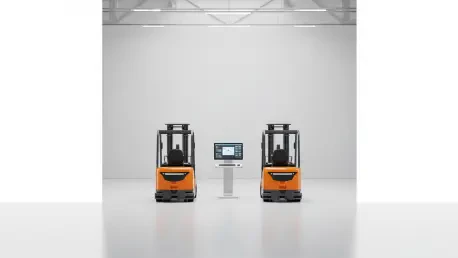

The historic gatekeeping of high-end logistics technology is finally crumbling as sophisticated autonomous systems move from the exclusive domain of global conglomerates into the hands of local warehouse operators. For decades, the material handling sector remained bifurcated between manual labor and million-dollar enterprise systems that required massive structural overhauls. Big Joe Autonomous Solutions is currently dismantling this hierarchy by pivoting toward small-to-medium-sized businesses with a product line designed for immediate utility rather than complex engineering projects. This shift represents a fundamental change in how the industry views scalability, prioritizing flexibility over rigid, permanent automation frameworks.
Modern warehousing currently exists in a state of high tension where the demand for rapid fulfillment clashes with the limitations of traditional storage layouts. While massive fulfillment centers have successfully integrated heavy-duty robotics, smaller facilities often lack the capital or the architectural flexibility to follow suit. The market is now seeing a rise in entry-level solutions that do not demand a total facility transformation. This enables smaller operators to adopt a tiered approach to modernization, starting with a single unit rather than a fleet-wide deployment that could disrupt daily workflows.
The technological foundation of this transition relies heavily on Light Detection and Ranging alongside Simultaneous Localization and Mapping. These advancements allow robots to perceive their environment in real-time, effectively eliminating the need for invasive infrastructure like magnetic floor tape or specialized, high-bandwidth Wi-Fi networks. By allowing machines to map their own paths and adjust to dynamic obstacles, the barrier to entry has dropped significantly. This infrastructure-free approach ensures that a warehouse can remain operational during the integration phase, which was previously impossible with older generations of guided vehicles.
Competitive dynamics are also shifting as agile innovators like Big Joe challenge the dominance of established giants like Toyota and Crown. While the larger manufacturers have focused on heavy industrial applications and massive fleet management, the move toward approachable automation targets the underserved niche of warehouses that need only a few versatile units. This competition is driving down costs and accelerating the pace of software updates, ensuring that even the most modest operation can access cutting-edge navigation tools. Furthermore, the push for sustainability through lithium-ion technology is ensuring these new units meet strict environmental regulations while providing the opportunity charging needed for high-demand schedules.
The Evolution of Material Handling and the Rise of Approachable Automation
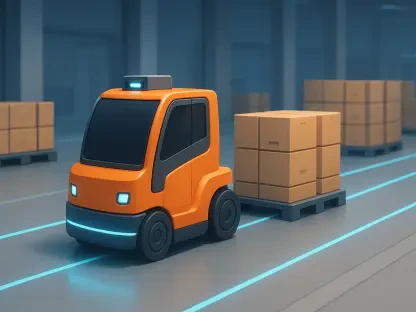
The material handling industry is moving away from the era of specialized robotics toward a philosophy of approachable automation. This paradigm shift focuses on creating tools that resemble their manual predecessors but possess the internal intelligence to operate without a driver. By maintaining a familiar form factor, these machines reduce the psychological barrier for staff who may be wary of advanced technology. It creates a bridge between the traditional world of pallet jacks and the futuristic vision of a fully lights-out facility.
Smaller businesses often face a unique set of constraints that enterprise-level systems fail to address, such as irregular floor plans and seasonal spikes in inventory. Approachable automation solves this by offering units that can be moved or reprogrammed with minimal downtime. This flexibility allows an operator to reassign a robot from a tugging task to a stacking task as the day progresses. The democratization of this technology ensures that the size of a business no longer dictates its ability to utilize high-speed logistics tools.
Navigating the Shift Toward Scalable Robotic Integration
Emerging Technologies and the Movement Toward Infrastructure-Free Solutions
The plug-and-play philosophy is the cornerstone of modern robotic deployment, allowing for immediate integration without facility retrofits. Instead of spending months on floor preparation and structural modifications, warehouse managers can now introduce autonomous units that begin learning their routes within hours. This immediacy is vital for companies that cannot afford to halt production for a digital upgrade. The simplicity of these systems means that a facility can evolve organically, adding one robot at a time as the budget allows.
Labor augmentation strategies are replacing the outdated narrative of total human replacement in the supply chain. With logistics turnover rates hovering around 36 percent, the goal is to stabilize the workforce by delegating monotonous and physically demanding tasks to machines. This allows human workers to move into supervisory roles where they manage robotic fleets rather than pulling heavy loads manually for miles every day. The focus is on enhancing the existing workforce, making the job safer and more intellectually engaging for the people who remain.
The versatility of hybrid fleets, including units like the AP44 pallet truck and the ASC40 stacker, provides a safety net for unpredictable operational demands. These machines offer multi-mode capabilities, meaning they can function as fully autonomous robots or as standard manual equipment at the flip of a switch. If a specific task requires human intuition or a sudden detour, the operator can take control immediately. This dual-purpose design ensures that the investment is never sitting idle due to software limitations or complex site changes.
Projecting Growth in the Autonomous Forklift and Logistical Robot Market
Market projections indicate that the global autonomous forklift sector will exceed 8 billion dollars by the end of this year. This rapid growth is fueled by a growing recognition that automation is no longer a luxury but a necessity for surviving in a low-margin environment. As more businesses realize the potential for long-term savings, the influx of capital is driving further innovation in sensor technology and battery efficiency. This creates a positive feedback loop where increased adoption leads to lower costs for the next wave of buyers.
Evaluating the return on investment for small businesses shows a surprisingly short payback period of 14 to 20 months. For companies running multiple shifts, the reduction in labor costs alone justifies the initial capital expenditure of 50,000 to 250,000 dollars. Beyond just the hourly wage savings, the precision of autonomous movement reduces the frequency of product damage and equipment repairs. These hidden savings often make the financial case for automation even more compelling than the direct labor reduction.
Documented performance indicators show an 85 percent increase in productivity when autonomous units are integrated into a traditional workflow. Throughput typically rises by 30 percent because robots do not require breaks and can maintain a consistent pace throughout an entire shift. This level of reliability allows warehouse managers to plan their logistics with much greater accuracy, leading to better customer satisfaction. Comparing these gains against the initial costs proves that the transition is a strategic move toward long-term operational stability.
Overcoming Operational Hurdles in Small-Scale Automation Deployment
The initial capital expenditure remains a significant barrier for many smaller operations despite the clear long-term benefits. Managing the high upfront costs requires creative financial strategies, such as leasing programs or performance-based contracts that allow businesses to pay as they grow. Some providers are now offering automation as a service, which shifts the burden of ownership to the manufacturer. This model allows small players to benefit from the technology without taking on the full risk of a large asset purchase.
Maintenance and support gaps can often derail an automation project if a company relies on a software-centric startup with no local presence. Utilizing established nationwide dealer networks provides the necessary boots-on-the-ground service that heavy machinery requires. When a robot experiences a mechanical failure, the business needs a technician who can arrive within hours, not days. This marriage of advanced software and traditional service infrastructure is what allows autonomous solutions to thrive in a rugged industrial environment.
Integration with existing workflows is often described as a logistical nightmare, but it can be managed through careful planning. The key is to avoid over-complicating the initial deployment by focusing on the most repetitive and simple tasks first. By starting with long-haul transport or basic pallet movement, a facility can iron out the kinks in the system before moving to more complex racking maneuvers. This gradual approach ensures that the human and robotic elements of the warehouse learn to interact safely and efficiently over time.
Standardizing Safety and Compliance in the Autonomous Warehouse
The regulatory landscape governing autonomous vehicles is becoming more defined as these machines become a common sight in industrial spaces. Safety standards now require multiple layers of redundancy, from physical emergency stops to advanced software-based obstacle detection. These mandates ensure that machines can operate in close proximity to humans without the risk of collision. Compliance is no longer just a legal hurdle; it is a fundamental requirement for maintaining a high-performance workspace.
Safety is also a significant performance driver because autonomous precision can reduce facility accidents by up to 90 percent. Unlike human operators, robots do not experience fatigue or distraction, which are the leading causes of forklift-related injuries. A safer environment leads to lower insurance premiums and less time lost to investigations or repairs. In this way, the strict adherence to safety protocols actually improves the bottom line by creating a more predictable and stable operational flow.
Data security and connectivity are increasingly important as robotic fleets become more integrated with warehouse management systems. Addressing cybersecurity requirements ensures that a connected fleet cannot be compromised by external threats. Modern fleet management software now includes encrypted communication channels and robust access controls to protect sensitive logistical data. As warehouses become more digitized, the ability to secure these connections will be just as important as the physical safety of the robots themselves.
The Road Ahead: Anticipating the Next Wave of Logistics Innovation
The future of the industry is not likely to be a dark warehouse filled entirely with robots, but rather a hybrid model defined by collaboration. Human intelligence is still required for complex problem-solving and exception handling, while machines handle the heavy lifting. This synergy creates a more resilient supply chain that can adapt to sudden market shifts or inventory changes. The goal of innovation is to remove the friction from logistics, making it easier for human workers to direct the flow of goods with high-level commands.
Technological disruptors like AI-driven predictive maintenance and advanced computer vision are poised to enhance the next generation of robots. Predictive maintenance allows a machine to signal for a repair before a failure occurs, virtually eliminating unplanned downtime. Computer vision is becoming so advanced that robots can now identify damaged pallets or misaligned loads, preventing errors before they move further down the line. These tools are making autonomous vehicles smarter and more independent with every software iteration.
Global economic influences, such as supply chain volatility and persistent labor shortages, will continue to accelerate the adoption of approachable technology. Businesses that fail to automate may find themselves unable to compete with the speed and efficiency of those that do. The democratization of these tools allows small players to compete on a more level playing field with global e-commerce giants. By lowering the barriers to entry, the industry is ensuring that innovation is accessible to every level of the supply chain.
Summary of the Pragmatic Path Toward Industrial Modernization
Big Joe successfully identified a critical gap in the market by providing flexible, infrastructure-free vehicles for the small-to-medium business sector. The report demonstrated that the transition toward autonomous solutions moved from being a luxury to a mandatory requirement for maintaining logistical competitiveness. Managers analyzed the multi-mode capabilities of the new fleet and found that the ability to switch between manual and autonomous operation mitigated the risks of early adoption. This pragmatic approach allowed for a seamless integration that did not require the cessation of current operations or massive capital investments.
The investment outlook for the remainder of the decade indicated a strong preference for scalable, modular systems over monolithic automation projects. Stakeholders recognized that the 14-to-20-month payback period was achievable for even single-shift facilities when factoring in reduced damage and increased throughput. This financial clarity prompted a wave of modernization among local distributors who previously viewed robotics as unattainable. The shift toward lithium-ion power further aligned these investments with global sustainability goals, ensuring long-term compliance with environmental standards.
Pragmatic automation emerged as the most viable future for the global supply chain, offering a path that respected both human labor and technological progress. Warehouse managers were encouraged to begin their transition by identifying high-frequency, low-complexity tasks for their first autonomous units. By focusing on dealer-supported hardware and infrastructure-free navigation, businesses secured their place in a more efficient and safer industrial landscape. The democratization of technology effectively leveled the playing field, allowing the smallest warehouses to operate with the precision of a global titan.