
The sheer volume of decisions required to run a modern distribution center, often exceeding a million per day, has far surpassed the capacity of human managers to effectively oversee every variable in real time. This operational complexity has sparked a significant evolution in how the industry approaches efficiency, shifting the focus away from simply equipping workers with hardware and toward implementing intelligent, software-driven ecosystems. Wearable devices, once viewed as simple data-capture tools like scanners or headsets, are now being recognized as the critical edge components in this new paradigm. They serve as the tangible link between the human workforce and the sophisticated management platforms that power them, transforming what was once a series of discrete tasks into a seamlessly orchestrated, data-rich workflow capable of dynamic problem-solving across the entire facility.
The Primacy of Intelligent Software
The prevailing industry wisdom now recognizes that providing a worker with a wearable device without a sophisticated system behind it is an exercise in futility, akin to sending someone to dig a ditch with a spoon. The physical hardware, while indispensable, is merely the vessel for a far more powerful force: the software. This crucial shift in perspective is driven by the necessity to bridge the immense decision-making gap inherent in today’s complex warehousing environments. Advanced software platforms now serve as the central nervous system of the operation, continuously assessing all variables to optimize the flow of work. This represents a fundamental move away from a hardware-centric model and toward a workflow-centric focus, where the objective is not just to direct an individual’s next action but to enhance efficiency across the entire chain of events, from the receiving dock all the way to outbound shipping. These systems are designed to make the millions of choices that a human manager cannot, ensuring that the right person is doing the right task at the right time.
The ultimate goal of this new generation of software is to achieve true workflow orchestration, transforming static, predefined processes into fluid, adaptable operations. Platforms from industry leaders are designed to function as an overarching framework that provides real-time visibility and control over the entire facility. In practice, this means they can dynamically reallocate resources, adjust priorities based on incoming orders and service level agreements, and guide workers through exceptions with intelligent instructions. This transforms wearables from passive tools into active instruments for fixing problems as they occur, a necessity in environments that are becoming as complex as a spaceship, with constantly shifting inventory and unpredictable customer demands. By orchestrating and balancing workflows across picking, replenishment, and packing, these systems ensure that the entire order fulfillment process is optimized, not just individual tasks. The focus is no longer on simply executing a pick list but on fundamentally reimagining how orders are fulfilled from start to finish.
Centering the Human Element for Maximum Impact
The successful implementation of any wearable technology now hinges directly on user acceptance, a factor that has gained significant prominence as companies grapple with employee retention and the need for peak operational efficiency. The modern workforce, highly accustomed to the intuitive and seamless technology in their personal lives, brings heightened expectations to their professional tools. Forcing employees to use clunky, unintuitive, or uncomfortable devices can quickly lead to job dissatisfaction, decreased morale, and ultimately, higher turnover rates in a fiercely competitive labor market. Consequently, system designers and warehouse managers now understand that technology must be built around the worker, not the other way around. The ease of use, comfort, and practical utility of a wearable device are no longer considered secondary benefits but are recognized as core requirements for achieving the productivity and accuracy gains the technology promises. A system that is rejected by its users is a failed investment, regardless of its technical capabilities.
To secure this crucial buy-in from the workforce, modern wearable systems prioritize an intuitive user experience and advanced functionality that meets the needs of a diverse labor pool. The initial training period, once a significant hurdle, has been drastically reduced, with some platforms enabling a new user to become proficient in less than an hour. Voice-based systems have evolved to the point where specific speech engine training is often unnecessary, and many now support multiple languages, with some even capable of switching between two languages during a single task. This mirrors advancements seen in mainstream consumer technology. Furthermore, the physical form factor and on-screen interface are increasingly tailored to specific industry demands. For example, in pharmaceutical distribution, where a single mispick can be extremely costly, wearable screens must be large enough to display all critical information clearly and unambiguously. In contrast, large-scale retail operations might prioritize a single, simplified device type to maintain consistency and ease of deployment across a vast facility.
The Technological Backbone of Modern Operations
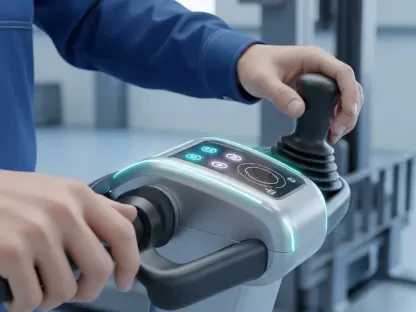
Functioning as the tangible “edge of edge computing” within the warehouse, wearables represent the critical intersection of data, workers, and physical inventory. These devices have evolved far beyond being passive terminals; they are now extremely powerful and intelligent platforms capable of running their own software and facilitating more seamless on-the-ground decision-making. The engine driving these advanced capabilities is Artificial Intelligence (AI) and its subset, Machine Learning (ML). For years, Large Language Models (LLMs) have been integral to voice systems, dramatically enhancing the accuracy and speed of speech recognition. Beyond voice applications, AI, often operating from the cloud or a local server, is the core component that enables the intelligent direction and process optimization provided by the overarching management platforms. It is this AI-powered orchestration that allows the entire system to adapt workflows on the fly and ensure that workers can respond effectively and efficiently to any operational shift or unexpected disruption.
This inherent intelligence is further magnified by an expanding ecosystem of deep system integration, which solidifies the wearable’s role as a central node in a comprehensive, interconnected information network. The connection is no longer limited to a simple data exchange with a single Warehouse Management System (WMS). Today’s advanced wearable ecosystems are deeply integrated with a full suite of operational software, including Warehouse Execution Systems (WES) that optimize how work is performed, Warehouse Control Systems (WCS) that manage automation, and even supply chain control towers that provide end-to-end visibility. This network extends to workforce management software, dock management applications, and parcel shipping systems, ensuring that the worker on the floor is fully connected to the real-time pulse of the entire supply chain. This level of integration ensures that data flows seamlessly between all parts of the operation, empowering the worker with the context and information needed to perform their job with maximum efficiency and accuracy.
A Proven Paradigm for Future Growth
The maturation of wearable technology within the warehouse has successfully transitioned from a conceptual promise to a source of proven, quantifiable success. The synergy between intelligent software, adaptive hardware, and deep system integration created a foundational platform for modern, agile operations. For instance, the implementation of a voice solution at Pet Food Experts directly addressed inventory challenges, resulting in a 38% productivity increase and a 99.9% order accuracy rate. Similarly, CarParts.com achieved a staggering 400% improvement in workflow efficiency by integrating arm-mounted tablets with a WES that used AI to orchestrate and balance tasks. At high-volume distributor RNDC, a voice system combined with a management console doubled picking productivity while maintaining near-perfect accuracy. These victories, once considered exceptional, became the industry standard, validating that the true value of a wearable was unlocked by the intelligence of its connected network. This established framework paved the way for the next frontier: the creation of a predictive operational loop, where systems could not only react in real-time but also anticipate bottlenecks and proactively optimize workflows before problems could arise.