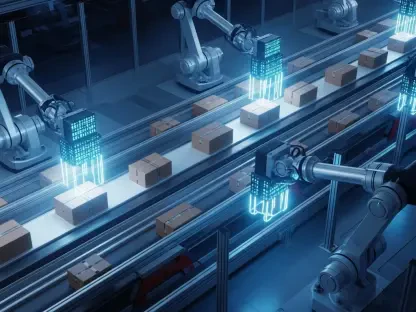

The silent hum of an autonomous drone navigating a towering warehouse aisle represents a far more profound operational shift than mere automation; it signals the dawn of a logistics ecosystem that can see, think, and adapt in real time. Warehouse Machine Vision, a sophisticated fusion of advanced imaging, artificial intelligence, and autonomous platforms, has evolved from a niche technology into a cornerstone of modern supply chain management. This review explores the technology’s journey, dissects its core components and system architectures, and analyzes its real-world impact on efficiency, accuracy, and operational intelligence. The purpose is to provide a comprehensive analysis of the technology’s current state, its emerging trends, and the strategic considerations for its implementation, ultimately assessing its transformative role in the future of logistics.
An Introduction to Vision Technology in Logistics
Defining Machine Vision and Its Core Components
At its core, warehouse machine vision is a technology that grants industrial systems the ability to “see” and interpret their surroundings. It functions by integrating three primary components: image acquisition, data processing, and actionable output. The process begins with advanced imaging hardware, including high-resolution cameras, 3D sensors, and LiDAR scanners, which capture detailed visual data from the warehouse environment. This hardware serves as the system’s eyes, collecting raw information about everything from pallet labels and product conditions to the spatial dimensions of storage racks.
Once captured, this visual data is fed into a processing engine powered by sophisticated software. This is where the “vision” truly happens. Algorithms, often driven by artificial intelligence and machine learning, analyze the images to identify patterns, read text, detect anomalies, and extract meaningful information. This engine translates pixels into structured data—for example, converting an image of a pallet into a confirmed product ID, location, and condition status. The final component is the actionable output, where this processed data is integrated into a warehouse management system (WMS) or presented to operators through an intuitive dashboard, enabling data-driven decisions and automated actions.
The Evolution from Barcode Scanning to AI-Powered Vision
The trajectory of data capture in logistics has been a steady progression from manual methods to increasingly intelligent automation. For decades, the handheld barcode scanner was the pinnacle of warehouse technology, replacing pen-and-paper checklists and dramatically improving the speed of inventory tracking. However, barcode scanning remains a point-in-time, human-dependent process. It requires an operator to be physically present, to aim the scanner correctly, and is rendered useless by damaged, obscured, or poorly printed labels. This method provides a narrow snapshot of inventory status, creating a lag between physical reality and system data.
The advent of AI-powered machine vision marks a paradigm shift from this legacy approach. Instead of merely decoding a predefined pattern, vision systems interpret the entire visual scene. Modern AI models can now read text using optical character recognition (OCR) even when a barcode is unreadable, identify products based on their appearance alone, and assess the structural integrity of a pallet without needing a specific label. This leap in capability moves data capture from a discrete, manual task to a continuous, ambient process, laying the groundwork for a truly intelligent and self-aware operational environment.
Why Machine Vision is Critical for Modern Warehouses
The pressures on modern warehousing and distribution centers have rendered traditional, reactive management models untenable. The explosion of e-commerce has led to an exponential increase in stock keeping units (SKUs) and order volumes, while customer expectations for next-day or even same-day delivery have compressed operational timelines to their absolute limit. In this high-velocity environment, the inaccuracies and inefficiencies inherent in manual processes—mis-picks, lost inventory, and data entry errors—are no longer acceptable costs of doing business. They are critical failures that directly impact customer satisfaction and profitability.
Machine vision addresses these challenges by providing a level of accuracy, speed, and consistency that is humanly impossible to achieve. By automating tasks like inventory counting, shipment verification, and quality control, it frees human workers from repetitive, error-prone activities and reallocates their skills toward higher-value problem-solving. More importantly, the continuous stream of data generated by vision systems provides an unprecedented level of real-time visibility. This allows managers to move from fighting fires to proactively identifying and resolving potential issues before they disrupt the supply chain, making machine vision an essential tool for survival and growth in the competitive logistics landscape.
Key Technologies and System Architectures
Advanced Imaging and Sensor Hardware
The effectiveness of any machine vision system begins with the quality of its sensory input. The hardware suite has become increasingly sophisticated and accessible, driven by advancements in sensor technology and falling production costs. High-resolution digital cameras are the foundation, capable of capturing crisp images even in the challenging lighting conditions of a typical warehouse. These are often supplemented by 3D depth-sensing cameras and LiDAR (Light Detection and Ranging) sensors, which create detailed point clouds of the environment. This allows the system not only to see an object but also to understand its volume, shape, and precise position in three-dimensional space.
This multi-sensory approach provides a rich dataset that is far more robust than a simple 2D image. For instance, a 3D sensor can detect if a pallet is leaning precariously or if boxes are overhanging the rack, a safety hazard a standard camera might miss. The increasing durability and miniaturization of these sensors have also been critical, enabling their integration onto a wide range of mobile platforms, from nimble drones to heavy-duty forklifts, without impeding normal operations. This hardware forms the physical backbone of the system, responsible for collecting the raw data that fuels the entire intelligent process.
AI, Machine Learning, and Data Processing Models
If sensors are the eyes of the system, then artificial intelligence and machine learning models are the brain. The raw visual data captured by the hardware is meaningless without sophisticated algorithms to interpret it. Modern AI vision models represent a significant leap beyond older, more rigid systems that required extensive, SKU-specific training. Today’s models are often pre-trained on vast, generalized datasets of warehouse imagery, enabling them to recognize objects, read text, and identify anomalies with minimal specific configuration. This adaptability makes them far more powerful and easier to deploy in diverse, high-SKU environments.
These AI models perform a variety of complex tasks in real time. Convolutional Neural Networks (CNNs) excel at object recognition, distinguishing between different products or identifying damage to packaging. Optical Character Recognition (OCR) models extract alphanumeric data from labels, even when they are partially obscured or distorted. Over time, these systems continuously learn and improve. By analyzing new data, they refine their recognition capabilities, becoming more accurate and adept at identifying subtle patterns and outliers, thus enhancing the overall intelligence and reliability of the warehouse operation.
Autonomous Platforms for Data Capture
To achieve comprehensive visibility, vision systems must be mobile. Mounting cameras on autonomous platforms has proven to be the most effective strategy for capturing data throughout a facility without disrupting workflow. Autonomous drones have emerged as a powerful solution for managing inventory at height. They can navigate warehouse aisles safely and efficiently, scanning high-level racks that are dangerous and time-consuming for human workers to access. This not only improves safety but also enables inventory counts to be conducted with far greater frequency.
On the ground, autonomous mobile robots (AMRs) and sensor-equipped forklifts provide continuous data capture at floor and mid-levels. By integrating cameras and sensors directly onto forklifts, warehouses can leverage the constant movement of their existing material handling equipment to perform rolling cycle counts as part of normal operations. As an operator transports a pallet, the onboard vision system automatically scans pallet and location labels, creating a constantly updated record of inventory status. This symbiotic relationship between autonomous platforms and vision technology transforms data collection from a scheduled event into a continuous, background process.
Integration with Warehouse Management Systems (WMS)
A machine vision system operating in isolation is of limited value. Its true power is unleashed only when it is seamlessly integrated with a facility’s core operational software, primarily the Warehouse Management System (WMS) and Enterprise Resource Planning (ERP) systems. This integration creates a closed-loop information ecosystem where the vision system acts as the real-time eyes on the ground, feeding a constant stream of verified data directly into the system of record. This eliminates the manual data entry that is a primary source of inventory discrepancies.
Effective integration ensures that the insights generated by the vision system are immediately actionable. When a drone identifies a misplaced pallet, for example, the WMS can automatically generate a task for a worker to correct it. When a forklift-mounted camera confirms a pallet has been placed in the correct location, the WMS inventory is updated instantly. This tight coupling between the physical and digital worlds ensures data integrity, improves decision-making, and provides a single, reliable source of truth for the entire operation. A failure to integrate effectively can create debilitating data silos, nullifying the potential return on investment.
Emerging Trends and Recent Innovations
The Shift Toward Continuous and Real-Time Data Capture
One of the most significant trends in warehouse technology is the transition from periodic, snapshot-based data collection to continuous, real-time intelligence. Traditional inventory management, reliant on quarterly or annual physical counts, provides a picture of the warehouse that is outdated almost as soon as it is completed. This reactive model forces managers to make decisions based on old information, leading to stockouts, overstocking, and inefficient use of labor.
Machine vision, deployed on autonomous platforms, fundamentally alters this dynamic. With drones and forklifts constantly scanning the facility, the data feed becomes a live stream rather than a static photograph. This continuous cycle counting provides an up-to-the-minute view of inventory levels and locations, enabling a proactive management style. Managers can identify and address discrepancies as they occur, rather than discovering them weeks later. This shift toward real-time data capture is not merely an incremental improvement; it is a foundational change that enables greater agility and responsiveness across the entire supply chain.
The Rise of the Warehouse Digital Twin
Building upon the foundation of continuous data capture is the emergence of the warehouse digital twin. A digital twin is a dynamic, virtual model of the physical warehouse that is updated in real time with data from machine vision systems and other sensors. This is far more than a static 3D map; it is a living, breathing replica of the operational environment, mirroring the exact location and status of every pallet, rack, and piece of equipment. This provides operators with a complete, holistic view of how both inventory and physical space are being utilized.
The digital twin serves as a powerful analytical and simulation tool. Managers can use it to visualize workflows, identify bottlenecks, and spot inefficiencies in storage patterns without ever setting foot on the warehouse floor. Furthermore, it enables them to test operational scenarios virtually—for example, modeling the impact of a new racking layout or a different picking strategy before committing to expensive physical changes. AI-driven platforms process this complex information and present it through intuitive dashboards, making sophisticated analytics accessible to frontline teams and transforming the warehouse into a highly optimized, data-driven ecosystem.
Advancements in AI for Anomaly and Damage Detection
The intelligence of machine vision systems is advancing rapidly, particularly in the nuanced area of anomaly and damage detection. Early systems were primarily focused on barcode reading and location verification, but modern AI models can perceive and interpret a much wider range of visual cues. These systems can now be trained to identify subtle signs of damage to packaging, such as dents, tears, or water stains, automatically flagging compromised goods for inspection at the receiving dock. This prevents damaged products from entering the inventory and potentially being shipped to a customer.
Beyond product condition, advanced AI is also being used to monitor operational processes and safety compliance. A vision system can detect when a pallet is stacked improperly, identify trip-and-fall hazards like debris in an aisle, or ensure that equipment is being operated within designated zones. By continuously monitoring the environment for deviations from the norm, these systems act as a vigilant, ever-present layer of quality and safety control, identifying potential problems that a human inspector might easily overlook in a busy, fast-paced setting.
Real-World Applications and Use Cases
Automated Inventory Management and Cycle Counting
The most immediate and impactful application of warehouse machine vision is the automation of inventory management. Traditional cycle counting is a notoriously arduous, time-consuming, and error-prone process that often requires shutting down sections of the warehouse to complete. Autonomous drones and forklift-mounted vision systems have revolutionized this task by making it fast, safe, and non-disruptive. Drones can autonomously scan an entire facility in a matter of hours overnight, while forklifts collect data continuously during their normal daily routes.
This automation yields significant returns in both labor savings and data accuracy. Employees are freed from the monotonous and often dangerous task of manual counting and can be reassigned to more strategic roles, such as analyzing the discrepancy reports generated by the system and resolving inventory issues. The resulting data is not only more accurate but also far more frequent, allowing for a perpetual inventory model that provides a true real-time picture of stock levels. This enhanced visibility reduces carrying costs, minimizes stockouts, and improves overall inventory health.
Inbound and Outbound Shipment Verification
The accuracy of inbound and outbound processes is critical to the integrity of the entire supply chain. Errors at the receiving dock can cascade through the system, leading to phantom inventory and fulfillment problems, while mistakes in outbound shipments result in costly returns and dissatisfied customers. Machine vision systems deployed at dock doors or on conveyor lines automate the verification process with exceptional speed and precision. As pallets or parcels move through these checkpoints, vision systems can scan every label, count items, and even verify product types against the purchase order or shipping manifest.
This automated verification process serves as a crucial quality gate. For inbound shipments, it ensures that the warehouse is receiving exactly what was ordered, flagging any discrepancies in quantity or product type before the goods are put away. For outbound shipments, it provides a final check to confirm that every order is complete and accurate before it leaves the facility. Some systems even capture photographic evidence of each shipment’s condition upon departure, providing valuable documentation in the event of a customer dispute.
Quality Control and Product Inspection
In addition to logistical tasks, machine vision is a powerful tool for automated quality control and product inspection. In environments where product integrity is paramount, such as pharmaceuticals, electronics, or food and beverage, vision systems can perform high-speed inspections that far exceed human capabilities. These systems can identify minute defects, such as cosmetic blemishes, incorrect labeling, or improper seals, on products moving down a production or packaging line.
By catching these defects early, companies can prevent subpar products from reaching the market, protecting brand reputation and avoiding the high cost of recalls. The data collected from these inspections can also be analyzed to identify trends, helping to pinpoint root causes of quality issues within the manufacturing or packaging process. This transforms quality control from a reactive, sample-based activity into a proactive, comprehensive, and data-driven function.
Optimizing Space Utilization and Storage Patterns
Warehouse space is a finite and expensive resource, and optimizing its use is a key priority for any operator. Machine vision systems, particularly when used to create a digital twin, provide the detailed data needed to make intelligent decisions about space utilization. By constantly scanning every rack and storage location, the system can identify empty or partially filled slots, a condition known as honeycombing, which represents wasted capacity. This allows managers to direct consolidation tasks more effectively.
Furthermore, the data can reveal inefficiencies in storage patterns. By analyzing the movement data of products and equipment, the system can help identify which high-velocity items are being stored in suboptimal locations, requiring excessive travel time for picking. Armed with this insight, managers can reorganize the warehouse layout, placing fast-moving SKUs in more accessible forward-picking zones. This data-driven approach to slotting optimization reduces travel time, increases picking efficiency, and maximizes the throughput of the existing facility footprint.
Implementation Challenges and Limitations
Technical Hurdles in Diverse Warehouse Environments
Despite its immense potential, implementing machine vision is not without its technical challenges, many of which stem from the difficult and dynamic nature of the warehouse environment itself. Poor or inconsistent lighting can create shadows and glare that confuse cameras, while dust and debris can obscure sensor lenses, degrading data quality. Highly reflective surfaces, such as shrink wrap or polished concrete floors, can interfere with LiDAR and other light-based sensors. The sheer diversity of product packaging, label types, and storage configurations adds another layer of complexity.
Overcoming these hurdles requires robust hardware designed for industrial use and intelligent software capable of adapting to variable conditions. For example, systems may use advanced image processing techniques to compensate for poor lighting or employ AI models that can recognize a product even when its label is partially torn or smudged. Successful deployment depends on a thorough site assessment to identify these potential environmental challenges and select a system with the resilience and adaptability to perform reliably within that specific setting.
Data Integration and Legacy System Compatibility
A significant barrier to adoption is the challenge of integrating a new machine vision system with a company’s existing technology stack. Many warehouses and distribution centers still run on older, legacy WMS or ERP systems that were not designed for real-time data exchange. These systems may lack modern APIs (Application Programming Interfaces), making it difficult and expensive to create the seamless, two-way communication channel required to unlock the full value of the vision data.
Without proper integration, the vision system risks becoming another data silo, forcing employees to manually transfer information between systems, which reintroduces the very inefficiency and potential for error the technology was meant to eliminate. A successful implementation project must therefore include a clear and well-defined integration strategy from the outset. This often requires close collaboration between the vision technology vendor and the company’s IT department to develop custom connectors or middleware that can bridge the gap between the new and legacy systems.
Calculating ROI and Managing Upfront Investment
The financial considerations of adopting machine vision technology are a primary concern for many operators. The upfront investment can be substantial, encompassing the cost of hardware (drones, cameras, sensors), software licensing, and the professional services required for installation and integration. For small to medium-sized businesses, this initial capital expenditure can present a significant hurdle, even if the long-term benefits are clear.
Therefore, building a compelling business case with a clear and credible calculation of the return on investment (ROI) is crucial. The ROI calculation must account for both direct and indirect benefits. Direct savings are often easier to quantify and include reductions in labor costs associated with manual counting and inspection, as well as the elimination of expenses related to inventory write-offs and shipping errors. Indirect benefits, while harder to measure, are equally important and include improved customer satisfaction, increased operational agility, and enhanced employee safety. Presenting a comprehensive case that balances the initial investment against these multifaceted returns is key to securing stakeholder buy-in.
The Future Trajectory of Warehouse Vision
From Data Capture to Predictive Analytics
The evolution of warehouse machine vision is moving beyond its current role as a sophisticated data capture tool and into the realm of predictive analytics. As vision systems accumulate vast amounts of historical data on inventory levels, product movement, and operational workflows, they create a rich dataset that can be mined by machine learning algorithms to forecast future events. This represents a shift from seeing what is happening now to predicting what is likely to happen next.
In the near future, these systems will not only report a current stock level but also predict potential stockouts based on recent demand trends and lead times, automatically triggering a reorder notification. They will be able to forecast equipment maintenance needs by analyzing subtle changes in the performance of forklifts or conveyors. By identifying patterns that precede bottlenecks, the system could predict congestion in a specific aisle during peak hours and proactively suggest alternative routing for picking tasks. This predictive capability will empower managers to prevent problems before they occur, elevating operational efficiency to an entirely new level.
The Fully Autonomous and Adaptive Warehouse
The ultimate trajectory for this technology is the creation of a fully autonomous and adaptive warehouse—a “responsive ecosystem” that can sense, decide, and act in real time with minimal human intervention. In this vision of the future, machine vision will serve as the central nervous system, providing a constant stream of sensory input to a central AI-driven management platform. This platform will not only monitor operations but also actively orchestrate them.
When the system senses an unexpected surge in orders for a particular product, it could autonomously dispatch a fleet of AMRs to reposition that inventory to a forward-picking area. If a conveyor belt is identified as a bottleneck, the system could automatically reroute packages to an alternative line. This adaptive warehouse would continuously optimize its own operations based on real-time conditions, learning from its performance and adjusting its strategies to maximize throughput, efficiency, and resilience. While full autonomy is still on the horizon, the foundational technologies are already in place, and the industry is steadily moving toward this integrated, self-optimizing model.
Expansion Beyond the Warehouse Walls
The principles and technologies of machine vision are too powerful to remain confined within the four walls of the warehouse. The next frontier is the extension of this real-time visibility into adjacent logistical domains, particularly yard and fleet management. The yard is often a “black hole” of operational visibility, where tracking the location and status of trailers and containers relies on manual checks and outdated spreadsheets. Vision systems, using drones or fixed cameras with long-range recognition capabilities, can automate this process, creating a dynamic map of the yard that shows the exact location of every asset.
Similarly, machine vision can be applied to fleet management to monitor the loading and unloading of trucks, verifying that the correct cargo is loaded in the correct sequence and is properly secured for transit. This provides end-to-end visibility, connecting the operations inside the warehouse with the transportation network outside. By dissolving the traditional boundaries between different logistical functions, machine vision promises to create a more unified, transparent, and resilient supply chain from the point of origin to the final destination.
Conclusion: Synthesizing the Review
Summary of Key Findings and Technological Impact
The review found that warehouse machine vision represented a fundamental technological leap, moving logistics operations from a reactive, snapshot-based paradigm to a proactive, real-time model. The convergence of accessible advanced hardware, powerful AI processing, and mobile autonomous platforms had created a tool capable of delivering unprecedented levels of accuracy and operational intelligence. Its impact was most pronounced in automating historically manual and error-prone tasks like inventory management and quality control, which directly translated into significant gains in efficiency and reductions in operational costs. The technology effectively replaced human inconsistency with automated precision.
Furthermore, the continuous data stream generated by these systems was a key enabler for higher-level strategic tools, most notably the warehouse digital twin. This innovation provided managers with a holistic and dynamic view of their entire operation, facilitating data-driven decisions on everything from space utilization to workflow optimization. The technological impact, therefore, was not just in automating individual tasks but in creating a foundation for a fully integrated, intelligent, and self-aware warehouse ecosystem.
Strategic Recommendations for Adoption
Based on the analysis, a set of clear strategic recommendations emerged for organizations considering the adoption of machine vision. It was determined that a focus on proven, real-world solutions over experimental technologies was paramount to ensure a swift and tangible return on investment. Prospective adopters were advised to critically evaluate the quality and actionability of the data output, ensuring the system provided continuous, complete information rather than intermittent updates.
A non-negotiable prerequisite for success was the system’s ability to integrate seamlessly with existing WMS and ERP platforms to avoid the creation of debilitating data silos. The ultimate goal was to acquire not just raw data, but actionable intelligence presented in a usable format, such as a digital twin, that could empower frontline managers. Finally, partnerships with vendors who demonstrated a commitment to long-term support and continuous AI model updates were deemed essential for ensuring the technology remained effective and did not become obsolete.
Final Assessment of Machine Vision’s Role in Logistics
In its final assessment, this review concluded that machine vision had firmly established itself as a foundational pillar of modern, competitive logistics. It was no longer an emerging trend or a niche application but an essential technology for any organization seeking to thrive in a landscape defined by rising customer expectations and complex, high-velocity operations. By providing the real-time visibility and data integrity that were impossible to achieve through manual means, machine vision unlocked new potentials for efficiency, accuracy, and agility. Its role had evolved from a simple tool for data capture into a central nervous system for the intelligent, adaptive, and ultimately autonomous supply chain of the future.