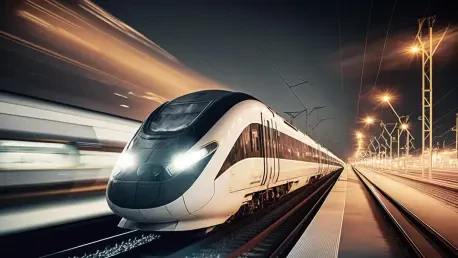

Pushing past the conventional boundaries of railway engineering, South Korea has officially completed a national research program culminating in the core technologies for a revolutionary high-speed train. The Ministry of Land, Infrastructure and Transport (MOLIT) has introduced the EMU-370, a marvel of domestic innovation designed to operate commercially at an impressive 370 kilometers per hour. This achievement not only sets a new benchmark for the nation’s transportation network but also solidifies its position as a formidable force in the competitive global high-speed rail industry.
A Leap Forward in High-Speed Rail Technology
The EMU-370 represents a landmark success story born from South Korea’s dedicated national research and development efforts. With a commercial operating speed of 370 km/h and a design top speed reaching 407 km/h, the train is more than just an incremental upgrade; it is a generational leap. The project’s central theme was the mastery of core technologies essential for next-generation high-speed rail, moving beyond reliance on established international standards to pioneer new solutions for the unique challenges of ultra-high-speed travel.
This initiative’s success signals a new chapter for South Korea, transitioning the nation from a consumer of high-speed rail technology to a leading innovator and producer. By developing the EMU-370, the country has demonstrated a comprehensive engineering capability that encompasses everything from advanced propulsion systems to cutting-edge aerodynamics. This positions South Korea to not only enhance its own infrastructure but also to compete for major international rail projects, exporting its technology and expertise to a global market.
The Strategic National Project Behind the EMU-370
The development of the EMU-370 was the outcome of a meticulously planned, four-year R&D initiative that recently concluded. Spearheaded by the Korea Railroad Research Institute, the project fostered a powerful synergy between public and private sectors, uniting a consortium of seven organizations in a shared mission. This collaborative model proved instrumental in pooling diverse expertise and resources to tackle the complex technical hurdles associated with breaking the 350 km/h speed barrier.
Financially, the project was structured as a strategic public-private partnership, with a total investment of 22.5 billion South Korean Won (approximately 15.5 million USD). The government contributed a significant 18 billion KRW, underscoring the train’s importance to national interests, while private partners invested the remaining 4.5 billion KRW. The technical roadmap began with the KTX-Cheongryong (EMU-320) as a proven foundation, with the primary objective being to systematically engineer solutions for the amplified aerodynamic resistance, vibration, and noise that become critical limiting factors at higher velocities.
Research Methodology, Findings, and Implications
Methodology
The research approach was a structured program designed to elevate an existing train platform to operate at significantly higher speeds. Instead of starting from scratch, the team focused on resolving specific high-speed challenges through targeted engineering and design modifications. This involved a deep analysis of issues such as aerodynamic resistance, which increases exponentially with speed, as well as the complex dynamics of vibration and noise that impact both stability and passenger comfort.
To validate the theoretical improvements, researchers employed a range of comprehensive testing techniques. A key part of this process involved the use of full-scale roller rig tests. By mounting a complete powered bogie on a specialized rig, the team could simulate real-world conditions and safely test the system’s performance and stability at speeds exceeding 400 km/h. This rigorous validation provided the necessary confidence that the newly developed components would perform reliably under the extreme stresses of ultra-high-speed operation.
Findings
The project’s primary outcomes are embodied in six core technological advancements. A cornerstone of this success is a newly developed 560 kW high-output traction motor, which provides a 47.4% power increase over the motors in the EMU-320, delivering the immense force needed for sustained high-speed travel. Concurrently, a complete aerodynamic redesign of the train’s nose, bogie covers, and rooftop equipment resulted in a 12.3% reduction in drag, lowering the aerodynamic drag coefficient from 0.868 to 0.761.
Further innovations include an optimized suspension system with enhanced air springs and dampers, which successfully reduced lateral vibration acceleration to below 6 m/s² for a smoother, more stable ride. Inside the cabin, advanced acoustic insulation using composite materials applied to the floors, walls, and ceiling has lowered interior noise levels by approximately 2 decibels compared to the EMU-320. Finally, the project achieved the localization of airtight passenger doors and developed entirely new safety and performance standards for trains in the 400 km/h class, filling a crucial gap in existing international regulations.
Implications
The practical impact of these findings is profound, significantly strengthening South Korea’s domestic manufacturing ecosystem. The successful localization of critical components like airtight passenger doors reduces the nation’s dependence on foreign suppliers and cultivates a more resilient and self-sufficient industrial base. This inward focus on domestic capability ensures that the economic benefits of rail development are retained within the country, fostering job growth and technological expertise.
From a theoretical and regulatory standpoint, the project’s significance extends far beyond national borders. By developing new safety and performance criteria for speeds above 350 km/h—an area where existing European standards are silent—South Korea has positioned itself at the forefront of establishing the next generation of global benchmarks for ultra-high-speed rail. This leadership role not only enhances its international prestige but also provides a platform for influencing future rail technology standards worldwide, while the improvements in comfort and quietness promise a superior travel experience for passengers.
Reflection and Future Directions
Reflection
The EMU-370 project stands as a testament to the successful navigation of the complex engineering challenges inherent to ultra-high-speed rail. The development team effectively confronted and resolved the critical issues that emerge when a train’s speed surpasses 350 km/h. Problems such as managing immense aerodynamic forces, ensuring vehicle stability against high-frequency vibrations, and mitigating overwhelming acoustic intrusions were not just addressed but overcome through targeted technological innovation.
This accomplishment was achieved by systematically deconstructing each problem and developing a dedicated solution. The increase in motor power directly countered the heightened resistance, while the refined train shape and suspension system worked in tandem to maintain stability and comfort. This targeted approach demonstrates a mature understanding of high-speed dynamics and underscores the project’s success in transforming theoretical challenges into tangible, real-world solutions.
Future Directions
With the core technology now proven, the project is transitioning toward implementation with a clear and defined roadmap. The national railway operator, Korail, is proceeding with an order for one to two initial EMU-370 trainsets, totaling 16 cars. The production of these first vehicles is commencing this year, officially moving the EMU-370 from the development phase into manufacturing.
Looking further ahead, the plan includes a period of extensive test operations scheduled to begin in early 2030. These tests will take place on designated sections of the national rail network, such as the Pyeongtaek–Osong corridor, to validate the train’s performance and reliability in a live operational environment. This final phase of verification is crucial before the EMU-370 is cleared for full commercial service, marking the final step in its journey to becoming a flagship of South Korean transportation.
A New Era for South Korean Transportation
The development of the EMU-370 was a monumental achievement in South Korean engineering, representing a decisive step forward in the nation’s technological sovereignty. By mastering the complex challenges of ultra-high-speed travel, the project not only produced a world-class train but also cultivated a domestic ecosystem of innovation and manufacturing excellence.
This project did more than just create a faster train; it established a new foundation for the future of the nation’s transportation infrastructure and its standing in the global high-speed rail industry. The EMU-370 has become a symbol of national ambition and capability, proving that South Korea is not only a participant in the high-speed rail market but a leader poised to define its future direction.