
The enduring challenge of automation has long been its struggle with unpredictability, as stairs, uneven ground, and harsh weather have consistently confined most robotic applications to the controlled predictability of indoor environments. Shenzhen-based Pudu Robotics, a company that built its reputation on service robots for delivery and cleaning within such structured settings, is now making a decisive leap into these untamed territories. The company has announced the D5 Series, a new generation of industry-grade autonomous quadruped robots designed specifically to address the automation gap in complex, large-scale outdoor and industrial environments. This strategic expansion marks a significant evolution for the company, moving beyond familiar applications to tackle critical tasks in settings where traditional wheeled robots have proven ineffective, heralding a new era of versatile, all-terrain automation. This move is not merely an extension of its product line but a fundamental step towards a future where robotics can seamlessly integrate into the most demanding facets of industry and public service.
Bridging the Automation Gap in Challenging Environments
A Dual-Model Approach to Versatility
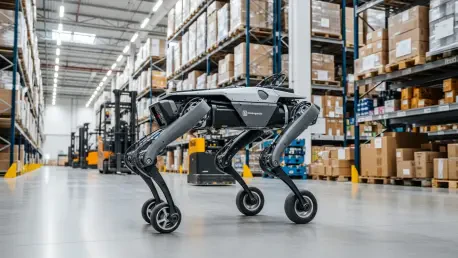
Pudu Robotics’ strategy with the D5 Series hinges on a nuanced understanding that a single design cannot effectively address the wide spectrum of challenging terrains. The series launches with two distinct models to provide tailored solutions: the PUDU D5, a legged quadruped engineered for maximum adaptability, and the PUDU D5-W, a wheeled variant optimized for superior performance and speed on mixed surfaces. The legged D5 is designed to mimic the agility of animal locomotion, granting it the ability to navigate exceptionally difficult landscapes that would immobilize wheeled platforms. In contrast, the D5-W leverages the efficiency of wheels to cover larger areas of semi-structured ground, like factory floors or paved campus pathways, with greater speed. This dual-model approach allows organizations to select the optimal platform for their specific operational context, whether it involves traversing rocky inclines, climbing flights of stairs in a power plant, or rapidly patrolling a large perimeter. This thoughtful bifurcation demonstrates a mature approach to product development, acknowledging that true versatility in robotics comes from specialized design rather than a one-size-fits-all compromise.
The core purpose of the D5 Series is to overcome the physical barriers that have historically limited the scope of automation. Traditional robots are often defeated by common environmental features such as slopes, stairs, and uneven ground, rendering them unsuitable for critical tasks like industrial inspection, security patrols, and emergency response. The D5 robots are specifically engineered to conquer these obstacles. The platform’s advanced locomotion system enables it to consistently navigate 25cm stairs and ascend slopes as steep as 30°, opening up multi-level industrial facilities and rugged outdoor sites to autonomous operation. Furthermore, the series is built to withstand harsh weather conditions, a critical requirement for outdoor applications that demand reliability year-round. By directly addressing these long-standing limitations, Pudu Robotics is positioning the D5 Series not just as a product but as a solution for sectors that have been unable to fully capitalize on the benefits of automation. This capability extends the reach of robotics into logistics support in difficult-to-access areas and provides a new tool for first responders in disaster zones.
Vision and Ecosystem Expansion
The introduction of the D5 Series represents more than just a product launch; it is a cornerstone of a broader strategic vision for Pudu Robotics. Felix Zhang, the company’s founder and CEO, characterized the new series as a major advancement and a pivotal milestone in the company’s mission to integrate robotics more deeply into the fabric of daily work and life. This move signals a significant pivot from a focus on single-task service robots in controlled environments to developing highly capable platforms for complex, dynamic, and unstructured settings. This evolution reflects the growing demand for automation that can operate alongside humans in the real world, not just within the confines of a restaurant or a hotel lobby. By venturing into the industrial and outdoor robotics market, the company is not only expanding its technological capabilities but also its ambition. It aims to become a key player in the next wave of robotics, where adaptability, resilience, and intelligence are paramount for tackling some of the most challenging operational problems across various industries.
Central to this expanded vision is the concept of building a collaborative ecosystem of specialized robots. The D5 Series is not intended to operate in isolation but to become part of a larger, interconnected network of Pudu’s robotic solutions. In this ecosystem, different robots could work in concert to perform complex, multi-stage tasks. For instance, a D5 robot could be deployed to patrol a large industrial campus, identifying a maintenance issue in an area inaccessible to other machines, and then relaying that information to a fleet of smaller indoor robots for a coordinated response. This interoperability creates a force multiplier effect, where the combined capabilities of different robotic platforms are greater than the sum of their parts. This forward-thinking strategy positions Pudu Robotics not merely as a hardware manufacturer but as a provider of comprehensive automation solutions. The goal is to create a seamless robotic workforce where specialized units collaborate to enhance efficiency, safety, and productivity across an entire enterprise, from the front office to the most remote field location.
Under the Hood of Advanced Autonomy
Powerful Computing and Perception Systems
At the heart of the D5 Series’ impressive autonomous capabilities is an automotive-grade, dual-processor computing platform that provides an extraordinary level of processing power. This system, which combines the NVIDIA Orin and RK3588 processors, delivers up to 275 TOPS (trillion operations per second), enabling the robot to perform complex computations in real time. This immense power is crucial for its ability to operate without direct human supervision in constantly changing environments. It drives sophisticated algorithms for Simultaneous Localization and Mapping (SLAM), which allows the robot to build a map of an unknown area while simultaneously keeping track of its own location within it. Furthermore, this computational engine supports real-time 3D reconstruction and dynamic path planning, allowing the D5 to intelligently navigate around moving obstacles and adapt its route on the fly. This level of onboard intelligence is what separates the D5 from less advanced robots, transforming it from a pre-programmed machine into a truly autonomous agent capable of making its own decisions.
To feed its powerful brain with the necessary data, the D5 is equipped with a comprehensive perception system that provides a complete 360-degree awareness of its surroundings. This is achieved through a sensor suite that includes four fisheye cameras and dual 192-line lidar sensors. The combination of these technologies gives the robot a rich, multi-layered understanding of its environment. The fisheye cameras provide a wide field of visual information, while the high-resolution lidar sensors generate dense and precise 3D point clouds. This data fusion allows the robot to accurately perceive the geometry of its surroundings, identifying everything from large structures to small, subtle obstacles with remarkable precision. This detailed environmental model is essential for safe and effective navigation, especially in cluttered industrial spaces or on uneven outdoor terrain. The ability to perceive and interpret such a high volume of sensory information in real time is a key enabler of the D5’s advanced mobility and operational reliability in dynamic settings.
Engineered for Endurance and Collaboration
The D5 Series was meticulously designed for large-scale, long-duration operations, addressing a key requirement for industrial and commercial applications. Its systems are capable of mapping and navigating facilities up to one million square meters in size, making it perfectly suited for vast locations such as international airports, sprawling logistics hubs, and extensive manufacturing campuses. A single battery charge provides a remarkable range of 14 kilometers, ensuring the robot can complete lengthy patrol or inspection routes without frequent downtime for recharging. Its robust aluminum construction is not just for durability; it also supports a substantial payload capacity of 30kg for over two hours of continuous operation. This allows the D5 to be outfitted with a wide array of specialized equipment, from advanced inspection sensors and thermal cameras to delivery containers, transforming it into a versatile mobile platform that can serve multiple functions within a single deployment, thereby maximizing its utility and return on investment.
Beyond its physical endurance, the D5 is engineered to function as an intelligent and collaborative partner for human teams. Its advanced wheel-leg hybrid locomotion system delivers both speed, reaching up to 5 m/s on flat surfaces, and unparalleled agility, enabling it to climb 30° slopes and consistently mount 25cm stairs. This physical prowess is complemented by its all-weather durability, certified with an IP67 ingress protection rating and a wide operational temperature range from -20°C to 55°C, ensuring reliable performance in virtually any condition. To enhance human-robot interaction, the D5 incorporates intelligent autonomous following, allowing it to trail a human operator without manual control. It also features gesture recognition and a sophisticated six-microphone array with AI noise reduction. This audio system enables reliable voice control even in the cacophony of a loud industrial environment, making communication with the robot intuitive and efficient. These features established it as a true collaborator, not just a tool.