
Rohit Laila is a seasoned veteran in the global logistics arena, bringing decades of experience that bridge the gap between traditional supply chain management and cutting-edge delivery technology. Throughout his career, he has witnessed the evolution of cargo movement from manual labor to sophisticated automation, fueled by a deep-seated passion for how innovation can solve the world’s most complex transportation hurdles. As the space economy moves from a distant dream to a multi-billion dollar reality, he is at the forefront of defining how we move goods not just across continents, but across the stars.
Current launch capabilities often outpace the infrastructure needed to move cargo from factories to orbit. How does your platform integrate these disparate stages into one system, and what specific steps are taken to ensure goods transition smoothly between ground transport and space-bound vehicles?
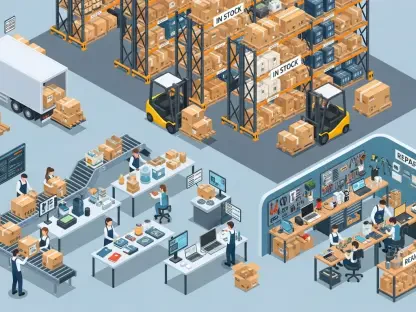
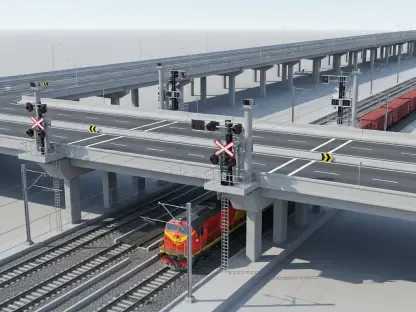
The current disconnect between rapid launch advancements and ground-level logistics is one of the most significant bottlenecks in the burgeoning space economy. Our platform addresses this by acting as a universal logistics operating system that unifies every facility, vehicle, and mission into a single, cohesive thread. We use a digital twin architecture to bridge the gap, ensuring that as goods move from a factory floor to a rail yard and eventually to a spaceport, the data and physical handling remain perfectly synchronized. This end-to-end integration is vital because it treats a space mission not as an isolated event, but as a continuous flow of containerized cargo. By automating the physical movement across these disparate modes, we eliminate the friction that usually occurs at transfer points, allowing the space economy to scale beyond its current limits.
Manual forklift operations and traditional storage methods are often too slow for high-consequence logistics. How does a self-loading, autonomous pallet system improve safety during trailer loading, and can you walk us through how it manages inventory counts without human intervention?
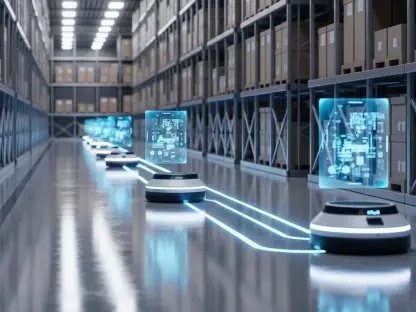
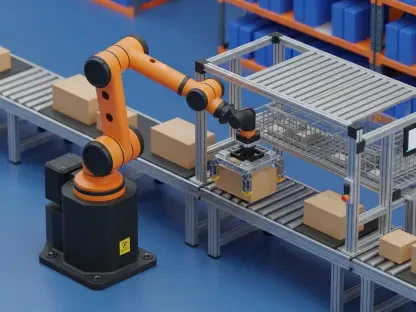
Traditional warehouses are inherently high-risk environments where the constant hum of manual forklifts creates a persistent danger for ground crews. Our self-driving, self-loading pallet system removes the human element from these hazardous zones, replacing manual handling with precision-engineered robotics. When it comes to trailer loading, these autonomous units navigate the tight confines of a cargo bay with a level of accuracy that a human operator simply cannot match, ensuring every inch of space is optimized safely. Beyond the physical heavy lifting, the system handles the mental load by performing automated cycle counts in real-time as it moves goods between connected facilities. This means inventory is tracked at every pulse-point of the journey, providing a level of productivity and safety that is absolutely essential for the rigorous demands of spaceport supply lines.
Real-time digital twins allow operators to stress-test logistics flows before any payload moves. How does the LINK platform use this data to orchestrate autonomous fleets, and what specific scenarios do you simulate to ensure the system can handle unexpected disruptions in a mission?
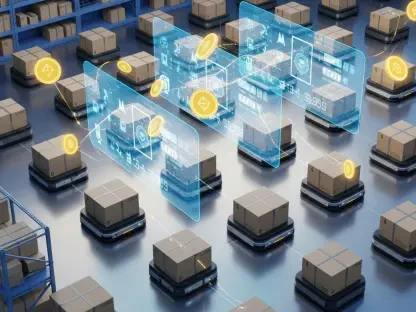
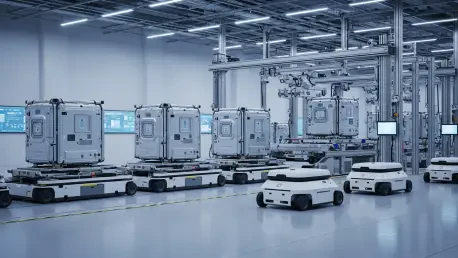
The LINK platform serves as the central nervous system for our operations, utilizing an AI-driven digital twin to model every pallet and mission in a virtual environment. We use this data to orchestrate fleets of autonomous mobile robots, directing their movements based on real-time demands and facility constraints. Before a physical payload ever leaves the warehouse, we run intense stress-tests to simulate scenarios like mechanical failures, sudden rerouting requirements, or unexpected bottlenecks at the spaceport. By modeling these disruptions digitally, we can optimize the logistics flow and eliminate guesswork, ensuring that the autonomous fleet can adapt instantly to real-world chaos. This predictive capability allows us to maintain a steady flow of goods even when a mission faces the high-pressure variables common in aerospace operations.
Pushing supply chain automation beyond TRL 6 requires a system that can function in both terrestrial warehouses and orbital depots. What technical challenges arise when scaling these robotics for off-world infrastructure, and how does the concept of “self-healing” logistics apply to long-term lunar staging?
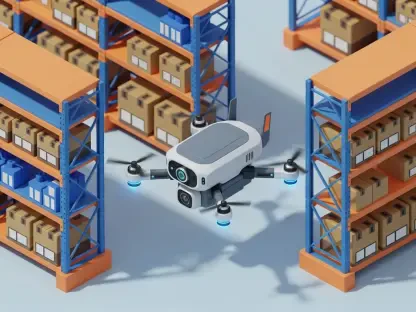
Advancing to a Technological Readiness Level beyond TRL 6 means creating a system that is robust enough to survive the transition from the stable environment of a warehouse to the harsh reality of an orbital depot. One of the primary technical challenges is ensuring that the robotics can handle the lack of gravity and the extreme temperature shifts of lunar staging areas while maintaining the same precision they show on Earth. This is where “self-healing” logistics become critical; the system must be able to autonomously diagnose disruptions, reroute missions, and manage inventory without a team of technicians on standby. In long-term lunar staging, where human intervention is limited and costly, a self-healing layer ensures that the supply chain remains functional and resilient. It transforms the logistics infrastructure from a static set of tools into an intelligent, adaptive ecosystem capable of supporting permanent off-world habitation.
What is your forecast for the space logistics industry?
I believe we are on the verge of a fundamental shift where the infrastructure supporting the journey will become just as critical as the rockets that get us there. My forecast for the space logistics industry is a rapid move toward fully autonomous, interconnected supply chains that blur the lines between terrestrial and orbital operations. We will see the emergence of standardized containerized cargo systems that allow for seamless movement from a factory in the Midwest to a lunar base, managed entirely by intelligent operating systems like LINK. As governments and private ventures continue to build out lunar infrastructure, the ability to manage goods with zero manual intervention will be the true catalyst for a sustainable space economy. Ultimately, the success of our future in space won’t just be measured by the distance we travel, but by the efficiency with which we can sustain our presence there through autonomous logistics.