
The relentless demand for instantaneous fulfillment has pushed traditional warehousing models to their absolute breaking point, forcing a radical shift toward autonomous solutions that can mimic human dexterity while maintaining the tireless precision of industrial machinery. As supply chains navigate the complexities of the current landscape, the emergence of humanoid forms signifies a departure from the rigid, bolted-down automation of the past. These machines are designed to operate within environments originally built for people, bridging the gap between manual flexibility and mechanical speed. By integrating advanced sensors and artificial intelligence, these robots are transitioning from experimental prototypes to active participants in the global logistics network.
The context of this evolution is rooted in the limitations of fixed infrastructure. Traditional sorters and conveyor systems offer high throughput but lack the ability to adapt to the rapid stock-keeping unit proliferation seen from 2026 to 2028. Humanoid robotics offers a compelling alternative by providing a mobile, versatile labor force that does not require a total warehouse redesign. This shift represents a broader technological trend where the machine is no longer a static tool but an intelligent agent capable of navigating dynamic spaces and interacting with a diverse range of objects.
The Rise of Robotics in the Modern Warehouse
Modern warehouse environments are increasingly defined by volatility and the need for rapid scalability. In the current year, the core principles of humanoid logistics center on the ability of a machine to function as a drop-in replacement for human pickers in brownfield facilities. Unlike traditional automation, which relies on heavy tracks and permanent installations, these robotic units utilize simultaneous localization and mapping to understand their surroundings. This allows them to transition between different zones of a facility without the need for specialized markers or magnetic tape, making them far more versatile than previous generations of automated guided vehicles.
The relevance of this technology in the broader industrial landscape is profound because it addresses the inherent rigidity of legacy systems. Manual labor remains highly flexible but is prone to fatigue and inconsistency, whereas traditional automation is consistent but brittle. Humanoid robotics attempts to capture the best of both worlds by providing a platform that can handle the physical variety of tasks—such as reaching high shelves or navigating narrow aisles—while maintaining the data-driven efficiency of a digital system. This evolution is particularly critical as e-commerce continues to demand smaller, more frequent order cycles that defy the logic of bulk-processing machinery.
Core Pillars of Humanoid and Specialized Robotics
Human-Centric Design and Bipedal Locomotion
The pursuit of bipedal locomotion is not merely a feat of engineering vanity; it is a functional requirement for operating in spaces optimized for the human gait. Legged movement allows these robots to step over obstacles, traverse uneven flooring, and potentially move between different levels of a facility using stairs or ramps. The complex interplay of torque-controlled actuators and high-frequency balance algorithms enables these machines to maintain stability even while carrying shifting loads. This performance in human-centric spaces is the primary differentiator between humanoid forms and wheeled robots, which are often restricted to perfectly flat, unobstructed paths.
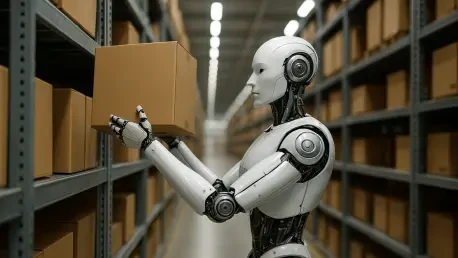
Beyond movement, the humanoid form factor allows for a unique level of task versatility. By possessing a torso and multi-jointed arms, these robots can replicate the reach and gripping patterns required for picking items from standard racking. This means that a single machine can theoretically perform various roles, from unloading containers to palletizing finished goods. The significance of this design lies in its ability to utilize existing infrastructure, such as standard workbenches and shelving units, thereby reducing the capital expenditure required for specialized robotic workstations.
Distributed Intelligence and Fleet Management
The operational success of these robots is heavily dependent on the “Robot Traffic Controller” and integrated warehouse control systems. This software acts as a decentralized brain, managing the movements of an entire fleet to ensure that no single robot becomes a bottleneck. By utilizing distributed intelligence, each unit can make real-time decisions about its local pathing while the central system optimizes global routing. This approach is essential for managing the surges in order volume that occur during peak seasons, as the software can dynamically reassign robots to high-demand areas without human intervention.
Real-world logistics surges require a level of coordination that exceeds the capabilities of traditional centralized control. These modern management systems treat each robot as a node in a mesh network, allowing for a more resilient architecture. If one robot experiences a mechanical failure or encounters an unexpected obstacle, the fleet management software automatically reroutes other units to compensate. This decentralized logic ensures that the warehouse continues to operate at peak efficiency, mitigating the risks associated with single points of failure that often plague fixed conveyor systems.
Emerging Trends and Operational Elasticity
A significant shift is currently occurring toward “operational elasticity,” a concept that prioritizes the ability of a warehouse to expand or contract its capacity on demand. This trend moves away from the massive, rigid investments of the past, which often left companies with underutilized assets during slower months. Humanoid and mobile robotics facilitate this elasticity by allowing operators to deploy only the number of units required for current throughput. From 2026 to 2030, this model is expected to become the industry standard, providing a hedge against the unpredictability of global markets and consumer behavior.
Industry reaction to the explosion of unique product variants has further accelerated the demand for scalable, energy-efficient automation. Rigid systems struggle with the physical diversity of modern inventory, whereas humanoid robots can be programmed to handle a wide array of packaging types. Furthermore, the focus on energy efficiency has led to the development of robots that can operate in “dark” warehouses, reducing the need for lighting and climate control. This shift not only lowers operational costs but also aligns with broader sustainability goals by minimizing the carbon footprint of the fulfillment process.
Real-World Implementations and Specialized Alternatives
The practical application of these technologies is most visible in the e-commerce and retail sectors, where the variety of items makes traditional automation difficult. In these high-volume environments, companies are deploying fleets to handle the “each-picking” process, which was previously the exclusive domain of human workers. However, the market is also seeing a rise in specialized alternatives that prioritize task-based efficiency over the purely humanoid form. These systems often utilize a modular design, combining the mobility of a robot with specialized picking attachments that can outperform a human-like hand in specific scenarios.
One notable implementation involves decentralized mobile fleets, such as the SOTR-S systems, which focus on transporting goods between human-operated stations. These systems prioritize a lower center of gravity and higher speeds than typical bipedal models, offering a different trade-off between flexibility and stability. While they lack the ability to climb stairs, their efficiency in horizontal transport makes them a powerful tool for large-scale distribution centers. These implementations demonstrate that the future of logistics is not a winner-take-all race for the humanoid form, but rather a diverse ecosystem of specialized machines working in concert.
Technical Barriers and Market Realities
Despite the rapid progress, a significant gap remains between the novelty of humanoid prototypes and their industrial readiness. History provides a cautionary tale through the example of manufacturing over-automation in the 1980s, where massive investments in robotics led to decreased productivity due to mechanical complexity. Today, the challenge is ensuring that these sophisticated machines can withstand the rigors of a twenty-four-hour warehouse operation without constant maintenance. Issues such as mechanical wear in high-stress joints and the reliability of vision sensors in dusty environments continue to be hurdles for widespread adoption.
Ongoing development efforts are focused on improving the cost-effectiveness and durability of these systems. The current strategy involves simplifying the mechanical designs to reduce the number of potential failure points while enhancing the software’s ability to handle edge cases. High-speed environments demand a level of precision and safety that is difficult to maintain when a robot is moving several hundred pounds of weight. Consequently, many manufacturers are prioritizing reliability over sheer speed, acknowledging that a slower, consistent robot is more valuable than a fast one that requires frequent downtime for recalibration.
The Trajectory of Autonomous Fulfillment
The path forward for autonomous fulfillment involves the gradual integration of more advanced models, such as the second and third generations of humanoid platforms. These newer versions are expected to feature improved battery life and more sophisticated tactile feedback, allowing them to handle delicate or irregularly shaped items with greater ease. As these technologies mature, the integration of generative AI will likely enable robots to learn new tasks through observation rather than explicit programming. This would drastically reduce the deployment time for new robotic fleets, making them accessible to smaller warehouse operators.
The long-term impact on global supply chains will likely be a hybrid approach that combines the sheer speed of task-specific machinery with the incredible flexibility of humanoid units. This synergy will create a more resilient logistics network capable of absorbing shocks and adapting to rapid changes in consumer demand. Society will likely see a shift in the nature of warehouse work, with human roles moving toward fleet supervision and complex problem-solving. This transition marks a fundamental change in the relationship between humans and machines, where the humanoid form serves as the ultimate interface for a fully autonomous logistics ecosystem.
Concluding Assessment of the Robotics Landscape
The evaluation of the current robotics landscape indicated that the industry moved away from the pursuit of a singular robotic solution toward a more nuanced, multi-faceted strategy. Analysts observed that the most successful implementations were those that balanced the aesthetic appeal of humanoid forms with the cold efficiency of task-specific automation. It became clear that the primary value of these machines was not their ability to look like humans, but their capacity to operate within the existing constraints of the built environment. This realization shaped the investment strategies of major retailers, who began prioritizing modularity and software-driven resilience over traditional, fixed infrastructure.
The transition to decentralized fleets provided the necessary elasticity to handle the volatile market conditions of the mid-2020s. By focusing on evolution rather than a total technological revolution, the logistics sector avoided the pitfalls of over-automation that had hampered previous industrial eras. The current state of the technology suggested that while the humanoid form remained a powerful tool for certain tasks, its true strength was found in its integration into a broader, intelligent ecosystem. Ultimately, the development of these systems laid the foundation for a more robust and scalable global supply chain that empowered human workers and maximized operational efficiency.