
Rohit Laila is a titan in the world of logistics, possessing a career that spans decades and continents, witnessing the slow and steady transformation of the supply chain from clipboards and forklifts to the sophisticated robotics of 2026. As an expert who has consulted for some of the largest global delivery networks, he brings a unique perspective on the intersection of human ingenuity and machine efficiency. Laila has navigated the growing pains of early automation and now stands at the forefront of the autonomous revolution, advocating for systems that are as flexible as they are powerful. Today, he shares his insights on how new software and hardware integrations are finally making the dream of “lights-out” fulfillment a practical reality for businesses that once thought such technology was far out of reach.
Our conversation traverses the complex landscape of modern fulfillment, examining how the latest fall product announcements are tackling the persistent headaches of SKU variability and manual exceptions. We explore the introduction of mixed-bin handling at single workstations, the expansion of automated case-picking into standard industry sizes, and the democratization of robotics for small-to-medium enterprises through flexible service models. Laila also illuminates the role of Generative AI in derisking multi-million dollar investments and explains how predictive fleet management is drastically cutting down the costly nightmare of unplanned system downtime across warehouse networks.
Traditional systems often struggle with SKU variability and rigid bin requirements. How does integrating mixed bin sizes into a single workstation change the game for warehouse space and labor?
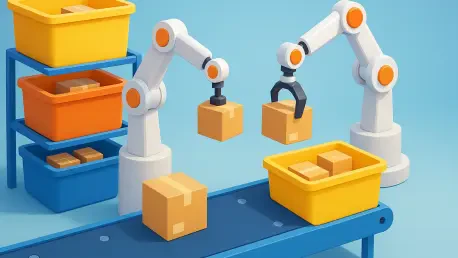
The introduction of the FlexBinsPort is a monumental shift for facilities that have historically felt like they were trying to fit square pegs into round holes. In the past, the rigid requirements of bin sizes meant that a warehouse was often shipping a lot of empty air, which is a silent killer of profitability and efficiency. By allowing all standard bin heights to be handled at one single workstation, we are finally seeing a reduction in the “operational effort” that helps bridge the gap toward total autonomy. We are looking at a tangible 10% to 15% improvement in storage utilization, which translates to a massive amount of reclaimed real estate on the warehouse floor that can be used for more inventory rather than more aisles. This means a worker doesn’t have to experience the physical fatigue of walking between different specialized zones; the system brings every diverse product size to one spot, streamlining the labor flow and making the entire operation feel significantly more fluid and less chaotic.
As businesses look to streamline their fulfillment, the distinction between case-picking and each-picking often creates silos. In what ways does a unified system for both workflows enhance operational flow?
The silos between case-picking and each-picking have long been a source of friction and bottlenecking, but the rollout of AutoCase is effectively tearing those walls down to create a unified workflow. By supporting the industry-standard 600 x 400 mm cases starting in Q1 2027, companies can now run these two previously separate worlds within the same architectural footprint, reducing the need for expensive, redundant infrastructure. I’ve seen this in action at pioneers like Nowaste Logistics in Sweden and Komplett in Norway, where the ability for multiple stations to work on the same task group in parallel creates a rhythmic, almost musical, continuous flow. It’s not just about raw speed; it’s about the out-of-the-box integration that will be available in the upcoming software release, which simplifies the transition to downstream operations like palletizing and packaging. This eliminates the frantic manual handoffs that usually lead to errors and delays, making the entire journey from the storage cube to the shipping dock feel entirely seamless and much more reliable.
Robotics has often been seen as a luxury for large-scale operations. How is the democratization of this technology through RaaS models impacting the competitive landscape for smaller businesses?
For a long time, high-end robotics was a luxury reserved only for the giants of the industry, but Pio Pal and the Robotics-as-a-Service (RaaS) model are completely flipping that script for the mid-market. We’re now seeing smaller, agile apparel brands like Famme achieving packing throughputs of up to 540 order lines per hour at a single workstation, which is a level of productivity that was previously unimaginable for a business of that scale. This is particularly transformative when you consider that single-line orders typically represent between 40% and 60% of all consumer e-commerce traffic today. By leveraging these new pre-picking capabilities, these businesses can increase their performance by up to three times without the stress of trying to find and train additional manual labor in a tight market. It’s an empowering shift that allows small businesses to focus on their brand and product, knowing their fulfillment can scale instantly as their orders grow without a massive upfront capital investment.
Planning a massive automation investment can feel like a leap of faith. How are AI-driven design tools like CubeExplore and CubeStudio changing the way stakeholders evaluate risk and ROI?
The fear of the unknown has historically stalled many automation projects, as stakeholders often felt like they were taking a “leap of faith” with their budgets, but the infusion of Generative AI into the planning phase is providing a much-needed safety net. With the new CubeExplore tool, we can now use real-world operational benchmarks and data from comparable projects to build ROI scenarios that are grounded in reality rather than optimistic guesses. CubeStudio then takes this intelligence further by acting as an AI-powered design assistant, letting partners compare different system configurations and scenarios side-by-side before a single robot is even ordered. This level of visibility into system sizing and performance before deployment turns a high-stakes gamble into a calculated, data-driven decision. It provides a sense of calm and confidence in the boardroom because the expected outcomes are backed by the massive data sets within the CubeVerse and Intelligence platforms, ensuring that the system is right-sized from day one.
Unplanned downtime is the enemy of any automated facility. How does moving from fixed maintenance schedules to data-driven fleet management impact the daily life of an operations team?
The shift toward predictive maintenance through CubeFleet is like giving an operations team a high-definition crystal ball for their warehouse health, moving them away from the “break-fix” mentality. Instead of waiting for a motor to fail or performing maintenance on a rigid, inefficient calendar schedule, teams now receive precise alerts and work orders based on live data from CubeAnalytics. This proactive approach is estimated to slash unplanned downtime by a staggering 35% to 45%, which can be the difference between a successful holiday peak and a catastrophic system failure during your busiest hour. When a manager can see a multi-site view and get an AI-powered summary of which fleet needs attention across their entire network, it changes the sensory experience of the job from being reactive and stressed to being in total control. It’s about keeping the system humming at peak performance with minimal human intervention, which is exactly what we need to reach that next level of autonomy and truly “lights-out” operations.
What is your forecast for the evolution of warehouse autonomy?
I believe we are entering a phase where the human role shifts from manual labor to high-level orchestration, as the “practical barriers” to autonomy are dismantled one by one through these incremental software and hardware updates. Over the coming year, the integration of tools like VersaAI into both new and existing configurations will make automated cycle counting and inventory validation the standard operational procedure. We are moving away from the idea of a single “giant leap” and toward a series of sophisticated, practical advances—such as automated item induction and barcode scanning at the workstation—that will eventually lead to true lights-out fulfillment. My prediction is that by the end of 2027, the distinction between “automated” and “autonomous” will have blurred so much that the systems will essentially manage their own optimization and health with only the most minimal oversight from human teams, allowing warehouses to operate at a level of precision we’ve never seen before.